KAD44 issue

When the clutch is past it’s best it demands more current to work this leads to voltage drop , the gauges suffer , the revs drop on the gauge , check the 7.5 amp fuse side of black electric box .
Then I’ll meet to you Santa Eulalia on the 14/07/ ��
 
When the clutch is past it’s best it demands more current to work this leads to voltage drop , the gauges suffer , the revs drop on the gauge , check the 7.5 amp fuse side of black electric box .
Then I’ll meet to you Santa Eulalia on the 14/07/ ��

Thanks Paul.

I know it's a long thread already but the revs are actually rising like someone blipping the throttle (along with the screeching noise). We're not seeing any drop in indicated revs.

Sadly we're not onboard for a while so won't be able to catch up with you in Ibiza this time :(.
 
Another reason possibly for the symptoms if the screeching comes on when cruising , up on the plane is a turbo is on its way out , dropping boost so the SC starts or try’s to engage .Its a bit masked by the other ( good ) engine initially.
But eventually as time passes it be becomes apparent.
So the knackered SC clutch is caused by a increasing lazy turbo .

We had exactly this scenario, complete with a short screech when the SC engages at 2600, but it's not what petem describes.
 
Just for clarity as the role of the compressor and the engage/disengage rpm keeps coming up.
From the Fuel injection manual for the KA(M)D 44 and 300 engines; Volvo Manual Fuel System EDC page 17.
Electromagnetic clutch (23)
The compressor is engaged and disengaged by an electromagnetic clutch.
The control modul decides when the compressor should be engaged, depending on operation situation and a number of parameters, as follows:
• After starting: The compressor is engaged to make the engine warm up faster and reduce white smoke when the engine is cold.
Parameters:
– coolant temperature below 60°C (140°F)
– reverse gear in neutral
Note: The lower the coolant temperature is, the longer is the time that the compressor is en- gaged.
• In normal operation: The compressor is en- gaged to give extra power for critical situations, headwinds or increased speed.
Parameters:
– injected fuel volume (load)
– engine speed ~1000–2800 rpm.
• On rapid acceleration: The compressor is en- gaged immediately on rapid acceleration (“kick- down”).
Parameters:
– difference between demanded and current
engine speed exceeds 1000 rpm.
– engine speed 700–2800 rpm.
 
Just for clarity as the role of the compressor and the engage/disengage rpm keeps coming up.
From the Fuel injection manual for the KA(M)D 44 and 300 engines; Volvo Manual Fuel System EDC page 17.
Electromagnetic clutch (23)
The compressor is engaged and disengaged by an electromagnetic clutch.
The control modul decides when the compressor should be engaged, depending on operation situation and a number of parameters, as follows:
• After starting: The compressor is engaged to make the engine warm up faster and reduce white smoke when the engine is cold.
Parameters:
– coolant temperature below 60°C (140°F)
– reverse gear in neutral
Note: The lower the coolant temperature is, the longer is the time that the compressor is en- gaged.
• In normal operation: The compressor is en- gaged to give extra power for critical situations, headwinds or increased speed.
Parameters:
– injected fuel volume (load)
– engine speed ~1000–2800 rpm.
• On rapid acceleration: The compressor is en- gaged immediately on rapid acceleration (“kick- down”).
Parameters:
– difference between demanded and current
engine speed exceeds 1000 rpm.
– engine speed 700–2800 rpm.
Last time I saw that complexity was when I looked into the rubics cube :):)

Hence we , the royal we ( forum ) are all over the place with this .
 
That is essentially good news, nothing obviously wrong and no smoke dust etc. A good thrash around the bay should reveal any weakness in the belt system. Could just be your partner sat at 1000rpm and cooked the clutch/belt as it engages/disengages.
Have the fuel filters been changed?
 
That is essentially good news, nothing obviously wrong and no smoke dust etc. A good thrash around the bay should reveal any weakness in the belt system. Could just be your partner sat at 1000rpm and cooked the clutch/belt as it engages/disengages.
Have the fuel filters been changed?

Spoke to my partner again today, he said he had the issue on initial start up and then when he tried it again after refuelling. The idea of it being filters would make some sense as the trip over to Ibiza may have stirred up some sediment in the tank. I'll see if Andy wants to check the filters before he takes it for a test run at the weekend.
 
What Fezza is that Porto?

One like this - get the boat theme :)
FDB05012-5C31-4F2A-B81C-4009D9EA0F66.jpeg
That ones currently on the Paris - Peking

We are not quite up there yet with classic rallying but building up .
We spent a L W/E in the U.K. Cotswolds getting piss wet on a rally and I have entered another in CH 300 Km,s / day over various alpine passes end of August .
The late Nikki Lauda help develop the chassis, and you know what it shows .
4 twin barrel Webber carbs , a barrel for each cylinder .The only Bertone collaboration, and the very 1 st mid engined V8 .
 
Not sure I follow the deal.

If it is the belt I get a beer fridge stocked ( you should see the size of it !) if not we are quits. Sounds win win !

Honestly Pete squeal is a belt. It eases post starting as batteries get slug of energy ( sub particles maybe!) from the alternator reducing demand and stopping belt slip

What have submarine particles got to do with it?
 
Well, after a number of cold starts, my guy has been unable to replicate the issue. Absolutely no evidence of slipping belts. He's still to check the fuel filters but other than that we're scratching our heads. Either wait until the issue crops again (which could be inconvenient) or start chucking parts at it (s/c clutch and alternator being the obvious candidates).

Separately, boat will be lifted next week for an anode change and also to have the stiff clutch cables changed (which I hope will rectify the long running and slightly unnerving issue of the boat occasionally sticking in reverse).

Boats, eh....

Pete
 
Fuel filters checked in the week, all clear on that front.

Will be out there in August with a mate who is handy with the spanners so we'll be lifting the hatch to get to the bottom of the issue if it occurs again.
 
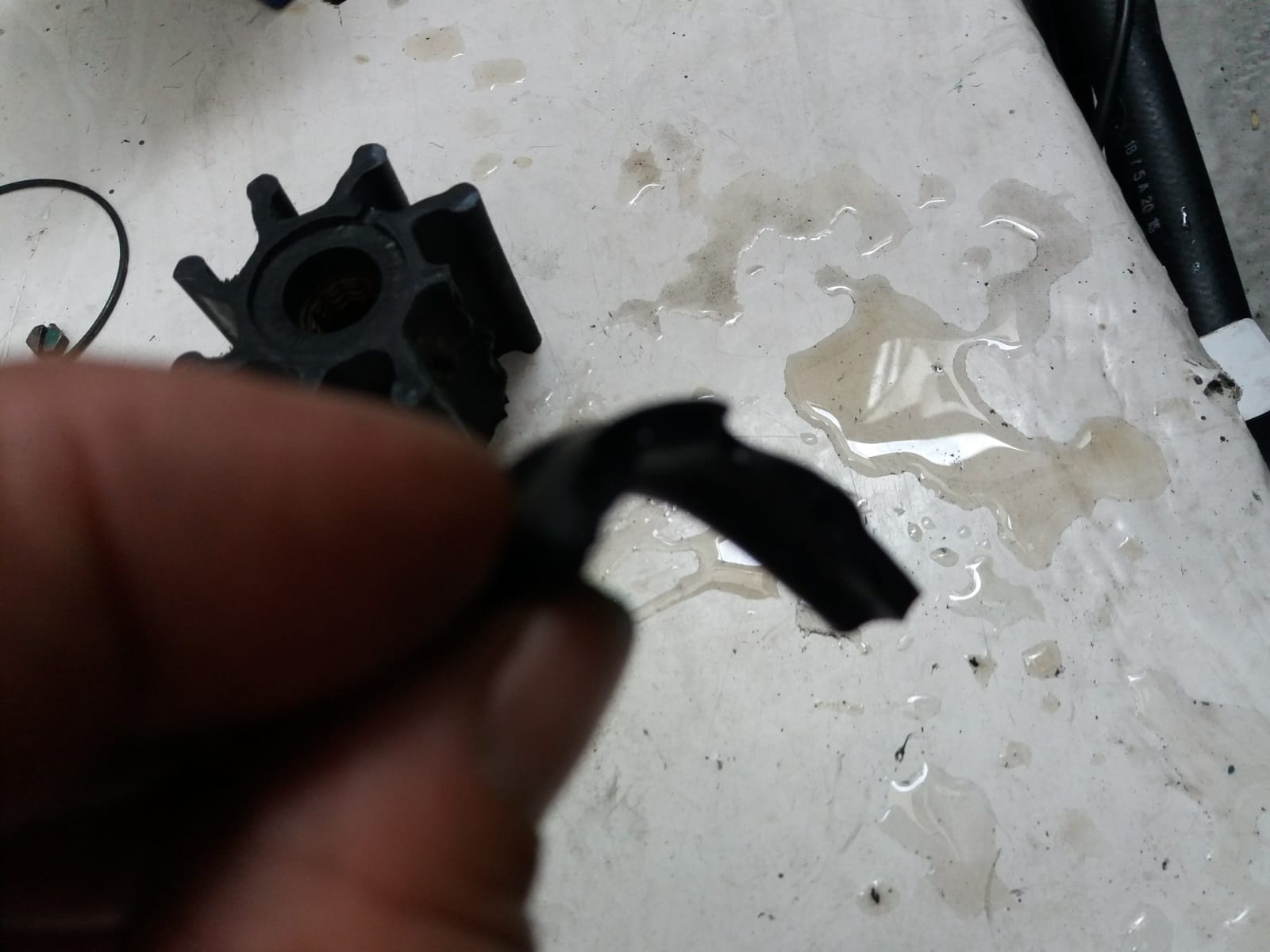
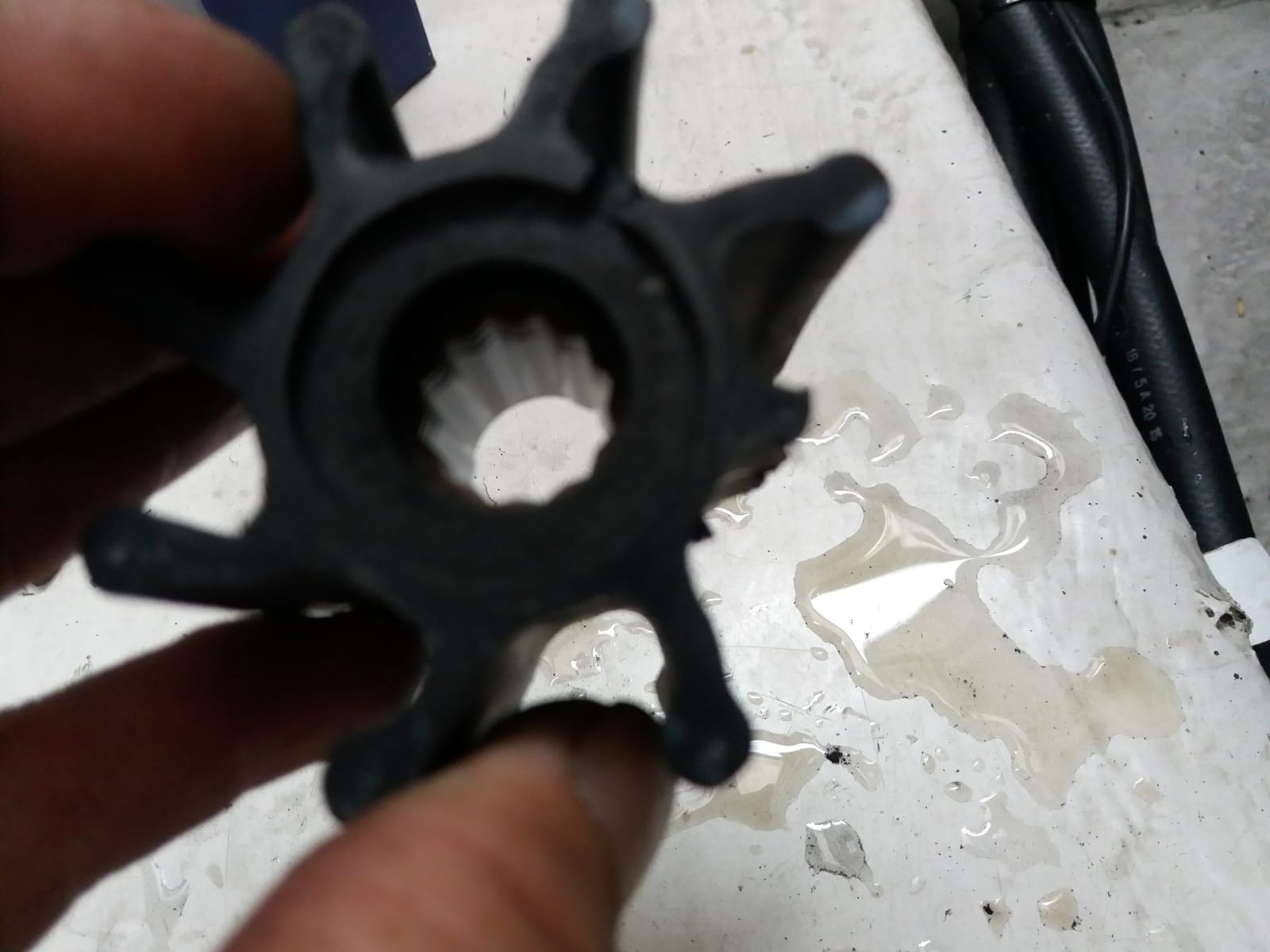
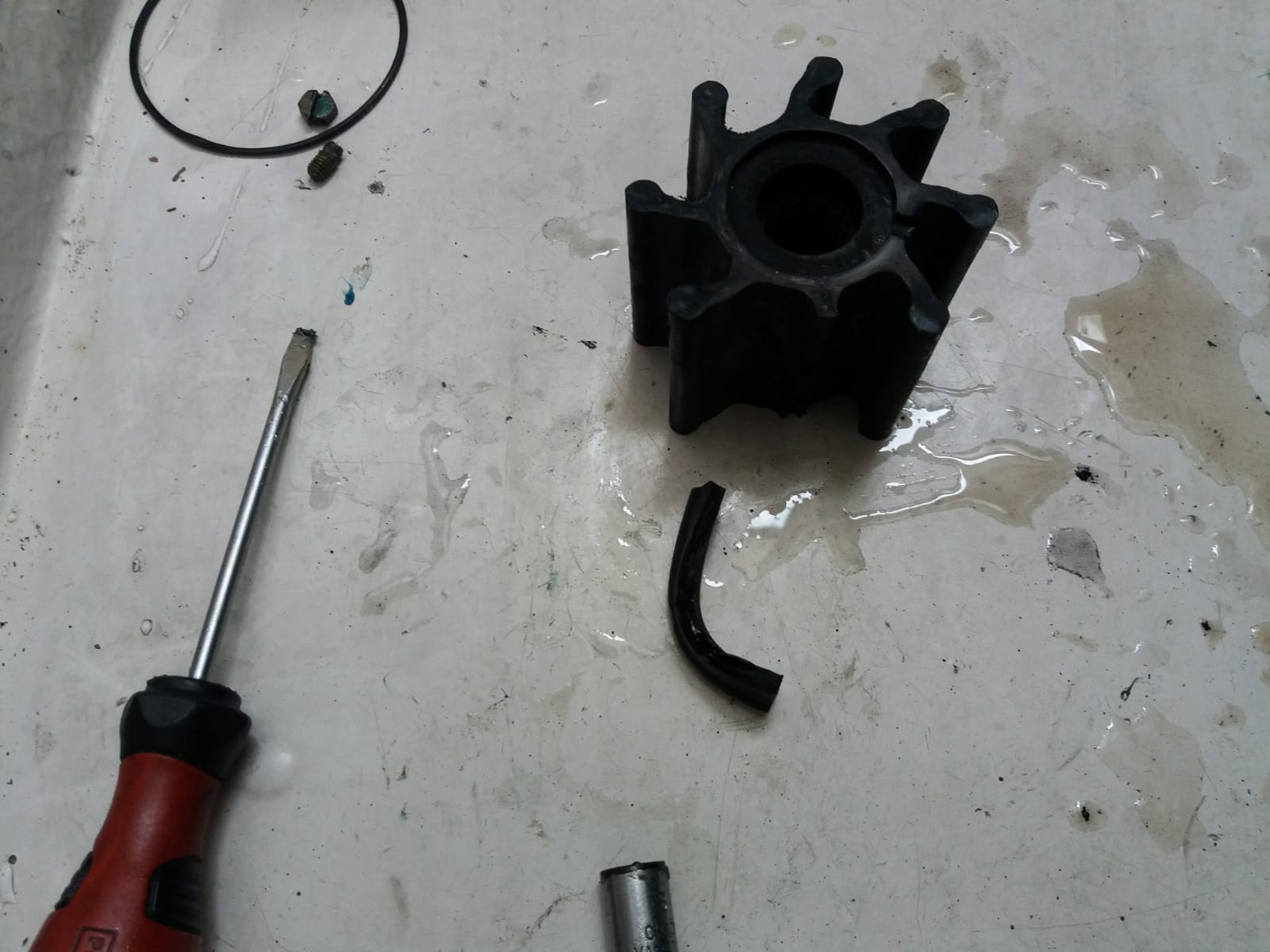
Incidentally, after they took the boat back to its berth they touched the impeller pump housings to ensure that they were cool (as they always do after a re-launch). The starboard side one was hot. On closer inspection the impeller had started to break up and one of the blades had jammed itself into the raw water inlet. They think it's been damaged for some time.

IMG-20190721-WA0000.jpg


IMG-20190721-WA0001.jpg


IMG-20190721-WA0002.jpg
 
Last edited:
They think it's been damaged for some time.
Blimey, that's bad news indeed.
If the broken blade restricted the water flow to the point of making the pump housing hot, I'd expect also the cooling circuit temp to be affected.
Was it always aligned with the other engine?
Besides, are there any rubber hoses in the exhaust, between the engine and the outdrive?
Far from being an expert of your setup, but I suppose they would be the first parts to suffer (to the point of potentially melt!), following usage with a much lower than normal raw water flow.
 
Blimey, that's bad news indeed.
If the broken blade restricted the water flow to the point of making the pump housing hot, I'd expect also the cooling circuit temp to be affected.
Was it always aligned with the other engine?
Besides, are there any rubber hoses in the exhaust, between the engine and the outdrive?
Far from being an expert of your setup, but I suppose they would be the first parts to suffer (to the point of potentially melt!), following usage with a much lower than normal raw water flow.

To clarify (I checked back at my old messages), they said that the affected pump was warm, not hot. they also said that it's not unusual for the pumps to circulate enough water to cool the engines at speed, it's just at tick-over that they struggle to pump the water round the system. I've certainly not seem any evidence of any cooling issues.
 
Top