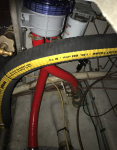
KAD 42's silicone Hoses

jamescf

New Member
Joined
24 Oct 2020
Messages
15
Visit site
Hi everyone
I am contemplating changing the cooling water and other hoses on my KAD 42's for silicon. The existing hoses are of an age that I feel I should replace them. Some of the hoses look OK however it's a peace of mind thing.
Any thoughts or experience would be appreciated.
 
Why silicon? I think it's a rubbish idea personally. On the 42 there are plenty rub points particualrly thermostat housing to heat exchanger for cooland and from pump to oil cooler for raw. Silicon holds out well against heat but is soft. I prefer abrasion resistant rubber myself and a boat that floats. Just my opinion.
 
I changed the hoses on my engines last year, all were original, no failures in that time and 18 years old, I fitted new Volvo Penta hoses.

I assume your 42's are at least as old.

The originals are shaped not straight runs why change products that give good service?
 
Hi everyone
I am contemplating changing the cooling water and other hoses on my KAD 42's for silicon. The existing hoses are of an age that I feel I should replace them. Some of the hoses look OK however it's a peace of mind thing.
Any thoughts or experience would be appreciated.
I've seen no evidence that silicone hoses would be more durable (granted, they will withstand higher temperature, a feature you don't need). Have you found someone selling pre-formed silicone hoses for the 42?

www.solocoastalsailing.co.uk
 
I changed the hoses on my engines last year, all were original, no failures in that time and 18 years old, I fitted new Volvo Penta hoses.

I assume your 42's are at least as old.

The originals are shaped not straight runs why change products that give good service?

at what age would others change the hoses, if no faults are found ?
 
at what age would others change the hoses, if no faults are found ?
50 years ago car coolant hoses used to go hard over time. Later materials do not seem to suffer in the same way. I rely on regular inspection for chafe and surface cracking. I did replace one hose last year which was 20 years old but on closer inspection it was actually in good condition with no sign of defect internally. So, unless I were to have a serious overheating problem that may have exceeded the hose temperature resistances (120 C?), I have no plan to change my hoses just because they have exceeded so many years.

www.solocoastalsailing.co.uk
 
At about 17 years I had an air hose a short ones on the charge air cooler system one failed at 17 years .

I am in the trade saw a seawater hose on a 74 fail between the cooler and the gearbox cooler, nearly sunk the boat.

I would say 20 years is a sensible time to future proof your engines .

But from about 12 to 15 years inwards inspect the hoses carefully for cracking and going hard, if in doubt replace.

Other things to consider: Disassembling and cleaning and inspecting the coolers, the turbochargers, the water injection bend, outdrives the exhaust horn, the sumps on outdrive boats etc
.
 
Changed all the black hoses when I bought my 14 y old then , boat .No previous history so I thought it prudent .
With MAN s they are seawater only as the closed circuit are metal .
We also did the seacocks.
Basically seeing as they appeared perfectly ok I wanted a baseline for my own piece of mind and some form of anti Insurance refute ammunition.
All work has been documented with invoices ready from the yard .

Also the racors re placed , more for piece of mind and reliability.New fuel pipes .New gearbox hydraulic pipes again to ensure a turn key every time .Thus far 5 seasons complete no breakdowns or rearranged schedules .

looks like this aligns with Bandits thinking ^^^ .
 
Great info and advice from Plum Thanks, and thanks to all that have contributed their experience and advice.
I found this info regarding Silicon hoses for Marine engines, Interesting.
Marine Grade Silicone Hoses for Wet Exhaust, engine and auxiliary generator systems, used in many of today's modern, in-board engines, generators and pleasure boats.
Manufactured from only the highest quality silicones and reinforcement fabrics, they are designed to operate at temperatures up to + 180°C.
Our High Temperature Wet Exhaust and Turbo hoses, will operate at temperatures up to 210°C with an optional Aramid reinforcement.
As a universal shape / size hose, we can supply straight hoses, single hump hoses, double hump hoses, and many elbow configurations. Also with an wire reinforced option our marine wet exhaust hoses range in diameters and lengths.

These are suitable for temperatures up to 180°C and will operate at significantly higher positive pressures or, under negative pressure caused by suction.
All Marine Hoses meet the requirements of SAE J2006 R3. For identification purposes marine grade silicone hoses have a RED inner liner.
On reflection I will replace a couple of the small bore hoses on my KAD 42's like coolant drain hoses as they have spent time laying
in the bilges. Not anymore they have been cleaned and secured in the correct position on the engines.
 
At about 17 years I had an air hose a short ones on the charge air cooler system one failed at 17 years .

I am in the trade saw a seawater hose on a 74 fail between the cooler and the gearbox cooler, nearly sunk the boat.

I would say 20 years is a sensible time to future proof your engines .

But from about 12 to 15 years inwards inspect the hoses carefully for cracking and going hard, if in doubt replace.

Other things to consider: Disassembling and cleaning and inspecting the coolers, the turbochargers, the water injection bend, outdrives the exhaust horn, the sumps on outdrive boats etc
.
Thanks Bandit
I don't have any problems with the cooling on my 42's. I plan to do the oil cooler, charge air cooler and the main heat exchanger at the end of 21 season. A preventive maintenance project.
This winter it's 2 new alternators 100amp (already purchased) any hoses that look like they need replacing, raw water reverse flush with Eco chemical flush. Oil change & filters, engine and also the oil in the superchargers. I have just replaced the closed loop cooling green coolant after flush out, next it's drive belts if they need it, and fuel filters and fuel water separator filter.
I would like to install isolation switches at the helm to isolate the super chargers, stopping them kicking in @1700rpm if I wish and when required. Outdrives to service and general anti fouling. I think that will keep me busy enough. I would like to get most of jobs on my list done prior to lift out. We will see how I get on. Best wishes and thanks for your advice.
 
Great info and advice from Plum Thanks, and thanks to all that have contributed their experience and advice.
I found this info regarding Silicon hoses for Marine engines, Interesting.
Marine Grade Silicone Hoses for Wet Exhaust, engine and auxiliary generator systems, used in many of today's modern, in-board engines, generators and pleasure boats.
Manufactured from only the highest quality silicones and reinforcement fabrics, they are designed to operate at temperatures up to + 180°C.
Our High Temperature Wet Exhaust and Turbo hoses, will operate at temperatures up to 210°C with an optional Aramid reinforcement.
As a universal shape / size hose, we can supply straight hoses, single hump hoses, double hump hoses, and many elbow configurations. Also with an wire reinforced option our marine wet exhaust hoses range in diameters and lengths.

These are suitable for temperatures up to 180°C and will operate at significantly higher positive pressures or, under negative pressure caused by suction.
All Marine Hoses meet the requirements of SAE J2006 R3. For identification purposes marine grade silicone hoses have a RED inner liner.
On reflection I will replace a couple of the small bore hoses on my KAD 42's like coolant drain hoses as they have spent time laying
in the bilges. Not anymore they have been cleaned and secured in the correct position on the engines.
What is source for this please?
 
I used some silicone hoses on the raw water side of my MD22 engines, only becasue all the other hoses I found were to stiff to bend nicely into position, I even cracked one of the raw water filter stubs trying!
I found it quite difficult finding wire reinforced silicone hose, and even then it does not like anything more than the sligtest bend.

Screen Shot 2020-11-07 at 06.01.57.png
 
Aircraft hoses are mandated to change at 10 years. Bear in mind anything aircraft is conservative.

My boat is 16 years old. I have had to change 2 hoses related to the generator but that was due to chafing not hose failure. I would say if they are obviously looking cracked change them. They do have a life and probably after 20 it’s well worth doing.

Some hoses are straight and cheap. Some are not !
 
Top