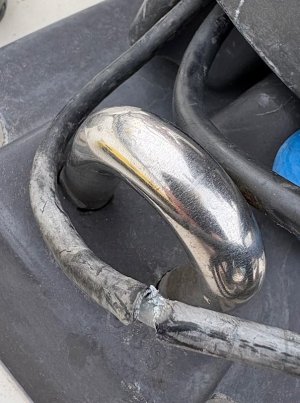
Joining VHF antenna cable above deck

MikeBz

Well-Known Member
Joined
22 Aug 2005
Messages
1,861
Location
East Anglia
Visit site
Things you wish you’d checked BEFORE stepping the mast #47 - cables at the mast foot, not just those up the mast:


View attachment 208242

Assuming I don’t find it’s corroded to b******y when I cut it back what would be the best way of joining it (for the amateur without specialist tools?

This? Coaxial Connector TN15-0058-C06WP - TNC Waterproof Crimp Plug, IP68, Hex Nut, Nickel Plated, RG58, LBC195 | Gigatronix

That is a) cheap manky cable and b) corroded for some distance internally. My recommendation is that you use it as a pull cord for some decent mil spec RG58 or even Mini 8 if you don't mind replacing connectors.

A joint can be done in many ways, not all of them waterproof or even resistant. Forget PL259 / SO239 solutions unless you have some quality compression types. Even then they are not wonderful RF wise. Self amalgamating tape is your waterproofing friend with such connectors.

I would use N types which can be waterproof, or BNC types which are but less so. Doing it "on the fly", I would be splicing it and there is a technique to do that.** Really though, swap it out in its entirety if at all possible.

** prepare the ends of the cable with the centre core about 1/4". Inner insulation of up to an inch with the braid pulled back. Keep the off cuts of inner core. Now push together the two inner conductors to mesh them and try to make them as linearly compact as you can, then solder them. Cut a slot down one part of the discarded inner insulation, cut it to size lengthwise and fit it over the exposed inner core. One wrap of insulation tape goes over that as well as the inner insulation either side. Then fold the braids towards the join, smooth them together and wrap with some copper wire. Solder them if feasible, otherwise a good tight wrap of self amalgamating tape will see you until you can replace the cable.

This technique will not work with cheap, foil screened cable or aluminium conductors.
 
** prepare the ends of the cable with the centre core about 1/4". Inner insulation of up to an inch with the braid pulled back. Keep the off cuts of inner core. Now push together the two inner conductors to mesh them and try to make them as linearly compact as you can, then solder them. Cut a slot down one part of the discarded inner insulation, cut it to size lengthwise and fit it over the exposed inner core. One wrap of insulation tape goes over that as well as the inner insulation either side. Then fold the braids towards the join, smooth them together and wrap with some copper wire. Solder them if feasible, otherwise a good tight wrap of self amalgamating tape will see you until you can replace the cable.
Thanks, that’s very useful. Could you just clarify “prepare the ends of the cable with the centre core about 1/4" - you mean 1/4” of bare inner core? And then 1” of inner insulation exposed. Maybe could use heat shrink tubing to insulate the centre core join before working the braids over it.

I agree the whole cable needs replacing, very frustrating not seeing this until the mast had been stepped, my bad.
 
Thanks, that’s very useful. Could you just clarify “prepare the ends of the cable with the centre core about 1/4" - you mean 1/4” of bare inner core? And then 1” of inner insulation exposed. Maybe could use heat shrink tubing to insulate the centre core join before working the braids over it.

I agree the whole cable needs replacing, very frustrating not seeing this until the mast had been stepped, my bad.

Yes, 1/4" of bare centre core. Certainly you could use heatshrink if you can think of a way to solder it with the heatshrink so close to the heat!

UP TO an inch of inner insulation exposed either side. Try to keep it to a minimum, hence the difficulty of using heatshrink.
 
That connector you link to is a TNC, screw version of a BNC. Perfectly good connector if you have male and females, plus the correct crimp tool. Compression type PL259 and N type can be had for a fiver upwards, each. Remember that you will need a male and a female, or two males and a female coupler.

I can recommend this supplier... Security measure | eBay
 
Coax can be reconnected without use of plugs / sockets .... the trick is to rebuild the construction.

Cut the coax at the bad point. Cut back a little till ends are flush and clean...
The coax has to have its OUTER insulaltion removed for reasonable amount, take care not to damage the foil / woven wire shield under - I would suggest about 2" each
Carefully peel the foil or woven wire shield back to the outer insulation exposing the inner plastic surround of the centre wire.
Carefully cut / remove that insulation from the centre wire for about 1/2" on both.
Put the two centre wires overlapping and hold while soldering to create a good continuity.
If the inner insulation you removed is usable - you can use to recover this centre wire .. but if not - take Hot Glue or tape to rebuild that inner insulation ...
Once inner insulation made - bring back the foil / woven wire shield to cover the rebuilt inner and make sure that the two shields are laid over each other / intertwined to make continuity ...
Bind whole with self-amalgamating insulation tape recreating the cable form.

The trick is to recreate the construction as the inner wire and shield are at a distance apart to determine the rating of the cable ...

The above is actually not just a DIY method - its actually a method advised when plugs / sockets are ill-advised or not possible. It will if done well - cause little or no reduction in cable transmission. It was shown and demo'd to me by a highly qualified experienced RF / Electronics Engineer.
 
Coax can be reconnected without use of plugs / sockets .... the trick is to rebuild the construction.

Cut the coax at the bad point. Cut back a little till ends are flush and clean...
The coax has to have its OUTER insulaltion removed for reasonable amount, take care not to damage the foil / woven wire shield under - I would suggest about 2" each
Carefully peel the foil or woven wire shield back to the outer insulation exposing the inner plastic surround of the centre wire.
Carefully cut / remove that insulation from the centre wire for about 1/2" on both.
Put the two centre wires overlapping and hold while soldering to create a good continuity.
If the inner insulation you removed is usable - you can use to recover this centre wire .. but if not - take Hot Glue or tape to rebuild that inner insulation ...
Once inner insulation made - bring back the foil / woven wire shield to cover the rebuilt inner and make sure that the two shields are laid over each other / intertwined to make continuity ...
Bind whole with self-amalgamating insulation tape recreating the cable form.

The trick is to recreate the construction as the inner wire and shield are at a distance apart to determine the rating of the cable ...

The above is actually not just a DIY method - its actually a method advised when plugs / sockets are ill-advised or not possible. It will if done well - cause little or no reduction in cable transmission. It was shown and demo'd to me by a highly qualified experienced RF / Electronics Engineer.
That's how i'd do it too (y)
 
If the inner core is ok, just cut back the outer and use some tin foil to remake the outer bit and wrap with a suitable tape.

Ideally though, replace cable and aerial. This can normally be easily done with the mast stepped using existing bracket.
 
fair enough ... but OP already had questions as your explanation was a bit sparse in points ... mine was more detailed .. :D

Yes, mine could have been a bit clearer. My head is not working as well as it did, hopefully that will improve once I have been butchered. :LOL:
 
I found a reel of Mil spec RG58 in my stores. Let me know how much you need and see if I can help.
That’s very kind of you. I’m going to try splicing it and see if that works until the next time the mast comes out or I have to pay someone to go up it (I’m really not good with heights).
 
In the cold wet real real world and with a non techy human doing the job.
Providing you can free up enough cable to chop out all the old corroded RG58 , have frequently directly spliced together two cable ends as suggested elsewhere with long term success.
Remove outer insulation from each end of "good"cable and fold back exposed braid, centre conductor (single or multi strand) and outer braid will need soldering.
Solder centre conductor and build up with tape to match inner insulator dimension, pull forward both braids over your taped connection.
Try to solder round the entire 360 of the braid.


At VHF frequencies cheap PL259 and SO239 will do that job.
All those other fancy connectors cost a fortune, are overkill, and right PITA to fit to that cable even for the those practised at fitting the horrid things for actual money, let along the world at large.
KISS. :)
 
Last edited:
At VHF, the energy transfer is in the plastic dielectric within the coax. So if you do rebuild that in a splice, be aware that the replacement should mate perfectly or you'll get a reflection of some power back towards the transmitter.

The PL-259/SO-239 argument is similar, they don't have a 50 ohm characteristic impedance.
 
At VHF, the energy transfer is in the plastic dielectric within the coax. So if you do rebuild that in a splice, be aware that the replacement should mate perfectly or you'll get a reflection of some power back towards the transmitter.

The PL-259/SO-239 argument is similar, they don't have a 50 ohm characteristic impedance.

Careful, you will shortly be accused of being a know all. ;) :LOL:
 
Top