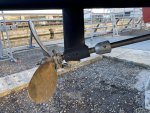
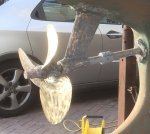
Is this shaft anode fitted properly?

MattS

Well-Known Member
Joined
7 Sep 2020
Messages
570
Location
Kent
Visit site
I'm fitting a new shaft anode to my prop shaft. I'm fairly sure the size (1") is correct, as the next size up is several mm larger and I think would not make solid contact. However I notice that the two halves of the anode are not touching with how I've tightened it up currently.

Is this correct, or should the fit be completely snug and two halves be completely touching for it to be fitted correctly?
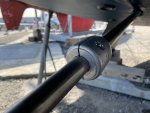
IMG_3500.JPG
 
is the anode solid on the shaft without any movement? It looks to be making good contact all around the circumference, so it doesn't look like you have mixed up 25mm and 1" sizes. The fact that there may be a tiny gap between the 2 halves wouldn't overly concern me, but i might give it a little tweak of extra tightness for good luck.
 
I'm fitting a new shaft anode to my prop shaft. I'm fairly sure the size (1") is correct, as the next size up is several mm larger and I think would not make solid contact. However I notice that the two halves of the anode are not touching with how I've tightened it up currently.

Is this correct, or should the fit be completely snug and two halves be completely touching for it to be fitted correctly?

If the two halves wre touching you would not be certain that they were both as tight and snugged up to the shaft as possible.

Did you use the "two hammer" technique to ensure that both halves are as tight as possible against the shaft or have you merely tightened the fixing bolts ?
 
I believe convention has it fitted closer to the cutlass bearing and the other way round.

But it is secured correctly on the shaft and looks perfect in this respect.
 
I was thinking about fitting a shaft anode this season. But I was worried that if they dissolve unevenly it might cause an imbalance. Does that make any sense?
 
The only thing I'd do extra would be to add a blob of sealant/sikaflex over the screw countersinks. This helps stop the anode eroding in that small area and letting the screws become loose in the holes. I had one do just that a few years ago and the anode stared rattling around on the shaft because the anode material had eroded from around the screws. I always use the blobs of sika now and have not had a problem since.
 
It should be closer to the P-bracket with the tapered end pointed at the bracket for smooth flow to the cutlass bearing. Placed in the centre of the unsupported section of shaft could set up eccentric rotation.
 
Thank you all - some really useful tips there. I've taken from this:

1. The shaft anode should be fitted with the tapered end facing towards the prop, and should be positioned close to the cutlass bearing. Approximately 15mm from the P bracket, to allow enough space for water to flow into the cutlass bearing.

2. You should apply some loctite to the screw threads to help avoid them working themselves loose

3. It can be a good idea to apply some sealant (e.g. Sikaflex) to the screw countersinks to reduce corrosion around the screws and therefore preventing the anode from working loose.

4. It is a good idea to use the 'two hammer technique', hitting both halves of the anode simultaneously and opposite, to help bed the anode right against the shaft. The simultaneous hits will help avoid applying uneven force to the shaft which could result in bending the shaft etc.

5. You can additionally put 2 plastic cable ties around the shaft either side of the anode, to prevent it from drifting along the shaft should it become loose (which could cause damage to the P-bracket or where the prop shaft leaves the hull).


This is now my list of tasks for next visit!

Updated: With more tips!
 
Last edited:
I also put two plastic wire ties around the shaft, one each side of the anode: should it get loose it would not drift towards the p-bracket or worse the hull when in rear gear (where once one of mine ground away a chunk of laminate :( )
 
Thank you all - some really useful tips there. I've taken from this:

1. The shaft anode should be fitted with the tapered end facing towards the prop, and should be positioned close to the cutlass bearing.

2. You should apply some loctite to the screw threads to help avoid them working themselves loose

3. It can be a good idea to apply some sealant (e.g. Sikaflex) to the screw countersinks to reduce corrosion around the screws and therefore preventing the anode from working loose.

4. It is a good idea to use the 'two hammer technique', hitting both halves of the anode simultaneously and opposite, to help bed the anode right against the shaft. The simultaneous hits will help avoid applying uneven force to the shaft which could result in bending the shaft etc.


This is now my list of tasks for next visit!
Just to add to your list, the anode is there to protect the prop so should be placed as close as possible which is usually around 15mm in front of the P bracket which allows sufficient space for water to flow into the cutless.
 
Thank you all - some really useful tips there. I've taken from this:

1. The shaft anode should be fitted with the tapered end facing towards the prop, and should be positioned close to the cutlass bearing.

2. You should apply some loctite to the screw threads to help avoid them working themselves loose

3. It can be a good idea to apply some sealant (e.g. Sikaflex) to the screw countersinks to reduce corrosion around the screws and therefore preventing the anode from working loose.

4. It is a good idea to use the 'two hammer technique', hitting both halves of the anode simultaneously and opposite, to help bed the anode right against the shaft. The simultaneous hits will help avoid applying uneven force to the shaft which could result in bending the shaft etc.


This is now my list of tasks for next visit!

About 15mm from cutlass bearing would probably be optimal. Edit: As already stated.
 
I don't have one as my shaft is bonded internally but what is this two hammer technique of which you speak?

Two hammers (the same size) one in each hand . swing both to strike the two halves of the anode simultaneously ffom opposite sides of the shaft.
The alternative is to hold a heavy solid object ( A very heavy hammer head for example ) against one half while striking the other.
Then retighten the fixing screws

(It may not be so necessary with a cored anode , like that pictured at the top of the thread , as it is with a non cored anode)
 
Moved the shaft anode last night - does this look right now? :)

Rotated, moved closer to the P bracket, and loctite on the threads. Will dab some sealant in next time I'm down!

IMG_3629.JPG
 
Sorry to revive an old thread.

I sent an email to MG Duff asking for their opinion on my anode installation which is the opposite orientation to what MattS has just done. They asked to see my set-up (see pic below) before commenting.

Anode MGD40MM 2018.jpg

The reply was -

Thank you very much for providing photos.
The orientation you have looks correct and allowing plenty of space for water flow into the cutlass bearing.

So there you go. Maybe it's because mine is slightly further away from the bearing than MattS.
 
Sorry to revive an old thread.

I sent an email to MG Duff asking for their opinion on my anode installation which is the opposite orientation to what MattS has just done. They asked to see my set-up (see pic below) before commenting.

View attachment 115765

The reply was -


So there you go. Maybe it's because mine is slightly further away from the bearing than MattS.
Surprising. I am sure I have read on their site some years ago that having the curved face aft was the correct way.
 
  • Like
Reactions: Ink

Other threads that may be of interest

Top