Is this normal?

Agreed and we have some of them onboard and they haven’t gone off but I will investigate.
Have you tested them? Not just the button, but extinguish some matches or candles and wave then umder the sensor. I have one in the small utility room and if I start the car in the integral garage it goes off something alarming (sic).
 
  • Like
Reactions: RMC
We have a Jeanneau 34.2 2001 new to us which has been well maintained and had a new Volvo D1-30f engine professionally installed 2013.
When we use the engine there is an engine smell down below which does go after we stop but our bedding in the aft cabin has a definite engine smell on it when we get home.

I must admit I don’t really notice it that much whilst on the boat other than getting an occasional whiff when in bed in the aft cabin but my wife is a bit more sensitive than I am and is aware of it a bit more.

Is this something you get used to bearing in mind you only have a cover between you and the engine in the aft cabin or does this warrant more investigation.

We would be interested in your feedback.

Paul & Jane
I have a Dufour 30 Classic dating from 2000. It was re-engined with a D1-20 in 2009, one year before I bought it. In 2019 I discovered a leak , caused by corrosion, in the the muffler, which was a similar one to yours. The original owners, when they had had the engine replaced, had used the original exhaust which roughly corresponds in age to yours, so that is where I would be looking for a fault. In my boat the muffler is accommodated in a moulded enclosure, and the water which leaked out through the rust-pitted stainless steel part was not immediately apparent.
You seem to be somewhat hazy on how your exhaust works; the cooling water emerges from the heat-exchanger and is injected into the exhaust right at the back of your engine, where you will see that the elbow has a small bore (1 inch approx), rubber pipe , L-shaped, quite short, connecting it to the heat exchanger. The gases and water collect in the muffler where the build-up of gas pressure pushes the water out through the (tail-) pipe in pulses. Your muffler is sized so that it has the capacity to contain whatever quantity of water might remain in the tail-pipe and flow back into it once the engine is switched off. Another thing to bear in mind regarding the muffler is that, if you make repeated attempts to start a reluctant engine, you will eventually cause the muffler and forward part of the exhaust pipe to fill up with sea water and backflow into your combustion chambers, with dire results, hence in these circumstances it is wise to turn off the seacock until the engine fires.
You mention that there are two large bore rubber/plastic tubes in the engine space; these are ventilation ducts and you will (probably) find that they terminate at plastic skin fittings at the transom. One of these tubes will have an extractor fan fitted into it, check that it's still working.
 
Last edited:
I have a Dufour 30 Classic dating from 2000. It was re-engined with a D1-20 in 2009, one year before I bought it. In 2019 I discovered a leak , caused by corrosion, in the the muffler, which was a similar one to yours. The original owners, when they had had the engine replaced, had used the original exhaust which roughly corresponds in age to yours, so that is where I would be looking for a fault. In my boat the muffler is accommodated in a moulded enclosure, and the water which leaked out through the rust-pitted stainless steel part was not immediately apparent. Another thing to bear in mind regarding the muffler is that, if you make repeated attempts to start a reluctant engine, you will eventually cause the muffler and forward part of the exhaust pipe to fill up with sea water and backflow into your combustion chambers, with dire results, hence in these circumstances it is wise to turn off the seacock until the engine fires.
You mention that there are two large bore rubber/plastic tubes in the engine space; these are ventilation ducts and you will (probably) find that they terminate at plastic skin fittings at the transom. One of these tubes will have an extractor fan fitted into it, check that it's still working.
Thank you, for the explanation and I was a bit hazy but learning quickly but I didn’t know there would be an extractor fan in the ducting so I will investigate.

I am going to pick up some Vetus exhaust hose and renew that first, I have checked invoices including the one for replacement engine and does not appear to have been changed and from what you have said I might just replace muffler as well as cost not outrageous and probably also 20 years old so might just be worth doing as well.

sounds worthwhile advice about reluctant starting filling up muffler, fortunately starts first push but sounds worth knowing.

Many thanks.
 
So that sounds like a resounding:

“No it is not normal”

Jane will be pleased she has enjoyed spending time on the boat and our first trip out (even if she was nervous tying up in the loch) but wasn’t keen on the smell so hopefully I can resolve it.
 
1E0AFD2A-EC82-4C93-A1FA-436F31ECBB15.jpeg7109DAD9-3DDC-44F5-8BAB-08C8602623C5.jpeg3138B3FC-3A95-4F13-ACD8-19BB5CAB3C96.jpeg
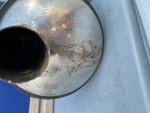
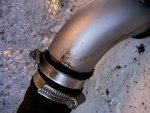
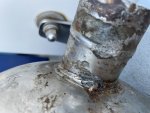
So having pulled everything apart there is signs of water leaking from Muffler inlet and the through hull outlet.
Muffler inlet looks badly corroded as well so will replace Muffler and hose and hopefully that will fix the exhaust smell.
Nothing like doing work on your boat to really get to know it.
 
Top