Is there such thing as a "better" engine oil?

I use shell remula rt4x after it was recommended on here.
After my 1st season of using it - when I pumped it out for changing it came out the same colour as it went in gold.
Fortunately in my job I have 2x 209ltr barrels of it spare so should last me a while.
Excellent stuff
Jon
 
Hmmm, MAN oil link says “Service intervals of up to 140.000 km”... That makes roughly 2800 engine hours. Then why do they recommend us to replace oil every year? Especially when most of us as pleasure craft users, do only 100 hours per year. Normally, according to what I see from several dimensions, I would easily change oil every 2 years. But of course I can't dare. However when I do oil change, the fishermen around start laughing and they take my “still gold colored” used oil to use at their boat engines. Well at least I don't need to carry them to the oil disposal tank:)

I would be glad to hear your comments.

PS: I am also using Shell Rimula semi-synthetic. All fine for now.

Hi,

The truck often runs almost every day of the year and they often follow the TNB additive oil test with a series and the test tells when it's time to change.

A pleasure boat is a different matter because it is unused for long periods of time often if you are driving every day or at least every two weeks with your boat and testing the oil for TNB concentration oil lasts longer and protects the engine if you can not do this is better to follow the manufacturer's instructions in the oil change avoid eg corrosion damage crankshaft bearing surfaces due to oxidized oil.

Hopefully I managed to slightly open the idea of ​​the difference between truck / pleasure boat oil exchange.

NBs
 
My engines take approximately 160 lts of oil at each change. Therefore it may be feasible to make the necessary oil test before deciding to change. If it was just 10 lts, then it wouldn't be that important. But I am feeling like we are pushed for too early servicing not only for oil, but also for filters, etc. How come an air filter get dirty when the boat is not in use? Same goes for oil filter, fuel filter. OK, I don't forget the time aging factor, but still... Pleasure craft engines are designed for average use of 1000 hours per year. Therefore the OEM oil filter should have been designed for that as well, right? And we change at every 100 hours or less.

It is difficult to go out of the line when it is your pleasure craft, you carry your family/loved ones with that boat, etc. But frankly speaking, I don't buy this...

Sorry for the thread drift, should be discussed at a separate thread.
 

Hi Eren,

Fuel Filter I made the question Parker (Racor) and got the most interesting answer to mind...

No, there is no problem. I have a diesel pick up and I have been running the same filter for 3 years now. I am going to change this year just because.

Best regards,

Racor Products Technical Service
Engine Mobile Original Equipment Division
3400 Finch Road
Modesto, CA 95354
209-521-7860
Racor "where to buy", news, literature and information: www.racornews.com
Product part finders and support literature: www.racor.com

My post...
Type in your question here: Hey, I live here in Finland and diesel is very clean and I am now driven more than 600 hours 3 years Racor 75/900 10mic filter and the filter is still visually clean and vacuum gauge needle moves only just a little bit so I have not changed the filter and it all works very same fleet guard 2mic last filter for my Cummins QSB. Do you see a technical problem / risk of using your filter for several years if the filter remains clean?

NBs
 
Very interesting input indeed!

I feel like our weak sides are abused in this "regular servicing" story. I wished that I could look after my own health as good as I look after my boat's engines! :)
 
Thanks for the info Portofino. I am aware of all this data and I go with the rules. But with big question marks in my mind, which I explained above.

We do supply ballistic vehicles to governmental organizations. We provide guarantee only for 2 years for the ballistic glass (it is actually a sector standard). This protects everyone from all legal issues that may come up later on. But most of our clients do not replace their glasses even after 5-10 years. I would do the same if I was at their seat. And at this story, it is the lives inside the car which are under question. Engine manufacturers are approaching the same way by forcing tighter than necessary service intervals. Furthermore spare parts are always very profitable for them. So why not push the end users for tighter service intervals? But with some knowledge, regular visual checks, some scientific backup (like oil tests), the intervals can be extended without giving any damage to the engines. That is what I believe.
 
Thanks for the info Portofino. I am aware of all this data and I go with the rules. But with big question marks in my mind, which I explained above.

We do supply ballistic vehicles to governmental organizations. We provide guarantee only for 2 years for the ballistic glass (it is actually a sector standard). This protects everyone from all legal issues that may come up later on. But most of our clients do not replace their glasses even after 5-10 years. I would do the same if I was at their seat. And at this story, it is the lives inside the car which are under question. Engine manufacturers are approaching the same way by forcing tighter than necessary service intervals. Furthermore spare parts are always very profitable for them. So why not push the end users for tighter service intervals? But with some knowledge, regular visual checks, some scientific backup (like oil tests), the intervals can be extended without giving any damage to the engines. That is what I believe.

Actually in terms of the environment and the pressure from the global warming groups ( which seen justified with the freak weather patterns ) there is merit in your line of thought of easing up on the chronological basis for an oil change to a more specific reason .
This would extend the drain intervals in the liesure marine .
TBN additive depletion maybe ? There are test kits and let’s face it our boats do ultra low hrs annually.
It does seem a total waste to see hardly darkened oil come out just because it’s been in about 12 months .

Having said that there’s no harm in upping the interval going the other way with internal combustion engines if it’s a keeper , Which I concede is an environmentalist nightmare ,
There’s a big difference of changing 10 L of oil every 1000 miles annually in a garage queen classic car cost wise than your 160 and my 65 L boat which has done 100/80 hrs respectively.
For me as said it’s about circa €500 ish which disappears in the annual maintenance budget .
The other thing the invoice for the oil along with the filters I hope forms a nice paper record when it comes round to offloading the boat to facilitate no awkwardness from propestive buyers dissing the service history .

I spoke to a commercial trawler skipper the other day , he did his own services on his VP 74 P rated a lot less than the liesure .He had the boat many years and changes the oil twice due to the hours and after about 12 years repowered , bought another same VP 7/8 L .
I,am not sure what hrs or how much but he factored in his business modal for a repower , offset against profits etc .

Us liesure boaters gain zero income from the hobby cost wise as we know boats are a money pit , but only to a measured degree I know nobody that’s factoring in a repower in [ inset your time ] because they have worn out the engines by doing zillions of hrs .
Obviously a premature shortened engine life would be expensive.
So via project fear we tend to do annual oil changes even though there’s little science @ less than 100 hrs it’s really necessary.
There’s how you use your boat as well , if you do a lot of pooling then the oil change Fq swing o meter moves towards annual ,certainly not towards the 400 hrs .
 
My engines take approximately 160 lts of oil at each change.
Eren, am I wrong in remembering that you've got the V12/1360 on your boat?
I'm asking because I'm aware of other MAN V12 engines (albeit older than yours) which take less than 40 litres each.
I can see reason why they might have enlarged the capacity with more powerful engines, but more than double sounds a LOT!
Or have you got two boats, maybe...? :rolleyes: :p

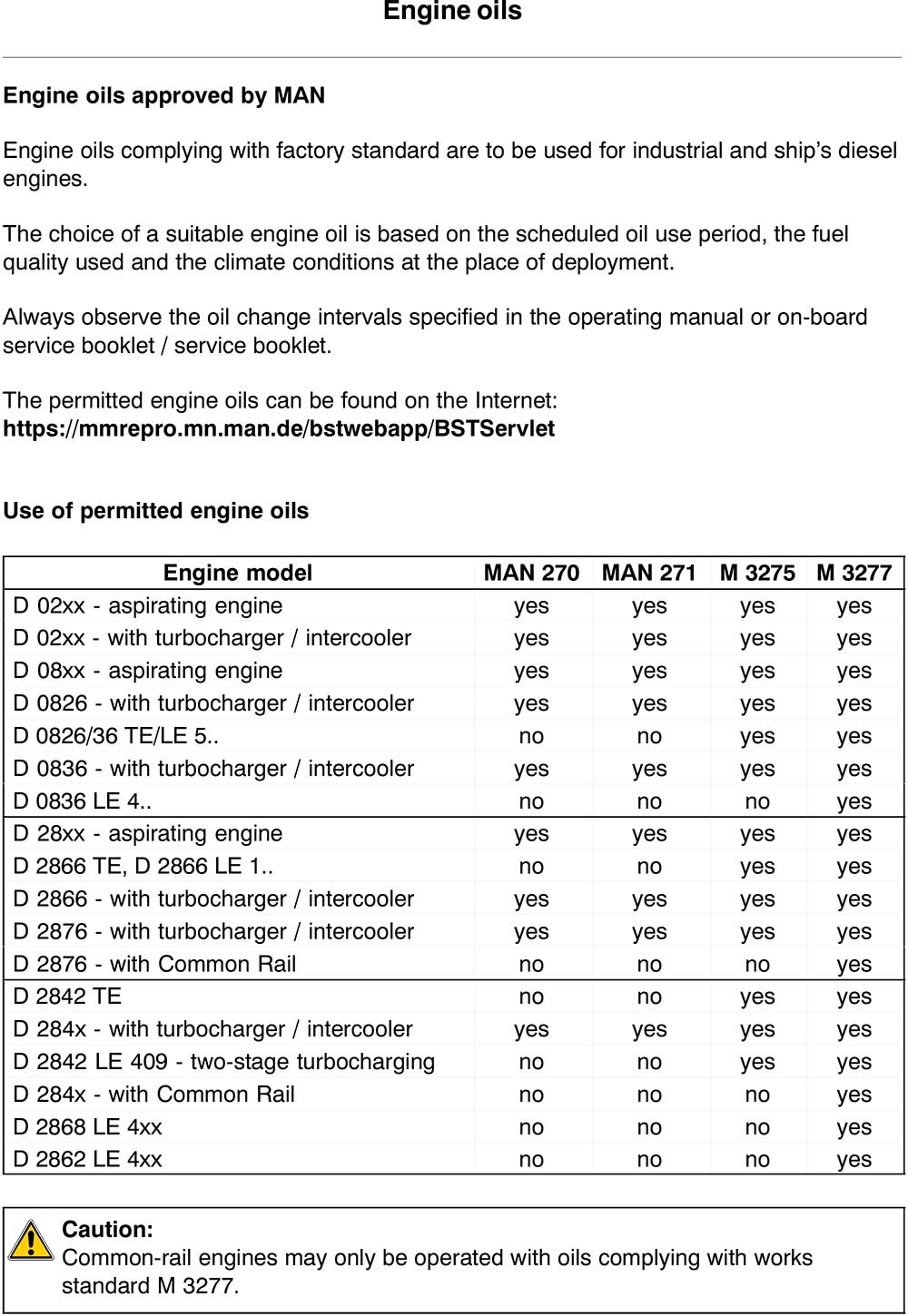
Anyway, careful with the approved oils list posted by PF above.
That's related to the M3275 spec, while MAN specifically require M3277 for CR engines - see below.
I don't know if there's any oil in that list which is both M3275 and M3277 compliant, but the ones I was considering from Shell and Mobil do NOT meet the M3277 specs.

8CBVVHOK_o.jpg
 
Eren, am I wrong in remembering that you've got the V12/1360 on your boat?

Mine are MAN V12/1550, D 2842 LE433. Both together drink somewhere between 7 to 8 bins of 20 lts, so totally around 140 to 160 liters. They require M 3277 and I use Shell Rimula. My oil change costs around EUR 1400 including oil, oil filters and labour. Air filters and fuel filters add another EUR 1.500. These two totally is around 10% of my yearly boating budget, excluding fuel which is a variable cost. I think the percentage is more or less the same for all of us.
 
Actually in terms of the environment and the pressure from the global warming groups ( which seen justified with the freak weather patterns ) there is merit in your line of thought of easing up on the chronological basis for an oil change to a more specific reason .
This would extend the drain intervals in the liesure marine .
TBN additive depletion maybe ? There are test kits and let’s face it our boats do ultra low hrs annually.
It does seem a total waste to see hardly darkened oil come out just because it’s been in about 12 months .

Having said that there’s no harm in upping the interval going the other way with internal combustion engines if it’s a keeper , Which I concede is an environmentalist nightmare ,
There’s a big difference of changing 10 L of oil every 1000 miles annually in a garage queen classic car cost wise than your 160 and my 65 L boat which has done 100/80 hrs respectively.
For me as said it’s about circa €500 ish which disappears in the annual maintenance budget .
The other thing the invoice for the oil along with the filters I hope forms a nice paper record when it comes round to offloading the boat to facilitate no awkwardness from propestive buyers dissing the service history .

I spoke to a commercial trawler skipper the other day , he did his own services on his VP 74 P rated a lot less than the liesure .He had the boat many years and changes the oil twice due to the hours and after about 12 years repowered , bought another same VP 7/8 L .


Hi,

Suitable for this topic. Nordhavn Skipper's idea of ​​oil change, their Johndeere has traveled over 10,000 hours, so I think his thoughts are also pretty reliable. In short, his oil exchange interval is 250 hours, but over the ocean the hours will be full and he will not change the oils at sea because of the many risks, in this story the hours are 375 before the oil exchange. A really interesting block for boat maintenance / trip report.

https://mvdirona.com/2016/01/to-change-or-not-to-change-that-is-the-question/

Do not misunderstand my writing, I think the same when you and me are good to follow oil change high quality oil and filter on schedule

NBs
 
Last edited:
Mine are MAN V12/1550
Aha, now I understand.
The 1550 and the 1400 were their first V12 engines with the longer stroke 24 litres block, which was later on pushed up to 2000hp.
Otoh, the 1360 that I had in mind was the latest development of the previous 22 litres block.
Obviously, they must have taken the opportunity of that redesign for increasing (more than doubling, in fact!) the oil capacity, among other changes.
I wasn't aware of that, but I'm not surprised at all, 'cause I always wondered why the oil capacity of MAN engines is amazingly lower compared to Cats.
Just to put that in perspective, my previous 6.6 liters/350hp Cat required 25 liters each for an oil change, so I was fearing a big increase in my oil expenses, when I bought a boat with 14.6 liters/800hp MANs.
But believe it or not, they drink one liter LESS instead, with a more than double displacement and power! :eek:
One should think that either at MAN or Cat some engine designer lost the plot.
And since based on what as you are telling us the MAN folks eventually followed the Cat route, I have a funny feeling that over time the latter choice proved to be the best... :ambivalence:

They require M 3277 and I use Shell Rimula.
At risk of making an egg suck lesson, careful because there's plenty of very different oils which are all called "Rimula".
And the difference is not simply mineral for older engines vs. synth for more modern ones.
For instance, the Rimula R5-E 10W/40 which you can find in the table linked by PF is a semi-synth oil, but has just the M3275 approval, so it's not good for CR engines.
I believe that either the Rimula R5-M (semi-synth) or R6-M (full-synth), both 10W/40, are M3277 approved.
Not very good news, considering that on top of the higher capacity, your engines require more expensive oils, but...
As we know, owning a gin palace ain't a bed of roses! :cool:
 
At risk of making an egg suck lesson, careful because there's plenty of very different oils which are all called "Rimula".

Yes, I know. I just was not able to remember the extension of the oil that I had used. It was something like R6-Me if I don't remember it wrong. I made sure that it was M3277 approved. Anyhow, good point to catch.
 
I've read this thread with interest, there has been a load of very good points made so i figured i might throw some of my experiences with oil and people who 'know' oil over the past 20 years of my seagoing career.

Early on in this thread there was a comment about large marine engines never changing the oil, this is true, there is no need to change the oil if regular testing is carried out and found still withing the operational specification of the engine and you constantly clean the engine oil using a purifier (centrifuge), I have a love hate relationship with purifiers... different story. Anyway you can run for years like this, but bear in mind this is a constant operation so no extended downtime or winter months up on the hard.

MTU 2000 series engines have a centrifugal filter mounted on the engine that uses nozzles to spin up the filter on oil pressure this works reasonably well considering the amount of sludge builds up on it, this has increased the oil change interval to 1000 hours from 500 hours on engines using standard spin on filters alone. The 4000 series have a step up again using centrifugal and auto flushing candle filters, if you can keep the oil clean you can use it confidently long term.

Mostly condensation is the killer, it mixes with the sulphur in the fuel creating sulphuric acid and washes down into the oil wiping out the alkalinity (TBN) of the oil rendering it useless to acid attack. At this point there is not really any option but to replace the oil other than adding TBN stabilisers... pretty much the same cost as the oil anyway so small engines its as cost effective to change the oil. On ships we are talking upwards of 5000l per engine so not cost effective!

Another interesting one for you I sailed on one ship that had separate tanks for engine lubricating oil and gearbox oil, but used a common pump for transferring it. Its always been drummed into me throughout my training that oils are specific to the task designed for and when the issue was raised with the ship builder they released a statement from Shell engineers that the base oils were in fact the same, and there isnt much difference between them. Now i know this will get alarm bells ringing, as it did with me when i first heard it but years worth of oil analysis down the line ive not once seen a negative report either from the main engines or the gearboxes!
 
Yes it how they are used that basically dictates which oil and it’s Fq interval .
As said in a previous post ,I am not happy pulling the keys at the end of the season and re inserting them @ Easter .
I was on my boat yesterday ( lovely flat calm bright sunny day, folks eating outside in the shore side restaurants ) , whole boats systems had a run .NAD
Nothing Abnormal Detected .
Oil heaters set up , but I,ll be back in Jan for another system run up .
4 of us ran our engines and generators ,so reassuringly others do regular run ups in the off season .

I change my oil at the start of the season , ridding any the potentially winter harmful products that may accumulate.
Just seems the right thing to do give them fresh oil when they gonna get loaded up very regularly so speak over the coming months in the summer .
 
Last edited:
On an earlier point about different brands of oils being recommended in different regions, this is common practise as differing regions and countries have different oils available to them; along with the fact some countries also have unwritten policies of keeping their trade in other companies in the same country, America being a prime example.

Commercial activity is another major factor and if one engine manufacturer has a contract with an oil company to provide them with their own branded oil then they will recommend it as the engine manufacturer is buying it in huge quantities at very low rates, then they stick their margins on top. Some countries may not also have the recommended oil manufacturers oil in their region/country and they have to recommend other brands. When these contracts to supply own brand oil expire the engine manufacturer has to look for another supplier and when they find one their recommendations change, you can get an engine service booklet for a 2016 marine engine which may recommend Exxon Mobil, the same engine manufactured in 2018 will recommend Valvoline in their service books as they have changed suppliers.
 

Fortunately, manufacturers give the consumer the full choice of any brand oil that meets the requirements of viscosity and class API, ACEC, in addition to various engine manufacturers' own categories VDS, CES, CAT, and others.

NBs
 
MTU 2000 series engines have a centrifugal filter mounted on the engine that uses nozzles to spin up the filter on oil pressure this works reasonably well considering the amount of sludge builds up on it, this has increased the oil change interval to 1000 hours from 500 hours on engines using standard spin on filters alone.

My CR2000s don't have centrifugal filters.
That is an optional extra and AFAIK, not fitted to the CR2000s supplied to the leisure industry.
 
You may be interested in the Fluids and Lubricants Specification publication from MTU
It lists the various oil products/manufacturers and how MTU classify them.
See here
https://www.mtu-online.com/fileadmi...specifications/neu_01_04_2015/A001061_36E.pdf

Essentially, they classify all oils into 3 categories.
Category 1 - Category 2 - and Category 3
It seems that recently, they have also added Categories 2.1 and Category 3.1
On our MTU course, we were told that Category 1 oils were the old ?rap stuff that would be used in a power station - Category 2 are the cheaper mid range oils and Category 3 are the very special oils that we probably don't want to use.
We were told that Category 2 oils were good in our CR2000s for 500 hours or 2 years - whichever is the sooner.
See page 12 - as said above mine are not fitted with the centrifugal filters.

The document lists the "in house" MTU oils first but if you cut through the "guff" and go to page 84 - Section 8, you will see the Approved Engine Oils by manufacturer.
They list Category 1 oils first so cutting further through the "guff" go to page 95 - Section 8.1.6 - Multigrade oils - Category 2
Again, they list their own "branded" oils first and on page 86 "Other Multigrade Oils" - by manufacturer.

So, cutting a VERY long story short - I use Shell Rimula
All the variants of Shell Rimula are listed as Category 2 Oils on page 101 - so Shell Rimula has been put into Room 101 :D:D
That means (in MTU terms) Rimula is good 500 hours or 2 years.

Now to my experience.
Our old Sealine had Volvo D12s and using the Volvo carp oils, we used to get lots of oil dripping from the breathers.
I switched to Rimula and it all went away.
My view is that the Volvo carp oil used to foam a lot whereas the Rimula is a better product that didn't foam.
That was 12 years ago and I've used Rimula ever since.
 
Top