Is Lightning Protection worthwhile?

coopec

N/A
Joined
23 Nov 2013
Messages
5,211
Visit site
I wonder what percentage of blue-water yachts have lightning protection? (My logic tells me If you are a "day sailor" you'd pick the weather you sail in so lightning protection would not be a priority).

I also wonder about the effectiveness of lightning protection in the event of a decent lightning strike. Is there any empirical evidence ? I wonder what is "effective lightning protection" when even the experts don't seem to agree.

Would the use of composite thru hulls (e.g. "Trudesign") change the situation? There is a YBW thread (March 2021) here which raises the possibility of a composite thru hull melting in the event of a lightning strike! 😂 Has this theory been tested in the real world? (How can a non conductor melt in a lightning strike?)

Vulnerability of Plastic Through Hulls ?

lightning-strikes-map.jpg

lightning-map-scale.jpg
 
Phew!
I think I'd like lighting protection in S.E. Asia!

How many thunderstorm days per year in Malaysia?

Image result for thunderstorm malaysia


204 days
... Malaysia is ranked among the countries with very high lightning activities [2], [51] . It has an average of 204 days of thunderstorms which is equivalent to 40 strikes per kilometer per year [52]. ...
 
At lightening voltage, everything becomes conductive!

I was going to toss away the SS skin fittings and replace them with reinforced acetal skin fittings but now I'm having second thoughts.

"3. Almost anything is a better conductor than air. Once the lightning hits it and goes into standard electric current physics, there will be a huge current flowing through it, enough to neutralize the voltage separation of from clouds to the ground.
UCSB Science Line


I look at my yacht's lightning protection and see flaws in its' design. For example lightning likes to travel in a straight line but if the mast is hit what happens to the charge coming down the fore-stay when it hits the bow roller? Maybe I should attach a chain to the bow roller and drag it in the water?

Maybe the answer is that anything you can do to facilitate conducting the lightning charge to the water is going to lessen (not eliminate) damage to the yacht?
 
Last edited:
Yes, yes , yes . Been affected twice, once off Morocco not a direct hit but enough lightening around to wipe out GPS and once off la gomera . , second time all electronics on the boat including engine electronics radio aerial fried so no engine no radio no instruments . I thought it would never strike twice but it did !! and I wished I'd taken precautions luckily close enough to turn back and there followed a very expensive repair I may be unlucky but . If I was ever going offshore agin ...........
 
The amount of energy is such that any Lightning rod / conductor you may have is totally overwhelmed.

I have been on two ships that one was a direct hit - Antennas were blown apart and VHF internals melted .... second was an indirect hit where it hit water and the mooring buoy .... it still travelled to the bow of the ship as it dissipated.

I wonder if this thread has started because of my chat about it on my replace Oven thread ??
 
The amount of energy is such that any Lightning rod / conductor you may have is totally overwhelmed.

I have been on two ships that one was a direct hit - Antennas were blown apart and VHF internals melted .... second was an indirect hit where it hit water and the mooring buoy .... it still travelled to the bow of the ship as it dissipated.

I wonder if this thread has started because of my chat about it on my replace Oven thread ??

I started the thread because of comments on "Bilge Pump Question" (But thanks, I will have a look at the "Replace oven thread")

It took a lot of time to install lightning protection on my yacht but I'm starting to think it may have been worthwhile. If the yacht is hit by lightning I would expect damage but hopefully it wouldn't be as bad as if I had no protection at all.:rolleyes:
 
I started the thread because of comments on "Bilge Pump Question" (But thanks, I will have a look at the "Replace oven thread")

It took a lot of time to install lightning protection on my yacht but I'm starting to think it may have been worthwhile. If the yacht is hit by lightning I would expect damage but hopefully it wouldn't be as bad as if I had no protection at all.:rolleyes:

Just to give an idea ...

When a Tanker is berthed - it has a 'grounding' wire attached to dissipate any static that's built up. The wire is usually about 15 - 20mm diameter and has literally a large croc clip on the end.
It has been proven that the gauge of wire is totally useless as it really needs to be about 15 - 20cms diameter to really work. Its not the wire resistance that's at fault - its that if the ship really did have suficient static to be of risk to cargo ops - that would blow the wire asunder.

How much power do you think is in a lightning strike ?? When you see cables / gear etc. after a strike - you realise how puny our protectors are.
 
I started the thread because of comments on "Bilge Pump Question" (But thanks, I will have a look at the "Replace oven thread")

It took a lot of time to install lightning protection on my yacht but I'm starting to think it may have been worthwhile. If the yacht is hit by lightning I would expect damage but hopefully it wouldn't be as bad as if I had no protection at all.:rolleyes:
My findings were that it is worthwhile. I will post my article later.
 
Is it needed - in the UK I doubt it. In 40 years of pottering with boats I have only heard of one UK lighting strike - but that struck and sank a brand new Westerly. The occupants were fine.

On the other hand, there has been a number of fatalities in my time. Drownings / related heart issues from cold shock.

I guess you protect on the basis of probabilities. Wearing a LJ all the time is more important than lightning protection. Apart from anything else, lighting damage is the insurance company's problem. Drowning is yours.
 
Just musing… Would a plastic boat be any better protected if the keel stepped mast went right through the hull? (with adequate mounting and sealing of course!). I figure the lightning is on its way to the sea, via the mast, and the last thing to get in the way is an inch or so of fibreglass.
 
Just musing… Would a plastic boat be any better protected if the keel stepped mast went right through the hull? (with adequate mounting and sealing of course!). I figure the lightning is on its way to the sea, via the mast, and the last thing to get in the way is an inch or so of fibreglass.

Well it would have to go through the ballast too wouldn't it?

If the ballast was external I'd bolt the mast to the external ballast. That would be the ultimate surely?
 
Just musing… Would a plastic boat be any better protected if the keel stepped mast went right through the hull? (with adequate mounting and sealing of course!). I figure the lightning is on its way to the sea, via the mast, and the last thing to get in the way is an inch or so of fibreglass.

When you see what a lightning hit can do .... whether keel stepped or not becomes academic !
 
Just musing… Would a plastic boat be any better protected if the keel stepped mast went right through the hull? (with adequate mounting and sealing of course!). I figure the lightning is on its way to the sea, via the mast, and the last thing to get in the way is an inch or so of fibreglass.
I will post the article later but I recall that the recommendation was for a copper plate immediately beneath the mast. Unfortunately it is secondary strikes that do most of the damage, which is the reason for bonding seacocks. This does appear to help.
 
This is the short article that came out of my research. Limited by the space available, not by the absence of information!
Interesting that the final paragraph seems to debunk the widely held belief that hanging chain from the shrouds will help to lead the current into the sea. It seems it may do exactly the opposite.

A surprising amount of research has been carried out into lightning strikes on yachts and boats, much of it in Florida but some in New Zealand, Australia and other countries. The findings are somewhat confusing when it comes to the layout of protection.

Detailed explanations can be found at
NASD - Boating- Lightning Protection, Lightning-Proof Your Boat and When lightning strikes
although there are many others.

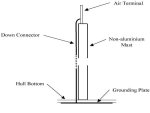
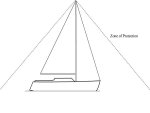
To summarise, the optimum protection according to all authorities is provided by a heavy conductor, preferably copper of at least 21 sq.mm. running from 15 cm above the masthead and all antennae in as straight a line as possible to an underwater plate beneath the mast foot. This should be copper, bronze or monel, not sintered and not embedded into the yacht’s hull, as electricity prefers to exit via an edge. This arrangement creates what is known as a ‘cone of protection’ within which people are relatively safe provided they are below deck, sitting as high above the waterline as possible and well away from the mast.

The American approach is similar but greater attention is paid to the possibility of side flashes, which may be particularly damaging to electronics and may even blow holes in the hull. This is the reason for the USA preference for electrically bonding all underwater components, such as seacocks, engine, drive and rudder. The cable used is of considerably heavier gauge than is needed for purely galvanic purposes. It is believed that this practice forms a cage-like network of conductors, helping to protect anything within it.

Further problems arise in the case of secondary paths from the main, vertical, path of the current and any other possible routes, particularly any with high impedance. In this case the electricity can follow alternative, unpredictable routes to the sea, resulting in serious damage and risk to life. Again, bonding helps to reduce the likelihood of secondary paths but may have an adverse effect on corrosion.

Lightning mast arrangement.jpg

Lightning cone.jpg
 
I will post the article later but I recall that the recommendation was for a copper plate immediately beneath the mast. Unfortunately it is secondary strikes that do most of the damage, which is the reason for bonding seacocks. This does appear to help.
Bonding seacocks for lightning protection is very different to normal bonding. The cable size needs to be far greater.
I did a lot of research a while back. In Florida it is common to install copper plates at water line level and attach down conductors from all the rigging to these plates. It's a very intrusive installation best carried out when a boat is built. A friends boat had this system installed. Huge cable sizes
 
Bonding seacocks for lightning protection is very different to normal bonding. The cable size needs to be far greater.
I did a lot of research a while back. In Florida it is common to install copper plates at water line level and attach down conductors from all the rigging to these plates. It's a very intrusive installation best carried out when a boat is built. A friends boat had this system installed. Huge cable sizes
See my later post.
 
Top