Is it just me or are all modern boats completely horrible ?

I am not sure that I would agree with that. For one thing a gaff rig has a lot of weight aloft.
However, the point I would make is that one should consider the rig as a whole. Not just look at, say, the mainsail. A Bermudian rig lends itself to better down wind fore sails ( yes I have seen pics of large gaffers ones with lots of flying jibs) . Add a spinnaker or a large asymetrical & I would say that a bermudian rig tacking down wind would be better because of easier sail handling , lighter rig & a sail that has a better shape. A gaffer flying a heavy gaff along with several jibs, (which is how they would have sailed), is not an efficient sail to handle. Even when it comes to quick reefing.
Then look at the shape of the gaffers sail when the gaff is on the wrong side. Not good, is it?
Personally i think you are wrong. But that is only my opinion & others will agree with you- I am sure
Personally, I like to base my opinions on facts supported by science. And, I like to get it straight, before I open my big mouth, by checking up on things if I'm not sure and before I tell someone they are wrong.
Marchaj, Sail Performance, page 147, Fig 127. Or see Page 149 ... in other words, the gaff sail will develop about 50% more driving force than a Bermudan sail, and hence on a broad reach the boat driven by a gaff sail will be faster. ... These findings were confirmed by wind tunnel tests at Southampton University. To sum up: on courses between 70 and 135 degr. the gaff sail form is up to 50% more effective and superior to the Bermudan planform.
The new fat head mains do look rather similar to a traditional gaff with topsail, though they are aerodynamically cleaner and hence would be better upwind with less drag.
 
Last edited:
I remember seeing the Falmouth Quay Punt 'Curlew'
Falmouth Quay punt "Curlew" – BC09 | National Maritime Museum Cornwall
taking part in Antigua Sailing Week in the 80's -
Antigua Sailing Week – Caribbean Sailing Regatta -
This was in the days before they had created the Antigua Classics Regatta -
Home - Antigua Classic Yacht Regatta

Curlew would have been in her 80's then, and her owners were full time liveaboards who enjoyed sailing competitively.
She entered the Sailing Week - I think in Racing Class, not Cruising - and proceeded to humiliate much or her competition, by beating them upwind, walking away from them downwind, winning on elapsed time and crucifying the opposition on corrected time.
 
I remember seeing the Falmouth Quay Punt 'Curlew'
Falmouth Quay punt "Curlew" – BC09 | National Maritime Museum Cornwall
taking part in Antigua Sailing Week in the 80's -
Antigua Sailing Week – Caribbean Sailing Regatta -
This was in the days before they had created the Antigua Classics Regatta -
Home - Antigua Classic Yacht Regatta

Curlew would have been in her 80's then, and her owners were full time liveaboards who enjoyed sailing competitively.
She entered the Sailing Week - I think in Racing Class, not Cruising - and proceeded to humiliate much or her competition, by beating them upwind, walking away from them downwind, winning on elapsed time and crucifying the opposition on corrected time.
Thank you for that. The irony is that I have no particular attachment to either long keels or gaff rigs. I do object to the notion that everything new is better, without numeric qualification. I own a 14' gaff sloop and I have sailed rings around larger and supposedly much faster and Bermudan rigged boats. By current perception a gaffer couldn't get out it's own way. A friend of ours owns 44' Boreal, a modern wedge shape aluminium centre board design. He told us how he got absolutely clobbered by a gaff rigged, lee board, bluff-bowed and 200 year-old design Lemster Aak. The Lemster was pointing higher and footing faster, close hauled and when they could bear off a little it simply walked away. Our friend is an experienced sailor.
It is much the same with long keels. Whenever some yachting journalist sails on one, the most frequent adjective when describing their sailing qualities is -"surprising". Really? Have we been all that brain washed by the yachting press? Of course there a lousy long keel boats, just as there are crummy short keel ones. Long keels have definite sea-keeping benefits and if you have the time you can work your way through Marchaj's comprehensive thome "Seaworthiness the Forgotten Factor" where the whole point is described in scientific and formulaic detail. That said, the term seaworthiness is usually expounded by folk who've never had need to call upon it. 95% of all recreational sailing is done in winds below 25kts. A further 80% of this is done in winds under 15kts. So much for the statistics. Consequently, pretty much any half-found boat will meet most any cruising requirement. Some are easier to sail on, others have an easier motion and to varying degrees all seem to work just fine. We presently own a long keel, more of a coincidence than intended. She suits us. We have modified her heavily to make her sail properly and occasionally we do "surprise" some supposedly more slippery jobs. She will never be as extremely close-winded as some, but that doesn't appear to be that much of a consideration, these days, when all have of powerful auxiliaries.
 
Personally, I like to base my opinions on facts supported by science. And, I like to get it straight, before I open my big mouth, by checking up on things if I'm not sure and before I tell someone they are wrong.
Marchaj, Sail Performance, page 147, Fig 127. Or see Page 149 ... in other words, the gaff sail will develop about 50% more driving force than a Bermudan sail, and hence on a broad reach the boat driven by a gaff sail will be faster. ... These findings were confirmed by wind tunnel tests at Southampton University. To sum up: on courses between 70 and 135 degr. the gaff sail form is up to 50% more effective and superior to the Bermudan planform.
The new fat head mains do look rather similar to a traditional gaff with topsail, though they are aerodynamically cleaner and hence would be better upwind with less drag.
Yes I am aware of the science of base to height ratios etc etc & I am aware that it is said that at certain angles a square sail shape may be more efficient. But in my defence did make the point that the rig would be heavy because even with a taller mast I would expect the bermudian rig to be lighter to handle. That has to be considered in the "efficiency test". The science does not take into account the shape of the sails around the gaff in practice ( at least, not that i am aware) Neither does the science take into account the entire rig- once again I have not taken the interest to read up on that but I someone will comment - if only to prove me wrong. Just sticking a sail up & saying that is the most efficient is no good -As I said ( & you seem to have conveniently ignored) It has to be used & one has to consider all aspects of how it is flown & how it is handled. Ask the owner of a junk rig why he thinks his sail is best. Did the science then consider what happens to the c of effort on other points of sail & the effect on the hull? Did it consider how easy it is to reef/gybe/trim?
If gaffs were so good then we would be still using them; & we are not. Yes I know about fat heads on race sails or just simple roaches on mainsails, but they are much lighter & have a far cleaner shape than a sail suspended on on a gaff. The batten system is different. It would not surprise me if ( from my sailboard days) that the aerodynamics of the fathead is somewhat different to that of a gaff sail.
I admit to not having sailed gaff rigged boats, only gunter rigged dinghies at the early age of 11-16 years, & one boat for a few hours in later years. My experience of them is nil. So I am at a disadvantage to those who have.
But I did say in my first comment that I expected others to disagree & if I was wrong in my opinion then so be it. But with respect I would point out that sticking ones' finger on a single point in some scientific result & saying " that proves my point" can sometimes lead to error. One needs to examine the wider view
 
Last edited:
I guess that's why the Volvo Ocean Race is full of gaffers then?

Put a geriatric or a complete novice in a WRC car and they would be beaten by Lewis Hamilton in a Kia Sorento, but observing Hamilton win does not support the conclusion that a Sorento is faster or better than a WRC car.

That's the main problem with anecdotal stories like these.
 
which kinda is the point: the builder's new offering looks a bit like it, but it still has that comfy interior.

But that's my point. It doesn't look anything like it.

Mass manufactured Cruising boats from the likes of Beneteau, Bavaria, Hanse etc simply do not look like, or seem to take any influences from any racing boats. They seem, to me at least, to be plowing an entirely separate farrow, one of large volume for interior comfort.
I'm sorry, but it simply does not wash to claim that contemporary AWB design is influenced by race boats.

oce_ueanis_41_1__ncz6683_a3-5a12.webp

is not influenced by this.
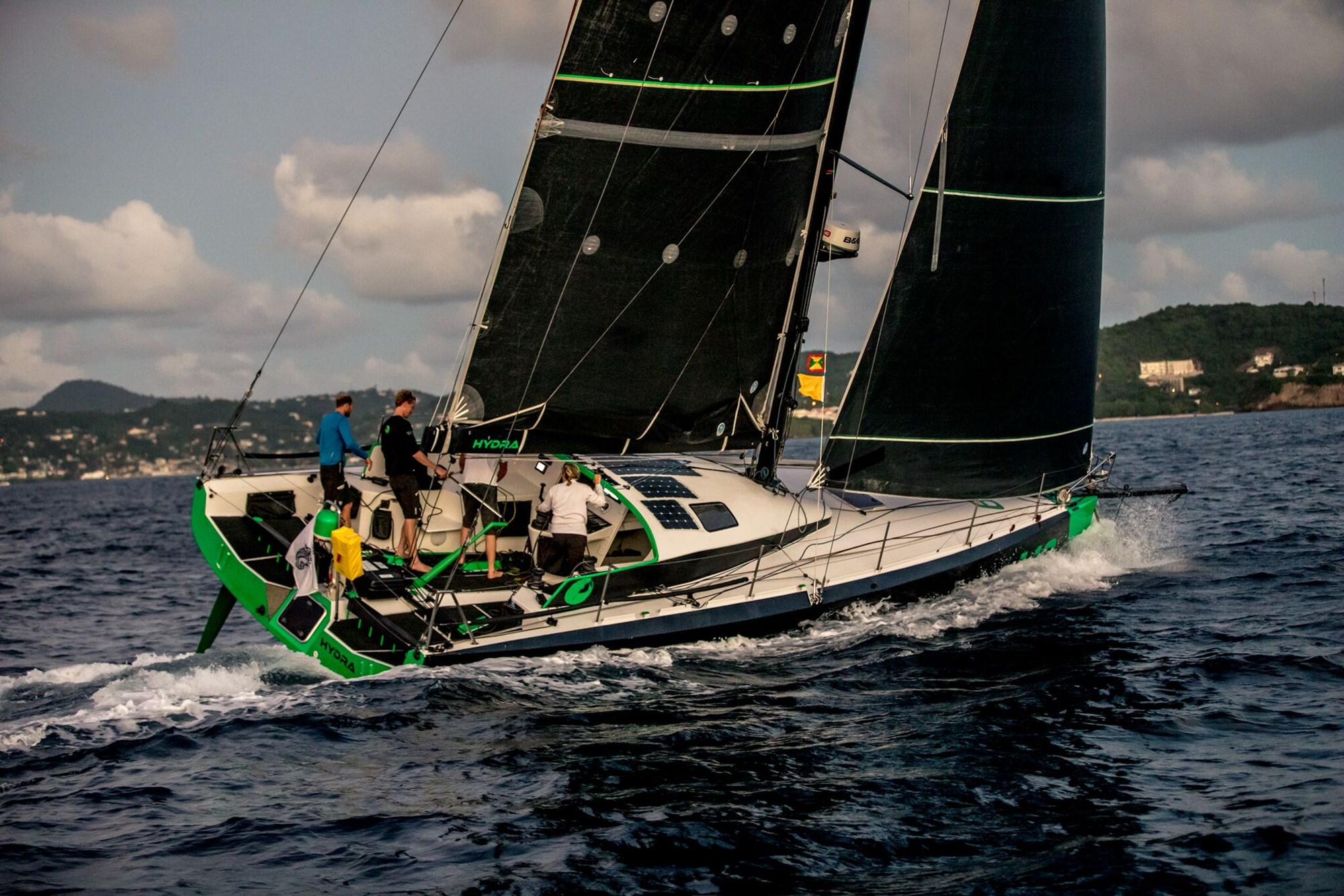
Class-40-For-sale-Hydra-149-3.jpg


The likes of POGO etc definitely have taken inspiration from race boats - the class 40s to be exact. But I think that's also due to sharing the same design goals rather than"make it look like a class 40 to make it sell".
Both class 40s and Pogos are designed to make fast passages off the wind with small crews. It's no massive surprise that they end up looking fairly similar.
 
Mass manufactured Cruising boats from the likes of Beneteau, Bavaria, Hanse etc simply do not look like, or seem to take any influences from any racing boats.


Class-40-For-sale-Hydra-149-3.jpg


Maybe not design in the wider sense, the figures do not add up. However, it seems to me that the styling of that 53 is full of race based clues:

Dart shaped plan
Flat decks to a..
Low wedge shaped coachrooof
Plumb bow
Big cockpit
Wide open transom

All things that fit nicely with the image.
Fit a cast iron keel because they all look the same painted. Put on black sails because it looks sexy but don't fit a traveller because it would get in the way.

There is always an "however" and it must be noted that Garcia, and the rest, have all ploughed their own furrow, which is great to see.
 
Maybe not design in the wider sense, the figures do not add up. However, it seems to me that the styling of that 53 is full of race based clues:

Dart shaped plan
Flat decks to a..
Low wedge shaped coachrooof
Plumb bow
Big cockpit
Wide open transom

All things that fit nicely with the image.
Fit a cast iron keel because they all look the same painted. Put on black sails because it looks sexy but don't fit a traveller because it would get in the way.

There is always an "however" and it must be noted that Garcia, and the rest, have all ploughed their own furrow, which is great to see.

Dart shaped, low wedged coachroof, plumb bow and open transom would clearly be specified in a boat designed for med sailing that is seeking to maximise interior space.
Big cockpit similarly...
Nothing to do with race styling, just what cruising sailors in warm climes would want.
 
.........open transom would clearly be specified in a boat designed for med sailing that is seeking to maximise interior space.
Big cockpit similarly... Nothing to do with race styling, just what cruising sailors in warm climes would want.

Not all sailors in warm climates want boats like that, many of us like centre cockpit. Boats such as you describe are not suitable for cruising long distances in open waters when conditions are challenging and cockpit needs to be secure.
 
That said, the term seaworthiness is usually expounded by folk who've never had need to call upon it. 95% of all recreational sailing is done in winds below 25kts. A further 80% of this is done in winds under 15kts. So much for the statistics. Consequently, pretty much any half-found boat will meet most any cruising requirement.

So much for the statistics, indeed. The post-2000 average UK wind speed from April to September is 7.5kts and this has been stable for over 50 years. Those who only sail in the winter months would experience somewhat stronger winds of c.9.5kts average. A little stronger in Western and Northern shores.

Do the maths and by your calculations those recreational sailors must be heavy-weather seeking!

As for the notion that, "the term seaworthiness is usually expounded by folk who've never had need to call upon it".
Any data for that, or did you just make it up also ? :)
 
So much for the statistics, indeed. The post-2000 average UK wind speed from April to September is 7.5kts and this has been stable for over 50 years. Those who only sail in the winter months would experience somewhat stronger winds of c.9.5kts average. A little stronger in Western and Northern shores.

Do the maths and by your calculations those recreational sailors must be heavy-weather seeking!

As for the notion that, "the term seaworthiness is usually expounded by folk who've never had need to call upon it".
Any data for that, or did you just make it up also ? :)

Dom, the problem with averages is it doesn't take into account the numerous balmy, blue skied f2 days which occur when one is in the office to be replaced with the f5 and grey days which seem to predominately happen at the weekend... :(
 
But that's my point. It doesn't look anything like it.

Mass manufactured Cruising boats from the likes of Beneteau, Bavaria, Hanse etc simply do not look like, or seem to take any influences from any racing boats. They seem, to me at least, to be plowing an entirely separate farrow, one of large volume for interior comfort.

Pretty much word for word what Group Finot say.

Your "farrow" typo (if deliberate, strait to top of class) is certainly apt for this thread, "a litter of pigs!"
?
 
So much for the statistics, indeed. The post-2000 average UK wind speed from April to September is 7.5kts and this has been stable for over 50 years. Those who only sail in the winter months would experience somewhat stronger winds of c.9.5kts average. A little stronger in Western and Northern shores.

Do the maths and by your calculations those recreational sailors must be heavy-weather seeking!

As for the notion that, "the term seaworthiness is usually expounded by folk who've never had need to call upon it".
Any data for that, or did you just make it up also ? :)
Liverpool has twice the average wind speed as Southampton so those rufty tufty northern sailors have a bit more wind
 
Dom, the problem with averages is it doesn't take into account the numerous balmy, blue skied f2 days which occur when one is in the office to be replaced with the f5 and grey days which seem to predominately happen at the weekend... :(

An inexplicable and irritating phenomenon! Last summer I was sat behind the desk looking at a settled N/NW wind to blow us gently from the Solent to Camaret. Come Thursday it was forecast SW F6/7 ?

Postponed for 5 days (luckily possible) and ended up motoring half the bloomin way across in balmy blue seas. Biggest danger turned out to be not having enough suntan lotion! ?
 
Top