Is a TomTom accurate on a marine chart?

On a similar theme what do people think of this approach?

I’ve got a Garmin etrex. An entry level hand held aimed at hikers mainly. It supports about a dozen data (datums) and I regularly switch between OS GB for walking and WGS84 for sailing.

I’m off to the Med for the first time in a couple of weeks so I used Google Earth to establish the Lat Long of numerous waypoints and have put them in my GPS just in case it proves to be useful.
Once I get hold of a local chart I'll switch the GPS to that datum (if necessary) and it will do all of the arithmetic
This has previously worked well for walking in France

Is there some obvious flaw in this plan?
 
You can be as pedantic as you like, but WGS 84 is the reference coordinate system used by the Global Positioning System, and satnavs natively deliver output in WGS84 and convert to others on the fly. So lat/long will nearly always be to WGS84, unless some on the fly conversion has been enabled.
Not so, and if you read about how the system works, you will discover that to be the case. Just for starters, a bit of text pinched from Wikipedia:

A GPS receiver calculates its position by precisely timing the signals sent by GPS satellites high above the Earth. Each satellite continually transmits messages that include

* the time the message was transmitted
* precise orbital information (the ephemeris)
* the general system health and rough orbits of all GPS satellites (the almanac).

The coordinate system for the ephemeris is not WGS84. To quote the authority, the National Geodetic Survey:

The National Geodetic Survey (NGS) computes orbits for the Global Positioning System (GPS) satellites in the Global Navigation Satellite System (GNSS) using 24 hour data segments observed at a global network of GNSS receivers and antennas. The global tracking network is coordinated by the International GNSS Service (IGS). The current reference frame used in the computation is the IGS05 reference frame, a GPS-only realization of the latest International Terrestrial Reference Frame (ITRF2005).
 
I’m off to the Med for the first time in a couple of weeks so I used Google Earth to establish the Lat Long of numerous waypoints and have put them in my GPS just in case it proves to be useful.
Once I get hold of a local chart I'll switch the GPS to that datum (if necessary) and it will do all of the arithmetic
This has previously worked well for walking in France
...And you'll be able to check the positions of the wps on the local chart to see how well the chart agrees with what Google Earth 'sees'.
 
can one use a TomTom?

I recently gave a lecture on GPS and covered inter-alia this exact subject: can one use a mobile 'phone or TomTom instread of or as a back-up to a marine GPS? The answer is yes to an extent, but one has to take some care and they are only to be considerd a back-up.

1. Leasure marine GPS, phones and TomToms all use the same chip sets - there are only a handful of manufacturers: Raymarine and TomTom 930 use chips from SiRF, which are well respected. TomTom OneXL uses chips from Broadcom (which have been somewhat inferior in my tests, but should still work sufficiently), as does the iPhone. Nokia use a chip from Texas instuments which, while I do not rate highly, should work suffciently if given a good view of the sky. Garmin use a variety, mainly SiRF. RIM/Blackberry use SiRF or Qualcomm. Samsung dont have GPS fitted on many models but mostly use Qualcomm, which works well. I do not know what Sony-Ericsson use. The various Bluetooth-GPS dongles work well and most use SiRF.

But it is important to realise that despite not making the chips or writing the low-level software themselves, the manufacturers like Raymarine and Garmin take great care optimising and testing for their intended use, insist on tweaks and especially pinning is disabled, see below. They also calculate SoG rather differently and filter it with longer time-constants - acceleration is lower in a yacht than in a Ferrari!

2. All are higly likely to use WGS84 coordinates as standard when outputting lat and long, but you may have to use a diagnostic page to get lat and long. It's best to check the setting is indeed WGS84 (the diagnostics page or web-based help should say). Incidentally, TomToms run linux, and you can connect a (RS232) serial cable and 'telnet' into them, or even do it over Bluetooth, whereupon lots of useful diagnostics are easily accessed.

3. There is a significant problem however: the ones for road use all have 'pinning' enabled. This is not at all good for use on yachts and will give significant errors, perhaps upto 100m, when sailing very slowly (2kts or less). Pinning is a software function of the Kalman filter which converts the pseudo-ranges (ie timings) to position whereby if speed is below some threshold, speed equal to zero is a strong constraint applied by the filter. This is to stop the position wandering when the car is stopped at the lights, which would be undesirable, but it means that the lat and long will freeze for some distance when creeping into port or an anchorage.

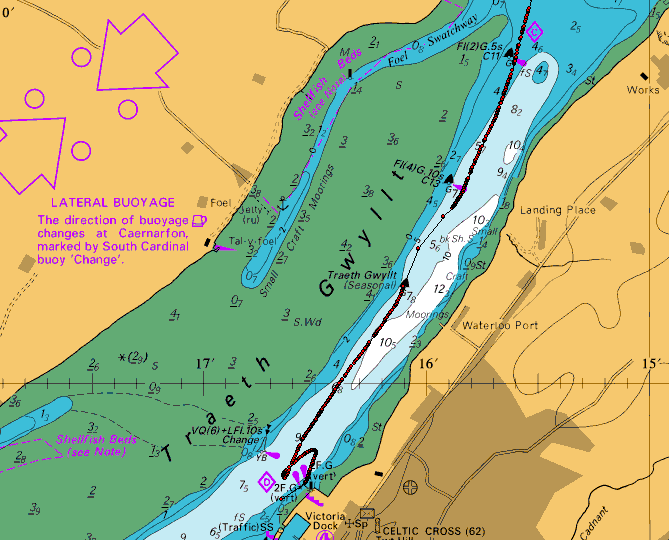
This can be seen in this screen shot taken using a commercial (not marine) Bluetoth-GPS dongle: near Traeth Gwylit stbd buoy we were going very slowly against the tide and the orange dots (which are the track) have 'gaps' due to pinning, whereas once we are moving at a decent pace there are no gaps between fixes. Actually they are not gaps between fixes - these are produced uninterruptedly once per second - but they represent episodes when the GPS set is sending positions wrong by upto the distance between points. In contrast my Raymarine GPS shows no such gaps and still works at all speeds.

menai.PNG


Interest warning: I am in this industry and have a number GPS signal processing patents to my name and so have a bag full of prejudices about how it should be done. I am expressing my personal opinions, not those of any company, and have disclosed nothing which is not already in the public domain from tear-downs and/or conference papers given at ION.
 
Not so, and if you read about how the system works, you will discover that to be the case. Just for starters, a bit of text pinched from Wikipedia:

A GPS receiver calculates its position by precisely timing the signals sent by GPS satellites high above the Earth. Each satellite continually transmits messages that include

* the time the message was transmitted
* precise orbital information (the ephemeris)
* the general system health and rough orbits of all GPS satellites (the almanac).

The coordinate system for the ephemeris is not WGS84. To quote the authority, the National Geodetic Survey:

The National Geodetic Survey (NGS) computes orbits for the Global Positioning System (GPS) satellites in the Global Navigation Satellite System (GNSS) using 24 hour data segments observed at a global network of GNSS receivers and antennas. The global tracking network is coordinated by the International GNSS Service (IGS). The current reference frame used in the computation is the IGS05 reference frame, a GPS-only realization of the latest International Terrestrial Reference Frame (ITRF2005).

Yes, thank you, I'm quite aware of how satnav works, and I don't need to look at wikipedia for the basics. All the calculations you describe need a datum

It's still WGS-84 that is the datum used by GPS. ITFR is a related realisation, and they have converged to an extent that worldwide, there are probably only 10cm difference max.

And as I've said previously, all this is technical detail not required, as the basic answer is that just about every commercially available satnav will use WGS-84 as the 'native' datum that it outputs lat/long on your receiver, and only outputs lat/long to other datums by mathematical conversion.
 
On a similar theme what do people think of this approach?

I’ve got a Garmin etrex. An entry level hand held aimed at hikers mainly. It supports about a dozen data (datums) and I regularly switch between OS GB for walking and WGS84 for sailing.

I’m off to the Med for the first time in a couple of weeks so I used Google Earth to establish the Lat Long of numerous waypoints and have put them in my GPS just in case it proves to be useful.
Once I get hold of a local chart I'll switch the GPS to that datum (if necessary) and it will do all of the arithmetic
This has previously worked well for walking in France

Is there some obvious flaw in this plan?
I took this approach (with a Lowrance equivalent) without any problems regarding 'dry land' but, of course, it's limited in terms of depth issues. I'm always concerned about making mistakes on data entry though (however many times I check it)

Easy enough for you to do your own 'test' based on GE figures for your local cruising area and your charts (electronic or paper)

Quite a turnaround really - internet based imagery providing lat and long to load onto a hand held device; with the realistic expectation that it's more accurate than many paper charts!

Whilst I happily navigate within meters of large rocks in the CIs (using electronic charting etc) I wouldn't do it in many of the areas discussed earlier in the threads for the reasons given - and this includes the GE approach even though I would have more confidence in it than some charts.
 
On a similar theme what do people think of this approach?

I’ve got a Garmin etrex. An entry level hand held aimed at hikers mainly. It supports about a dozen data (datums) and I regularly switch between OS GB for walking and WGS84 for sailing.

I’m off to the Med for the first time in a couple of weeks so I used Google Earth to establish the Lat Long of numerous waypoints and have put them in my GPS just in case it proves to be useful.
Once I get hold of a local chart I'll switch the GPS to that datum (if necessary) and it will do all of the arithmetic
This has previously worked well for walking in France

Is there some obvious flaw in this plan?

YES see my posts!

The long and lat on your GPS COULD be very different from the long and lat on your chart and the actual long and lat of the place on the earths surface. The handed down wisdom out here is dont use GPS as your primary nav. The only things you must have are a chart that dipicts the bit of sea you are in, a compass and some daylight. In other words you must believe your eyes first, then try to make sense of the chart and at no time believe the gps UNTIL it has proved to be accurate; but even then you cannot assume that because its accurate (in terms of charts and position) in one location its accurate in all locations.

Enjoy your stay in the Med - take care and make it a long one.
 
Henrick acknowledged in his original first post, that charts might not be accurate. He wanted to know if a Tomtom would output accurate lat/long to put onto the chart, so he acknowledged that problem. As far as I can see, he simply wanted to know if the Tomtom would give accurate lat long, which means being on the correct datum for the chart, which is about as much as you can expect, if you recognise the issues involved. It's all become rather technical and obtuse since then, though I'm willing to become as obtuse as required, though I rather like the input from jdc which is stuff you are seldom likely to see other than in hotbeds of information like ybw!
 
Henrick acknowledged in his original first post, that charts might not be accurate. He wanted to know if a Tomtom would output accurate lat/long to put onto the chart, so he acknowledged that problem. As far as I can see, he simply wanted to know if the Tomtom would give accurate lat long, which means being on the correct datum for the chart, which is about as much as you can expect, if you recognise the issues involved. It's all become rather technical and obtuse since then, though I'm willing to become as obtuse as required, though I rather like the input from jdc which is stuff you are seldom likely to see other than in hotbeds of information like ybw!

Yes I agree the technical stuff on chipsets was very interesting, but for me what’s interesting is that you can have a GPS and chart both "set" to the same datum and yet the positions don’t accord with reality, its scary and disconcerting especially at night. So inevitably the discussion gets complex because on one hand yes the position information from the Tom Tom is "good enough" in terms of its Lat and Long but on the other its not good enough if transcribed - manually to a paper chart or electronically to digital chart.

But again its a question of use, if your plotter pencil point represents a radius of 1 NM then there is no issue, its only when we try and go to the edge of the envelope on resolution that the issues manifest themselves in “huge errors” or should we say discrepancies, up to 1.5 NM in some parts of the world.

The OP has highlighted the conundrum and the very real problems with sat nav that you are warned of on every welcome screen, the problem is many people never stray far from well charted and "resolved" areas so they tend to believe the GPS implicitly.

I m not sure the discussion has become obtuse, but has suggested that to be safe the OP has to take great care when transcribing between systems and the errors inherent in each can and do multiply and renders them useless in terms of “accurate navigation”.

The guy who taught me to navigate would take positions from sun shots (usually 4) and plot them on the chart. They would form a box (cocked hat) somewhere on the sea he would then spread the fingers of his hand and place it over the plots and declare that we were probably somewhere in there. The nav officer was instructed to decide what was the most dangerous place within that palm print, assume we were there and set a course accordingly. He died a very very old man.
 
3. There is a significant problem however: the ones for road use all have 'pinning' enabled. This is not at all good for use on yachts and will give significant errors, perhaps upto 100m, when sailing very slowly (2kts or less). Pinning is a software function of the Kalman filter which converts the pseudo-ranges (ie timings) to position whereby if speed is below some threshold, speed equal to zero is a strong constraint applied by the filter. This is to stop the position wandering when the car is stopped at the lights, which would be undesirable, but it means that the lat and long will freeze for some distance when creeping into port or an anchorage.
Presumably there's no easy way to access an automobile-type GPS receiver's software to change the pinning parameters or to disable pinning?

It's an interesting effect: I tried walking slowly down the garden holding a car GPS, a 'proper' handheld and a PDA with a GPS plugin. Sho' 'nuff, just as jdc says, the car one didn't change continuously unless I walked quite quickly whereas the 'proper' one and the PDA always kept track of where I was.

My neighbour seemed to think it a little odd that I needed three GPS's to find my way around my own garden, though.
 
My TomTom has an option to calculate walking routes. I wonder if this would have a lower or no threshold of pinning?

Marsupial, the lat and long that a working GPS produces is correct to within the accuracy of the calculation and the datum. If it differs from the chart, it is usually down to the chart having been surveyed using an older and less accurate system. I can't see how you can say that the lat long from the GPS doesn't accord with reality. Perhaps you could explain?
 
Interest warning: I am in this industry and have a number GPS signal processing patents to my name and so have a bag full of prejudices about how it should be done. I am expressing my personal opinions, not those of any company, and have disclosed nothing which is not already in the public domain from tear-downs and/or conference papers given at ION.

Can you decode the Precise code? :D
 
I think you are wrong Brendan but its a bit of pedantry on my part. The satellite signal is basically a time signal. The GSP converts this into a position on the geoid and its the gps that does that calc in terms of WGS84 or another datum . In other words the lat and long numbers he gets out of his GPS will vary according to what datum there is in the program in the TomTom..

If we are being pedantic, I think the order of your function chart is mistaken. AFAIK, the GPS signal recieved is three or more time signals, one from each locked satellite, that is used to calculate a position in three-dimensional spherical space using trigonometry (much as the old sextant operators used to do before the compilations of star navigation tables!), which is then converted to position on the (and above) earth, and then mapped to map dataum.

The reason I believe that is the case is the large numbers of GPS units that can give altitude readings if they have four satellites locked, which would seem to be impossible unless they were doing the full set of spherical trig calculations, as the map datum is only a two-dimensional projection onto a sphere.

The other reason I believe that to be correct is the availability of units such as the Garmin 172 and other "mapless" GPS units, which have no map datum whatsoever. I have a 13 year old black and white GPS that only has land maps for the US market, that still provides accurate lat/long data on my boat here in the UK, checked against the chartplotter onboard.

So, carrying that forward, nearly EVERY GPS unit will be able to provide an lat/long, as long as they can have enough of an antenna to get the signals from three satellites. FWIW, I believe that the antennas on auto GPS units are smaller and less effective than the antennas on marine GPS units, as they are planned to be under a single pane of glass and are designed to be very thin and portable. So the OP's TomTom will probably only get good signals and reliable data from up on deck...I'd be sure to bring a plastic bag for it as it is not water resistant in the slightest!
 
Even a non mapping GPS uses a datum. The datum is not the *map* datum it is the *coordinate* datum. Maps are also aligned to a coordinate datum.

The WGS84 is the typical coordinate datum used on output by the GPS, but the GPS engine uses spherical trig internally to calculate the XYZ locations (2 of them but one is out in space and is discarded).

Here you go: http://www.ngs.noaa.gov/faq.shtml#WhatDatum

And further down that page http://www.ngs.noaa.gov/faq.shtml#WGS84 "WGS 84 is used by DoD for all its mapping, charting, surveying, and navigation needs, including its GPS "broadcast" and "precise" orbits."

So there you have it, GPS uses WGS84 - from the horses mouth.
 
Last edited:
Antennas

...
I have a 13 year old black and white GPS that only has land maps for the US market, that still provides accurate lat/long data on my boat here in the UK, checked against the chartplotter onboard.

So, carrying that forward, nearly EVERY GPS unit will be able to provide an lat/long, as long as they can have enough of an antenna to get the signals from three satellites. FWIW, I believe that the antennas on auto GPS units are smaller and less effective than the antennas on marine GPS units, as they are planned to be under a single pane of glass and are designed to be very thin and portable. So the OP's TomTom will probably only get good signals and reliable data from up on deck...I'd be sure to bring a plastic bag for it as it is not water resistant in the slightest!

I pretty much agree: all reasonable GPS sets should give accurate results of lat and long vs WGS84, but whether the charts are that accurate or accurately aligned to WGS84 is more subject to doubt.

However GPS receiver technolgy has moved on a long way in the last 10 years because:

(i) selective availability - the deliberate degradation of accuracy by the USAF - has been turned off. But older sets may, since their designers were not expecting to be able to produce a fix more accurate than 100m accuracy, not have worried or tested their arithmetic routines to a sub 100m precision; bit widths, truncation and sine or tangent look-up tables could all be to too low a precision.

(ii) In the last 10 years so called 'Moore's Law' has meant that 100x as many gates and 100x as much memory are available in the chip sets for the same cost as before. This has led to much better times to fix and better precision since the cost of more precision (more decimal points) in intermediate calculations has become negligable.

Pedantic point: you say three SVs are required. Actually it's 4 because you also have to solve for time as a fouth variable since the clock in the receiver has unknown offset and drift rate. But as we nearly always get 6 or more usable SVs at the moment at 60 degrees lat, and more nearer the equator (may reduce over the next few years but that's another discussion) it's not a problem.

Antennas are not actually that bad in TomToms since they have to cope with tinted and metalised glass, and never get that good a view of the sky anyway when in cities, so sensitivity is really important to these guys. Nor are there lots of other radio transmitters crammed into the same small box. So it probably will work in the cabin.

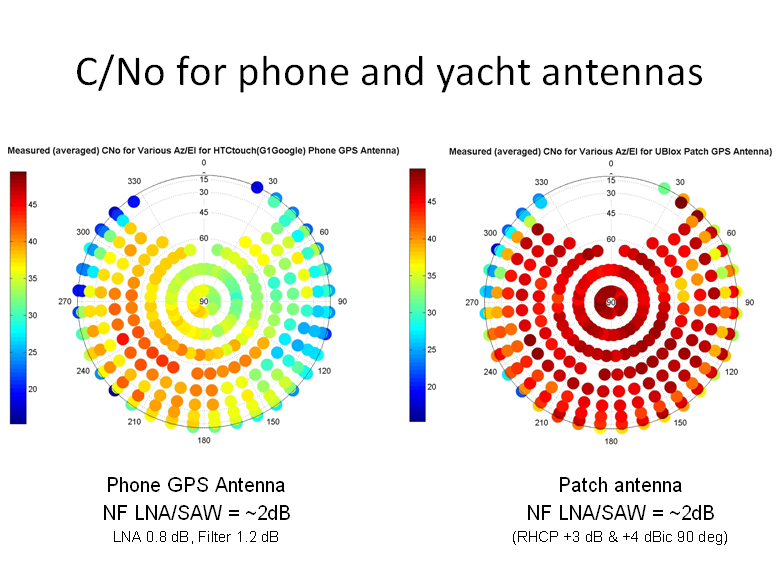
Mobile phones on the other hand have simply dreadful GPS antennas! We should have some sympathy however since they are so small and contain loads of radios. All antenna designers I know complain that the case designers and stylers pay no attention to antennas yet the poor RF guy has to manage somehow. The GPS antenna may very well be shared with Bluetooth, WiFi or even GSM. Here is a plot of the GPS signal recieved on a modern phone antenna and on a state-of-the-art commercial GPS receiver, both in open sky conditions, taken at around 50 degrees N. To get reasonable fixes once acquired you need C/No (after correlation with the C/A spreading code) substantially greater than +15dB in a 1 HZ bandwidth ('dBHz'), and to acquire you must decode the ephemeris, for which you need more than +23.5 dBHz.

When going from on deck to below-decks, the attenuation is probably around 15dB. Less near a hatch, so that's where I put my back-up GPS's antenna.

GPS_Antennas.PNG
 
Last edited:
I think you are wrong Brendan but its a bit of pedantry on my part. The satellite signal is basically a time signal. The GSP converts this into a position on the geoid and its the gps that does that calc in terms of WGS84 or another datum . In other words the lat and long numbers he gets out of his GPS will vary according to what datum there is in the program in the TomTom..

No; it also depends on the satellite ephemeris which is downloaded from the satellites; this is in coordinates that relate to WGS84. So, the precise time signals that you correctly mention are used in conjunction with satellite positions that relate to WGS84; the native location given by ANY GPS is therefore WGS84. Any other datum is arrived at by a further processing step that transforms the WGS84 coordinates to another datum.

By the way MOST GPS systems can be reset to use alternate datums, but it is usually hidden away in the more obscure menus. Really clever ones even allow you to create your own datum - but even I would regard that as extreme and something for case-hardened geodesists to use (apart from anything else, you need up to 11 long numbers to be computed and input!). However, it is becoming a much less usual thing to have to reset the datum of a GPS as increasingly maps and charts are related to WGS84. However, in less well charted areas, you should not rely on this! 19th century surveys may well be excellent in terms of relative accuracy, but can be expected to have absolute errors in the region of hundreds of metres.
 
Even a non mapping GPS uses a datum. The datum is not the *map* datum it is the *coordinate* datum. Maps are also aligned to a coordinate datum.

The WGS84 is the typical coordinate datum used on output by the GPS, but the GPS engine uses spherical trig internally to calculate the XYZ locations (2 of them but one is out in space and is discarded).

Here you go: http://www.ngs.noaa.gov/faq.shtml#WhatDatum

And further down that page http://www.ngs.noaa.gov/faq.shtml#WGS84 "WGS 84 is used by DoD for all its mapping, charting, surveying, and navigation needs, including its GPS "broadcast" and "precise" orbits."

So there you have it, GPS uses WGS84 - from the horses mouth.

WOW - thanks for that link...a great bit of geeky reading! The only thing I might add is that I would believe the spherical trig calcs are in radius and radians, not X,Y,Z co-ordinates. The "datum" then should be the conversion of the pure radius, inclination, and azimuth spherical co-ordinates to X,Y,Z taking into account the non-spherical imperfections of the Earth's ellipsoid. From the X,Y,Z you have lat/long...or you could get it from the datum directly if it is compiled as such (given the wording on the page you reference I would believe that X,Y,Z are used).

THEN those points can be overlayed onto geographic chart data if what you want is a chartplotter...

Does this sound right? Or have I overly complicated it?
 
It could well be radians - I expect jdc can comment knowledgably on it. From my reading of the info, it looks like the co-ordinate system is relative to the centre of the earth.

You would appear to be spot on: the XYZ coordinates are from the centre of the earth, according to the Geodetic Online Toolkit...who's web site you may want to bookmark should you ever need to be able to convert XYZ into sphericals or lat/long: http://www.ngs.noaa.gov/TOOLS/XYZ/xyz.html

There is also a free PC Windows programme there to do the same functions, and also a host of downloadable software on neighboring pages.

My inner geek is satisfied for the day, I've learned something new. Thanks!
 
"Once I get hold of a local chart I'll switch the GPS to that datum (if necessary) and it will do all of the arithmetic
This has previously worked well for walking in France

Is there some obvious flaw in this plan?"

Just realised the implications of this last part - I didn't do this bit! I used the google earth data over the charted data together with my GPS position (which is what I thought you said you were doing)
 
Top