Is a TomTom accurate on a marine chart?

Even a non mapping GPS uses a datum. The datum is not the *map* datum it is the *coordinate* datum. Maps are also aligned to a coordinate datum.

The WGS84 is the typical coordinate datum used on output by the GPS, but the GPS engine uses spherical trig internally to calculate the XYZ locations (2 of them but one is out in space and is discarded).

Here you go: http://www.ngs.noaa.gov/faq.shtml#WhatDatum

And further down that page http://www.ngs.noaa.gov/faq.shtml#WGS84 "WGS 84 is used by DoD for all its mapping, charting, surveying, and navigation needs, including its GPS "broadcast" and "precise" orbits."

So there you have it, GPS uses WGS84 - from the horses mouth.

Which is what I said all along. Heyho.
 
No; it also depends on the satellite ephemeris which is downloaded from the satellites; this is in coordinates that relate to WGS84. So, the precise time signals that you correctly mention are used in conjunction with satellite positions that relate to WGS84; the native location given by ANY GPS is therefore WGS84. Any other datum is arrived at by a further processing step that transforms the WGS84 coordinates to another datum.

By the way MOST GPS systems can be reset to use alternate datums, but it is usually hidden away in the more obscure menus. Really clever ones even allow you to create your own datum - but even I would regard that as extreme and something for case-hardened geodesists to use (apart from anything else, you need up to 11 long numbers to be computed and input!). However, it is becoming a much less usual thing to have to reset the datum of a GPS as increasingly maps and charts are related to WGS84. However, in less well charted areas, you should not rely on this! 19th century surveys may well be excellent in terms of relative accuracy, but can be expected to have absolute errors in the region of hundreds of metres.

They'll still argue with you, no matter how many logical statements you make! :)
 
May I pose a question to our GPS experts?

When you look at the display on a plotter and you are in a known position, perhaps in a Harbour, you can see the positional error e.g. It shows you in the wrong berth.

I have always assumed this error was either a datum problem, or the inherent inaccuracy of the system.

If I am correct, wouldn't some sort of calibration feature fix both problems? If you could click on the map and say "I am exactly here" would that correct both datum and system error?

Or is that too simple a solution? I suspect it may be or someone would have done it already.
 
I have been using a Tom Tom for driving in the Ionian this summer. I can confirm that it is very accurate . All the small lanes in the centre of Lefkas Island are present (it needs to show the width of some of them !)
It even accurately positions the fishermans quay at Vliho so I am sure that, providing the chart datum is correct you will have no problems.
 
registering GPS to charts

May I pose a question to our GPS experts?

When you look at the display on a plotter and you are in a known position, perhaps in a Harbour, you can see the positional error e.g. It shows you in the wrong berth.

I have always assumed this error was either a datum problem, or the inherent inaccuracy of the system.

If I am correct, wouldn't some sort of calibration feature fix both problems? If you could click on the map and say "I am exactly here" would that correct both datum and system error?

Or is that too simple a solution? I suspect it may be or someone would have done it already.

The not very helpful answer is that it depends on the type of error:

Time invariant ones can be calibrated out, time varying ones not.

Of the time invariant errors, the number of points needed for the calibration depends on the order of the errors (by order, I am using a mathematical definition, whereby the order is the number of terms in the polynomial expansion of the (2D) error function - ie ax^2 +bx +c is order 2 and has 3 terms needing calibration: a,b and c).

Some exapmples of errors:

1. Charting errors

A simple translation is order zero and just needs a constant offset, so a 1 point cal as you describe is enough.

Scale arrors are first order, so two points are enough. Rotations without scale errors are another form of first order error (being first order in polar coordinates) and would need 2 points, but I've never heard of significant rotation errors on marine charts using Mercator projection.

More complicated errors would need more and more points, effectively you'd be re-surveying!

However you've reached the end of my knowledge of chart errors - I have no idea of the relative magnitudes of these types of error. My _guess_ is that 90% of the error will be simple zeroth order, ie translational errors which can be fixed by a 1 point cal as you suggest.

I assume that charting errors are time invariant (continental drift ??).

2. GPS errors

These are not normally static, but the time over which the error moves around can be minutes, hours or days depending on the error source.

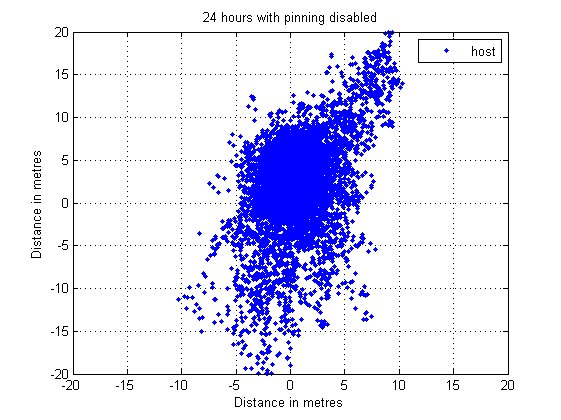
Random errorrs due to propagation and changing geometry, a typical plot of which is shown below, account for +/- 20m or so over 24 hours. This is easily enough to put you in the adjacent berth.

The predominant error source is unmodelled variation in tropospheric propagation, although poor HDOP can exacerbate the errors. The geometry of the fix (ie where the SVs are relative to you and each other) repeats every 8 days (from memory - could look it up), but I don't think amounts to greatly more than the 24 hour error plotted below WHILE WE STILL HAVE 31 OPERATIONAL SATELLITES. Ie the HDOP will never be that bad provided there are bothe lots of SVs to get a fix from and you have a good view of the sky - rather obvious.

Clearly these types of time varying errors can not be calibrated out unless there is a static GPS receiver, and a means of getting its measurements back to your set (a differential method). A simple differential method reduces random errors over 24 hours from around +/- 20m to more like +/- 2m. The distance over which a static receiver is useful for navigational purposes is some hundreds of km - surveying is another world not relevant here.

An example of exactly what I have described - one or more reference receivers spread a few 100 km apart and a means of sending the errors back to your set - is EGNOS, so enable it if your set supports it.

Thus your calibration idea might be useful for old charts not mapped using GPS at all, or on a modern chart it could help get a sort of super accuracy for maybe a few minutes or 10s of minutes.

The circumstances in which this last would be genuinely useful are difficult to imagine - perhaps a really tortuous passage through rocks: get to the first rock, press 'cal now' and then for the next few mins the reduction in error could get you through the difficult bit? Not sure I'd trust it 'tho.

noPinning_enu_pos_2.jpg
 
May I pose a question to our GPS experts?

When you look at the display on a plotter and you are in a known position, perhaps in a Harbour, you can see the positional error e.g. It shows you in the wrong berth.

I have always assumed this error was either a datum problem, or the inherent inaccuracy of the system.

If I am correct, wouldn't some sort of calibration feature fix both problems? If you could click on the map and say "I am exactly here" would that correct both datum and system error?

Or is that too simple a solution? I suspect it may be or someone would have done it already.

If you were never going to move your yacht, it would be a solution! But a harbour plan may well be on a datum that applies only within the harbour; it may really only be a sketch to give you a general idea of the layout, rather than a precise depiction. Also, GPS is good, but not THAT good - 10m is still the expected error, and it will be MORE than that 35% of the time. The error is more or less random. It may be less if you have a differential correction system (EGNOS or some such), but most don't.
 
1. Charting errors

A simple translation is order zero and just needs a constant offset, so a 1 point cal as you describe is enough.

Scale arrors are first order, so two points are enough. Rotations without scale errors are another form of first order error (being first order in polar coordinates) and would need 2 points, but I've never heard of significant rotation errors on marine charts using Mercator projection.

More complicated errors would need more and more points, effectively you'd be re-surveying!

However you've reached the end of my knowledge of chart errors - I have no idea of the relative magnitudes of these types of error. My _guess_ is that 90% of the error will be simple zeroth order, ie translational errors which can be fixed by a 1 point cal as you suggest.

I assume that charting errors are time invariant (continental drift ??).

This is an excellent summary; you are too modest! Perhaps I can give a little more background to charting errors.

The problem arises in that while it is pretty straightforward to measure the position of objects with respect to other known points quite accurately , determining the initial "fixed" points is much harder. The former is very mature technology - the Elizabethans knew how to do it, and barring some improvements in the accuracy and convenience of the equipment, it could be done to modern standards of accuracy by the 18th century - witness the very accurate charts and plans created by Cook, especially in his formal surveying of the St Lawrence and Newfoundland.

However, the problem of determining the start points - the "control" points - in a survey is much more difficult, and prior to GPS depended on elaborate astronomical observations. And at best, astronomical techniques (without the benefit of a substantial fixed observatory) are only good to a few hundred metres. EACH such control point has this kind of error - these errors get distributed around a triangulation network using mathematical tools. And before the advent of digital computers, the techniques for computing a large trigonometric network and minimizing the errors were time-consuming and error-prone, taking years for a country the size of the UK - a really well surveyed country by (say) eastern Mediterranean standards. It should be noted that computation of such networks must take into account the shape of the earth; it is spherical trigonometry, not plane trigonometry.

Of course, between surveyed points ("trig points") the depiction of the terrain depends on other techniques - these days, aerial or satellite imagery; but basically field sketches or plane-table observations before such methods were available.

So, in any map of chart, we have two levels of error:

1) errors arising from the survey network of the map or chart.
2) errors arising from creation of detail between survey points.

Of course, other errors arise from failures of interpretation; someone unfamiliar with the terrain may actually be mistaken in their interpretation of the terrain. Even Cook was not immune; he thought Banks peninsula on South Island, New Zealand was an island and Stewart Island was a peninsula.

So, If you are dealing with a map or chart whose surveying pre-dates about 1980, it is highly likely to have errors in the region of hundreds of metres, except in very well surveyed areas such as the UK and Western Europe. The crucial thing is to check the date of the SURVEY - not the chart publication. And always assume that charts are quite likely to be accurate in the relative positions of things, but less likely to be accurate in absolute (i.e. GPS) positions.

Finally, also take account of the SCALE of chart publication. A chart whose original scale - which of course you can over-ride on a chart plotter, zooming in or out as you fancy - is 1:50,000 CANNOT resolve positions more than about 15 metres apart. The rule of thumb is to divide the chart scale by 1000 and then multiply by 0.3 to get resolution in metres.
 
I sail in Turkey are based on 19th century surveys, and can be as much as half a mile out in places. I can correct my position on my chartplotter when in harbour, for example in the small harbour at Bozburan, QUOTE]

Bozburan Harbour....
Have you had the set meal at Osmans, where he and his Scottish wife Lynne do 3 courses for 19L and they give you the choice of anything on the menu for each course?
Must be the best value along the Turkish coast! :)
 
Hi, I maybe teaching you to suck eggs but the 7xx series tomtom has a configuration page which displays the lat/long in larger digits while showing your heading/speed and sat positions. Ok the tomtom is not waterproof and will not display charts - but for lat/long either metric or deg/min/secs it will be just fine and accurate enough for a safe back-up. Definately more accurate than a sextant!
 
3. There is a significant problem however: the ones for road use all have 'pinning' enabled. This is not at all good for use on yachts and will give significant errors, perhaps upto 100m, when sailing very slowly (2kts or less). Pinning is a software function of the Kalman filter which converts the pseudo-ranges (ie timings) to position whereby if speed is below some threshold, speed equal to zero is a strong constraint applied by the filter. This is to stop the position wandering when the car is stopped at the lights, which would be undesirable, but it means that the lat and long will freeze for some distance when creeping into port or an anchorage.
Just been looking back through this interesting thread and spotted jdc's post with this significant warning for those using a car satnav for nautical purposes. I'm assuming that the "pinning" he refers to is the same thing as "static navigation" mode (maybe jdc can confirm?). If so, in some cases it's possible to disable this if you can 'hack' into the satnav's operating system to the extent that you can run other software. You then need to send a message (in Sirf binary - not NMEA) to the GPS receiver telling it to switch off static navigation. This'll need to be done immediately before running your satnav chart program. It needs to be done every time you use it as the receiver will reset to "static navigation" mode when switched off/on.

This'll only work on satnav's using Sirfstar GPS receivers AFAIK.
 
I know, I was commenting on the obtuseness of some others around here! :)


Are you surprised :D:D:D You have been here long enough.


I once sailed with a second mate who took real pride in his standard of
navigation. One of his hobbies was to accurately position Islands and other places be passed as we tramped around the globe earning a crust.

These were the old days prior to GPS and Sputnik 1 was a gleam in some russian's eye.

He explained that back in the dark ages when the surveying was done on which modern charts were based the accuracy was sometimes affected by the technology available. He frequently found that there were substantial errors between the actual position of places and the charted positions.

Remember the yacht that hit an Island last year off Aussie???

He would send copious reports to the hydrographic office with notes and chartlets regarding his observations. Well he had nothing else to do once all the books on board were read and we had seen Major Dundee for the hundredth time. Even the radar had a rotary converter to give it the AC it required.

I suspect many of these chart errors still exist especially in waters were there has been no real surveying since Captain Cook. These errors have in some cases no doubt carried through to the charts in our plotters.

The Tom Tom in the Ionian will be fine so long as the charts have been converted to WGS 84 otherwise things wont be where they appear to be. However it won t be Tom Toms fault. The OP will soon deduce the error and be able to make adjustments. Maybe the source of the charts is important? Will Hydrographic Charts from the UK be more likely to be updated to WGS 84????
 
Last edited:
Top