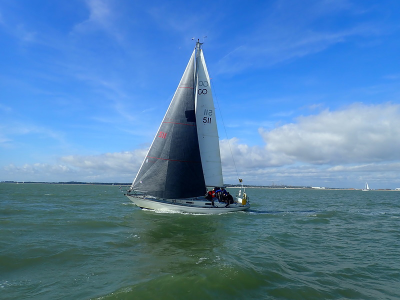
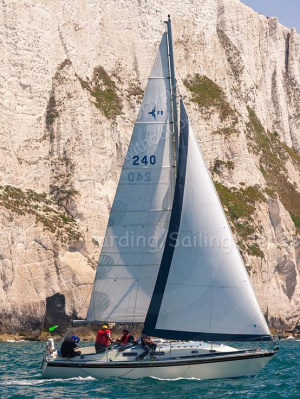
Is a Contessa 32 basically a man cave for Boomers longing for the halcyon days of the 70s?

I’ve always thought the closest motoring analogy to the Contessa 32 has to be the Morgan 4/4 (one of which I bought new in 2011 and kept for 5 years).

Slow, cold, leaky but also charming and beautiful to behold. They are loved by their owners for their shortcomings almost as much as for their qualities.

...and I'd rather be sitting in my modern car looking at Morgan than in a Morgan looking at a modern car. Same can be said for a C32.
 
There is no context as to what these single set of results relate to - but I don’t think anybody would realistically claim that if sailed to the same standard of crew and sails a CO32 would finish nearly an hour ahead of a similarly competitive Grand Soleil 37. Or most of the other boats there. So some context needed.

For another example the first race results I looked up at random (for WHW) by coincidence it had a Fulmar finishing well ahead of two CO32 on elapsed time. Again just one race so may be lots of valid reasons. But no black sails or big budget campaigns there (except perhaps at the bar).
Reading the spreadsheet it appeared to be the round the island race in 2017, a pretty good test and open to all
 
Reading the spreadsheet it appeared to be the round the island race in 2017, a pretty good test and open to all
… but equally the Round the (English) Island Race has a HUGE variety of competitiveness amongst the boats - from professionals and Olympic medalists, with cost no object 3DL sails - to families and groups of friends having a jaunt and not wanting to spill the beers
 
Other great thing about my Morgan. It took me less than a week to sell it for pretty much what I paid for it new. I could no doubt have actually made money on it if I’d been prepared to put more time and effort in,

I loved it. I bought it because I wanted a vintage driving experience without the hassle. That’s exactly what I got.
 
In the 2025 race, there was a Fulmar in place 230 .....

1756319138153.png

.. and the first CO32 came in 3 mins and 21 seconds later ... in 264 th place

1756319230064.png

I don't think that is enough of a difference to secure a table at the pub, but it was close.

The Co32 had a crew of 6 and looked like this ...

1756319480641.png

The Fulmar was also crewed by competent racers and looked like this ...

1756319661446.png

Now to throw a cat among the pigeons, a Dehler 33 managed 7 hours and 23 minutes which is enough for a quick shower and change of clothes before heading to the pub ....

1756319980730.png

1756320122217.png

... and a Frist 40 knocked another half hour off that time - they would be showered, shaved and well into their second pint.

1756320279365.png

1756320584613.png

I'll get my popcorn.
 
Reading the spreadsheet it appeared to be the round the island race in 2017, a pretty good test and open to all
It’s a terrible example. There’s a massive local fleet of CO32 in the Solent all sailed by some of the most enthusiastic racing crews around with local knowledge.
Many of the boats in the RTIR are in it for the post race beers so from a purely statistical perspective that’s the worst dataset imaginable to quote.
A boat with a 24’ LWL is unlikely to be competitive in a fair race with even a modern 32’ with a 32’ waterline, let alone a 40 footer that can also sail downwind effectively. That’s not bias, it’s the reason handicap exists.
 
… but equally the Round the (English) Island Race has a HUGE variety of competitiveness amongst the boats - from professionals and Olympic medalists, with cost no object 3DL sails - to families and groups of friends having a jaunt and not wanting to spill the beers
I use that one if I lose at burnham week.
 
It’s a terrible example. There’s a massive local fleet of CO32 in the Solent all sailed by some of the most enthusiastic racing crews around with local knowledge.
Many of the boats in the RTIR are in it for the post race beers so from a purely statistical perspective that’s the worst dataset imaginable to quote.
A boat with a 24’ LWL is unlikely to be competitive in a fair race with even a modern 32’ with a 32’ waterline, let alone a 40 footer that can also sail downwind effectively. That’s not bias, it’s the reason handicap exists.

I thought this would be easy to settle, but no.

NHC says C32 is faster than a Bav 32.
PHRF says Bav 32 is faster than C32.

I can't find any other handicaps. 🤷‍♂️

Personally, I can't imagine that the Bav could be slower except upwind in a decent breeze becaise the C32 finds some extra LWL heeled over and the Bav 32 has massive freeboard/windage.

Having said that, I'm sure the Bav perhaps doesn't have a symetrical kite as standard? So with a dead down wind leg and a breezy upwind leg maybe the C32 has a significant advantage.
 
It’s a terrible example. There’s a massive local fleet of CO32 in the Solent all sailed by some of the most enthusiastic racing crews around with local knowledge.
Many of the boats in the RTIR are in it for the post race beers so from a purely statistical perspective that’s the worst dataset imaginable to quote.
A boat with a 24’ LWL is unlikely to be competitive in a fair race with even a modern 32’ with a 32’ waterline, let alone a 40 footer that can also sail downwind effectively. That’s not bias, it’s the reason handicap exists.

Feel free to post better, it's all in the public domain.

If facts are not to your taste, we can hear from an experienced skipper:


.
 
In the Sydney Hobart disaster, 6 people lost thier lives ...

The Winston Churchill, a 25 ton wooden veteran that had been competing in the race for decades was tossed off the top of a wave into a trough ... the hull was breeched and she was sinking, the 9 crew took to liferafts. 3 were lost from the liferafts.

The Sword of Orion, a 43 ft boat was rolled through 360 degrees by an 80ft wave ... the boom punched the helmsman over the side, breaking his harness as it swept the cockpit.

Business Post Naiad (40ft) was rolled twice by the waves, first time it lost the rig and ripped a hole in the cabin roof and took on considerable amounts of water. Second roll it remained inverted for 4-5 minutes during which time one crew member drowned, the skipper was lost later to a heart attack. It turned out that 300kg of ballast had been removed prior to the race which was seen as a contributing factor.

1998 Sydney Hobart: 115 entries, 5 yachts sank, 66 retired, and 44 finished (38% finish rate)
1979 Fastnet: 303 entries, 23 yachts sunk or abandoned, 193 retired and 87 finished (28% finish rate)

Statistically thats an improvement over a 20 year period, yachts have got bigger, faster and I would argue safer.

Comparing the two weather events is also interesting.

The 1979 Fastnet had winds of 60-65 knots compared to the Sydney Hobart where there were sustained winds exceeding 65 knots with gusts up to 80 knots .... the wave height on the Fastnet was reportedly 50ft while the Sydney Hobart had 33 to 50ft with many reports of rogue waves over 66ft, one of 120ft was recorded by a rescue helicopter.

These weather conditions make survival a lottery IMO and with those wave heights, the smaller the boat, the more likely you will be rolled - and when it gets to that stage your survival is in the lap of the gods. A breaking wave greater than 50% of the boat length presents a significant risk of capsize .... that's 15ft for a 30ft boat and 20ft for a 40ft boat .... the odds are in favour of the bigger boat.

What often gets ignored is the hydrodynamics of the keel righting the boat, short keel length with a bulb travels sideways through the water with less resistance than a long keel .. so even though the gravitational force from a heavy long keel may be higher, it needs to displace more water to travel sideways and right the boat - a long keel is also more likely to "trip the boat up" when caught beam on at the top of a breaking wave, rather than slide sideways down the wavefront.

A narrow beam, wineglass hull also has less form stability, which is another reason why more ballast was needed - to stop them sailing on their ears in normal use.

The ballast needed to make an older, narrow beam hull shape sail upright is far more than that needed to make a more modern hull with more form stability sail upright - and as long as the boat rights itself "fast enough" after a knock down, then ballast is just mass which slows you down in light, variable winds.

Ballast does give a small boat more inertia which damps its movement, but it also results in a "wet boat" to sail, as that inertia carries it through waves instead of over them.

Here's how fast an AWB pops back up .... perfectly adequate IMO, and indicative of what to expect in really bad weather as the boat would be on a storm jib or bare poles.

Wow, the engine kept running!
 
I thought this would be easy to settle, but no.

NHC says C32 is faster than a Bav 32.
PHRF says Bav 32 is faster than C32.

I can't find any other handicaps. 🤷‍♂️

Personally, I can't imagine that the Bav could be slower except upwind in a decent breeze becaise the C32 finds some extra LWL heeled over and the Bav 32 has massive freeboard/windage.

Having said that, I'm sure the Bav perhaps doesn't have a symetrical kite as standard? So with a dead down wind leg and a breezy upwind leg maybe the C32 has a significant advantage.

YTC (IRC lite) listings here RYA YTC Listings - Royal Ocean Racing Club | Rating Office
 

Only one Bav 32 but (without a kite) it's faster (991) than the C32s without a kite and faster than some with.

Probably as conclusive as we're going to get.

Weirdly, Sadler 32s appear slower than C32s which feels wrong to me. They seem a much less compromised design and all the ones I've been on had a kite. Did David Sadler really get worse at designing boats by the end of the 70s despite needing to worry less about ratings? 🤔
 
Last edited:
As mentioned earlier, comparing a cruiser/racer against a dedicated cruiser perhaps isn’t the best comparison.

From that list more modern takes on CRs of around that size typically rate around 900 or less compared with 970 (give or take) for a CO32

I deliberately chose the Bav becaise it's the most cruisery of cruisers. The equivalent of the Focus/Cooper comparison earlier.

Ie you can have massive internal accommodation, a roomy shower, a sugarscoop stern to play off and still be faster than the C32. (If we trust those numbers.)
 
Top