Integral Battery Electric Outboards… with MORE POWER!

nestawayboats

Well-Known Member
Joined
2 Apr 2010
Messages
157
Location
Christchurch, Dorset
www.nestawayboats.com
For over a decade now Torqeedo (since 2011 in fact) and ePropulsion (since 2015) have been selling electric outboards in the “1kW class” and these are widely - but not universally! - considered to be viable alternatives to small petrol outboards from about 2-4hp. Examples include the Torqeedo 903 and 1103, ePropulsion Spirit PLUS etc. Various rivals such as TEMO and Remigo have come along since, with similar power offerings.

A key factor in the success of these outboards has been their integral but easily-removable lithium batteries, making them easy to pass up and down in component form, with the heaviest bit somewhere around 10kg (ie lighter than any petrol outboard). They are also of course quiet, clean and “pushbutton easy” to use.

Most customers – and that is now several thousand in the UK – are very happy but we do sometimes hear “we love it, and would never go back to petrol, but sometimes we wish it had a bit more power”. Part of this stems from one brand’s decision to say 1kW is “equivalent” to 3hp, which all other companies thereafter seemingly felt obliged to echo. Whilst 1kW motors do have the same or possibly more torque / “shoving power” as a 3hp petrol, they don’t have the same “whizzy top end”… so 1kW motors will push your heavily-loaded dinghy along just as well as – quite possibly better than – a 3hp petrol, but won’t get it on the plane when lightly-loaded (which a 3hp petrol might).

Anyway… developments in battery and motor technology have led to the recent launch of several electric outboards – still with integral batteries – at or around 2kW, including:
- Blade Halo. This has a 3kW motor with 1.7kWh capacity battery. Two year warranty. Announced this Summer, prototypes shown at Southampton, available early 2026. £2275
- ePropulsion Spirit 2. Offers 2kW motor (3kW in boost mode) and 1.54kWh capacity battery. Three year warranty. Launched this week (18 Nov), available UK April 2026, price £2600.
- Momentum U2. 2kW motor (up to 2.5kW when battery allows), 1.4kWh battery. 2 Year Warranty. Announced at Southampton, availability early 2026. £2450
- Torqeedo Travel XP. 1.6kW motor with 1.4kWh battery. Two year warranty. These have been on the market a year or so, price around £3000.

So what? Well 2kW really does translate to about 3hp using conventional engineering rules (OK, 2.7hp for the pedantic), so in terms of power these will achieve similar things to 3hp petrol motors. The models with boost modes (or whatever they choose to call it) should be able to get the right shape, lightly-loaded dinghy up on the plane and then throttle back. And customers who wish to use these motors to power sailing dayboats (think Drascombe, Hawk, Bay Raider etc) will find they have a lot more shove than 1kW motors if they’re trying to make progress directly against wind/tide/chop (one might say “equivalent” to 4-6hp petrols, in that role).

Besides the increases in power/battery capacity, features like colour screens, GPS (for speed/range) and cable-free battery connection are fast becoming the standard. We’re also seeing improved functionality in components like the clamp brackets, with shallow water drive angles for example (yes common on petrol outboards but not so on earlier electrics).

If you’re considering buying a new petrol outboard of 4hp or less for 2026 season, you really should be looking at electric options too…

As always I should make it clear that we sell some of these, but that does also mean we have more experience with them than most people, and most forumites seem to appreciate our posts.

Ian, Nestaway Boats
 
Great post Ian. Very informative and balanced as ever.

PS. As an aside, I fully agree with you on the 1kW (ie 1.4hp) being fine for pootling and therefore most use, but NOT “equivalent to 3hp”. A while back I did a test with my ancient eBay purchase Mariner 2.5hp and solo it got my 2.7m dinghy planing at 7 knots. Don’t do this often, but demonstrates “the maths” in practice.
 
Great post Ian. Very informative and balanced as ever.

PS. As an aside, I fully agree with you on the 1kW (ie 1.4hp) being fine for pootling and therefore most use, but NOT “equivalent to 3hp”. A while back I did a test with my ancient eBay purchase Mariner 2.5hp and solo it got my 2.7m dinghy planing at 7 knots. Don’t do this often, but demonstrates “the maths” in practice.
That is a misunderstanding of what is involved in moving small boats at displacement speeds. It is the thrust the propeller produces that moves the boat NOT the rated horsepower (however measured) of the power unit. Your little petrol outboard may make the boat plane if you can get it to rev high enough to produce the power to turn the little fast turning prop fast enough. That does not necessarily make it good for the dinghy in displacement mode. The electric outboards have large slow turning propellers so even though the motor is rated at lower output the thrust is superior and will power a displacement dinghy with load just as well as a petrol, which will never produce its rated output in this type of use. As Ian says if you want to plane with an electric you need to more than double the power (and energy usage) to get the prop turning fast enough to get the boat to plane.

What the "equivalent to" means is that at displacement speeds the electric will produce the same (or more) thrust as a petrol 3hp engine and push your boat just as well. Learned all this nearly 50 years ago when testing motors for British Seagull. The 40+ which was "3hp equivalent" produced greater thrust on bollard pull than any 2.5 or 3hp petrol despite the powerhead producing less than 1kw. The large slow turning prop was the difference. Not suggesting we go back to Seagulls, but if you look closely the prop sizes and shaft speeds of the 1Kw electrics are almost the same as a 40+
 
Ian, is there replacement plugs and sockets for the old style that have very fine threads that cross quite easily . I want to change mine. Something that just pushes together would be much more user friendly. There fine on a quiet sunny day but in wind and rain ....well
 
As Ian says if you want to plane with an electric you need to more than double the power (and energy usage) to get the prop turning fast enough to get the boat to plane.
Yes... from memory whilst visiting them at METS ePropulsion said the new Spirit 2 will achieve about 2100rpm at 2kW, and 2600rpm in "boost mode" (which can increase power output up to 3kW if the battery's happy etc).

Whereas the 1kW Spirit PLUS maxes out at 1200rpm, and the other 1kW motors are similar.

Note that for direct drive motors - most small electric outboards today (but not older Torqeedos) - the motor speed and the propeller speed are the same, unlike petrol ones.
 
Ian, is there replacement plugs and sockets for the old style that have very fine threads that cross quite easily . I want to change mine. Something that just pushes together would be much more user friendly. There fine on a quiet sunny day but in wind and rain ....well
If you're referring to a Torqeedo - models 503 to 1103 - not really but those connectors appear to be amazingly resilient, despite being plastic and fairly easy to cross thread. There is a slight knack to it but you can feel when they're "not quite right" and unless you force them deliberately and very hard it doesn't seem to do any damage. We still see quite old ones (10 years plus) where the connectors work fine.

As an aside, also announced at METS, Torqeedo are about to replace the 903 - last of their integrated battery models with cables to connect - with the "Travel XS" which is a reduced power and battery capacity version of the Travel XP. The Travel XS will be rated at 700W with a 648Wh capacity battery, a bit lighter but same physical size as the XP.

If you're referring to an ePropulsion Spirit 1.0 (2015 to 2020ish) they had similar plastic connector to the Torqeedo, but a small percentage of those did break and there is or was a way to replace it (talk to ePropulsion UK, it's usually easiest to send it to them). The ePropulsion Spirit PLUS and EVO (from about 2020) had a similar-looking connector but made from PVD-coated stainless steel with a half-turn bayonet type connection, those seem to be very reliable.

The most likely cause of problems with any of these outboards is dirt or corrosion on one of the small pins inside the connector. The best thing you can do to increase their already very good reliability is use contact spray in both sides of the connector, fairly frequently (every two months, say).

On the new ePropulsion Spirit 2 I was particularly pleased to see the all the pins in the slide-on connector are much bigger diameter than previously used. We were involved in an early design meeting and connectors were part of it... I remember the lightbulb moment when one of the engineers said "hang on, just because the communication pins can be small, doesn't mean they have to be small!" Time will tell but that connector looks like a useful improvement.

Ian, Nestaway Boats
 
Ah wow this is amazing news that not just one model exists of 2kw-3kw with swappable batteries, but now several.

We'd long searched and hoped for something like this for our Jaguar24 (and I know I've msg'd you a few times over the years Ian in trying to figure out what could/would work for us here in the strong tidal waters around Menai Strait.

Its only a bit of a shame as we're looking to go for a bigger boat now and have a good idea the boat we're really after (Westerly Konsort Duo or W33 most likely) and we're still searching but if we end up deciding to keep our Jaguar 24 for another season or two I'm strongly tempted by the Spirit2.

We ended up going for a brand new Mercury 5hp this year and while its been very useful we still had some problems - I remember once we were having a problem starting it (I think we'd flooded it) and it took ages to get it going, and then we were worried once we'd got out into Conwy Bay about turning off incase it didn't start again, so we spent 9 hours with it running constantly - loads of vibrations/fumes/noise and having an electric engine we could reliably start/stop and work with the tides as we've been doing with our petrol outboard would be a relief (though tbh we'd still likely keep it as a backup down below for longer trips just incase)

But that there's now outboards like these where you could have similar power, and maybe get a backup battery for longer days on the water would be lovely and I think would work well for daysailing in good weather (which tbh we've been out in F5+ in ours and it isn't something we want to do again often - its such a light boat and was a very uncomfortable day)

But yeh I think had these Spirit 2's been around earlier this year we'd have def gone for one (we came very close with the Torqueedo Travel XP) and our boat with a well where the owner could use the same outboard to get out to the swing mooring, then swap it into the well for getting out onto the bay - then even take it out and put it down below while sailing would be a real boon to this type of boat.

Food for thought while we look at larger boats over the next few months incase we don't find one this year
 
Ah wow this is amazing news that not just one model exists of 2kw-3kw with swappable batteries, but now several.

We'd long searched and hoped for something like this for our Jaguar24 (and I know I've msg'd you a few times over the years Ian in trying to figure out what could/would work for us here in the strong tidal waters around Menai Strait.

Its only a bit of a shame as we're looking to go for a bigger boat now and have a good idea the boat we're really after (Westerly Konsort Duo or W33 most likely) and we're still searching but if we end up deciding to keep our Jaguar 24 for another season or two I'm strongly tempted by the Spirit2.

We ended up going for a brand new Mercury 5hp this year and while its been very useful we still had some problems - I remember once we were having a problem starting it (I think we'd flooded it) and it took ages to get it going, and then we were worried once we'd got out into Conwy Bay about turning off incase it didn't start again, so we spent 9 hours with it running constantly - loads of vibrations/fumes/noise and having an electric engine we could reliably start/stop and work with the tides as we've been doing with our petrol outboard would be a relief (though tbh we'd still likely keep it as a backup down below for longer trips just incase)

But that there's now outboards like these where you could have similar power, and maybe get a backup battery for longer days on the water would be lovely and I think would work well for daysailing in good weather (which tbh we've been out in F5+ in ours and it isn't something we want to do again often - its such a light boat and was a very uncomfortable day)

But yeh I think had these Spirit 2's been around earlier this year we'd have def gone for one (we came very close with the Torqueedo Travel XP) and our boat with a well where the owner could use the same outboard to get out to the swing mooring, then swap it into the well for getting out onto the bay - then even take it out and put it down below while sailing would be a real boon to this type of boat.

Food for thought while we look at larger boats over the next few months incase we don't find one this year
I'm confident a 2kW motor would be enough power for your Jaguar 24. As discussed up thread it's torque you need to drive hulls at displacement speeds; electric motors have buckets of torque and I doubt you'd often need more than 1kW. We very rarely use more than 2kW on our 4 tonne Sadler 29 (which has a 6kW electric pod motor).

However the 1.5kWh battery supplied with an ePropulsion Spirit 2 is unlikely to be enough, unless for in-harbour manoeuvres only. The rivals all have similar size batteries. You could buy a second one of the manufacturer batteries, but obviously that only doubles the capacity/range (ie still probably not enough). For similar in fact less money I'd now put a third party 48V LiFePO4 battery on board, eg the Fogstar 48-125 which has 6.4kWh capacity and is £900 (quintupling the range!). Possibly one could argue you then don't need the Spirit 2 battery at all, but in your case I'd still want one so that it could be used as a standalone dinghy outboard (it also gives useful complete energy supply "redundancy" for the Jag, like a second fuel tank).

Much as ePropulsion, Torqeedo etc won't like me saying it the price disparity between their own batteries and third party ones is now so great that it cannot be ignored (particularly for applications like this where significantly more range is needed).

Ian, Nestaway Boats
 
I see that the established petrol outboard manufacturers now have electric offerings with trolling motors from Yamaha and a self contained unit from Mercury. Hopefully the competition will improve performance and lower prices.
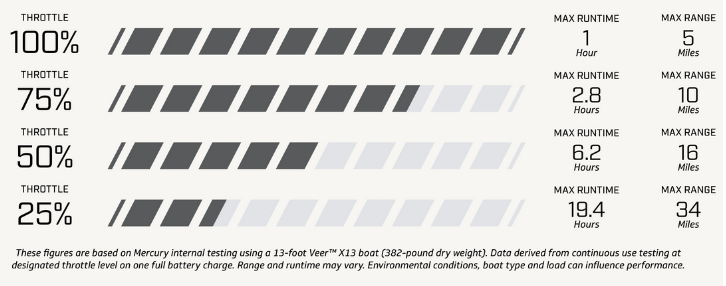
I found this table from Mercury giving range at different throttle settings very interesting.
1763983592524.png
 
... a third party 48V LiFePO4 battery on board, eg the Fogstar 48-125 which has 6.4kWh capacity and is £900 (quintupling the range!).
Thanks so much Ian and really good to know

Also £900 now for 6.4kWh storage - amazing that prices are getting lower now for offerings from 3rd parties
 
I see that the established petrol outboard manufacturers now have electric offerings with trolling motors from Yamaha and a self contained unit from Mercury. Hopefully the competition will improve performance and lower prices.
I found this table from Mercury giving range at different throttle settings very interesting.
View attachment 202699
That table/presentation is a bit strange to me.

Assuming it refers to Avator 7.5E then it has an 890W input motor, 750W output (hence presumably the 7.5E name), and 1030Wh battery.

- Based on that at "full throttle" it should run a bit longer than 1 hour, more like 1hr 10mins or 1.15hrs to use their format.
- But then at "75% throttle" they claim 2.8hrs which would mean (1030 divided by 2.8) about 370W which I'd call "40% power" definitely not 75%.
- And at "25% throttle" apparently it lasts 19.4 hours but to run for 19.4 hours you'd have to use only 53W or about 6% power. Not very much at all. 53W might push that boat, I don't know that boat, at 1.75 mph but it certainly wouldn't push a 9ft inflatable dinghy with 3 people in it at that speed (the 1.75 number comes from 34 miles divided by 19.4).

OK the battery might last a bit longer than my numbers at very low outputs but to claim "2.8 hours at 75% throttle" might mislead some potential customers... one could interpret that to mean it has a battery capacity of 1869Wh (which it doesn't).

The Avator 7.5E looks great but it's quite physically big and actually has a bit less power than most of the "1kW class", at around £2400 inc battery. For comparison the ePropulsion Spirit PLUS is £1875 (1kW power, 1276Wh battery), and the Torqeedo 903 is £1650 (900W power, 915Wh battery). So no in this case while it's providing more choice it's not really providing (price) competition!

As an aside all the manufacturers do this to some extent, ie claim ridiculous ranges at ridiculously low speeds for very easily-driven boats on a flat calm lake. But as a good working generalisation you need about 500W (Watts) to push a typical inflatable dinghy with two people in it at 3.5 to 4 knots. The maths is then fairly easy if you know the battery capacity in Wh (Watt hours), but we're always happy to give you a "real world estimate" for your use case if you phone/email us.

Ian, Nestaway Boats
 
Top