
Inconsistent rigging fitting sizes

wwaites

New Member
Joined
24 Oct 2021
Messages
13
Visit site
Hi all,

I am renewing the rigging on Hale Kai, a cutter-rigged Golden Hind 31. My plan is to use HMWPE rope (happy to discuss, perhaps in another thread, but that is not what this question is about).

I've been going around all of the chainplates and mast fittings, inspecting and measuring everything. It appears that all chainplates have holes to fit 3/8" (9.5mm) pins and all of the mast fittings have holes to fit 5/16" (7.9mm) pins. This seems very strange to me. I would have thought to use the same at both ends. No sense gratuitously creating a weak point aloft. Can you think of any reason why this may have been done? It was clearly intentional as it is perfectly consistent: the upper end of all stays and shrouds is smaller and the lower end is larger.

-w
 
Hi all,

I am renewing the rigging on Hale Kai, a cutter-rigged Golden Hind 31. My plan is to use HMWPE rope (happy to discuss, perhaps in another thread, but that is not what this question is about).

I've been going around all of the chainplates and mast fittings, inspecting and measuring everything. It appears that all chainplates have holes to fit 3/8" (9.5mm) pins and all of the mast fittings have holes to fit 5/16" (7.9mm) pins. This seems very strange to me. I would have thought to use the same at both ends. No sense gratuitously creating a weak point aloft. Can you think of any reason why this may have been done? It was clearly intentional as it is perfectly consistent: the upper end of all stays and shrouds is smaller and the lower end is larger.

-w
No reason not to use heavier fittings at deck level, because their weight doesn't matter down there, and bigger is better when it comes to important, highly stressed fittings. If you can reduce wear by increasing the bearing surfaces, in a place where weight doesn't matter much, then why not use bigger fittings.

Aloft, of course, weight and windage are crucial.
Up top, the calculations of the original design might have pared down the scantlings of the mast fittings, one reason might be weight and windage aloft, but there might be others as well. Everything is a fine balance, or compromise you could say, designing yachts,cars, aircraft etc.
So you could say the lower fittings are a strong point, thicker than strictly neccessary, rather than the upper fittings being a weak point.
If both ends were the same size as the upper fittings, you might not have given it pause for thought!
 
Not realy logical, but stayed (pun) up so far. Tranona is your man, likely he will comment.
Indeed. I will look at mine (Hull 208) on Tuesday when it is being surveyed. However there are several variations of chain plates on GHs and the early Hartwells boats were galvanised with 3/8" holes and on later boats there were at least 3 different types of stainless ones and some had through deck chain plates rather than the more common external type. I expect the hole size and pins were kept the same just because that was what they always were. Masts however varied and the tangs and caps were fitted by the mast makers, usually Proctors, which is what mine is so they would have determined the size of holes and pins.
 
Gary: Interesting, though I would think that the weight saving from slightly smaller fittings would be dwarfed by the weight of the wire rope itself. Not a choice that I would have made in any case.

Tranona: very keen to hear what you find. Hale Kai is hull 199 built by Terry Erskine so is possibly similar. The chainplates are the external type (one of the at least three, I guess) in stainless, I've attached a photograph. There's a slightly strange arrangement with a triangular piece of sheet metal for the extra stays to balance the inner forestay -- I've seen pictures of the other cutter rigged GH (I think there was only one other) that had a fourth chainplate. In any case, all 3/8".

Maybe I am over-thinking it, but to my mind 3/8" makes sense. The minimum breaking load of SS parts with pins around 3/8" or 10mm tends to be around 50kN. This is comparable but a little less than the shear capacity of the three approximately M10 bolts that hold the chainplates in place of about 60kN. (Gary, this calculation is why I would indeed have thought twice if I had found 5/16" clevis pins at the bottom. Actually, I did find one, but it was clearly just someone used the wrong size pin.)

The the MBL of 1/4" or 6mm wire rope around 25-30kN. That's gives a nice margin which means the rope should break before any of the fittings. Replacing a wire especially at sea is better than dealing with a mangled mast fitting. But the MBL for things with 5/16" or 8mm pins is more in the 30-35kN range which is much less comfortable. But maybe this is moot -- I don't have a clear idea of what loads would cause the mast extrusion to fail at the attachment points. Maybe as Tranona suggests, the mast makers knew that there wasn't any point in having fittings bigger than 5/16" because the mast itself would fail first in any case.

I wonder if there is anyone who still works at Selden who used to work at Proctors who could check if this line of reasoning is right...

(Photograph failed to attach... Not sure why...)
 
The other cutter rigged ones that Terry built were ketches - not sure how many, some say 3, but maybe only one, this one yachtsnet.co.uk/boats/s991019/s991019.htm which as you see does not have a check stay, just the normal 3, but further forward.

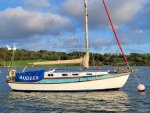
Several boats, like mine shown below and an earlier wooden one I saw recently have 2 masthead forestays, one to the stemhead and the other as you can see on a short bowsprit. Unclear what the forward one was for as there is no sail with the boat, but guess it was probably for a second light headsail for offwind sailing. The boats as standard are a bit short on sail area and many were sold for owners to go long distance sailing and extra foresail area perhaps as twin headsails would have been useful.

Mark Urry who built the last 5 boats redesigned the rig with a taller mast and cutter rigged, but still used the original uppers and lowers with no checkstay. I have seen this bigger rig retrofitted to an early Hartwells built boat, but still with the original stays.

I only bought my boat 2 weeks ago and it is in Wales whereas I live in Poole, but going up there tomorrow for a couple of days for the insurance survey and to put it to bed for the winter as won't move it to Poole until the spring. I have a long association with the boats as I owned for nearly 40 years the first Eventide 26 that Hartwells built, met Terry in the late 70's and knew Mark first by sailing on his original GH and later when he was building the boats. Now finally get to own one!
 

Attachments

  • 303654_635f452e29bc0986811554dee4f17562.jpg
    303654_635f452e29bc0986811554dee4f17562.jpg
    160.2 KB · Views: 11
No reason not to use heavier fittings at deck level, because their weight doesn't matter down there, and bigger is better when it comes to important, highly stressed fittings. If you can reduce wear by increasing the bearing surfaces, in a place where weight doesn't matter much, then why not use bigger fittings.

Aloft, of course, weight and windage are crucial.
Up top, the calculations of the original design might have pared down the scantlings of the mast fittings, one reason might be weight and windage aloft, but there might be others as well. Everything is a fine balance, or compromise you could say, designing yachts,cars, aircraft etc.
So you could say the lower fittings are a strong point, thicker than strictly neccessary, rather than the upper fittings being a weak point.
If both ends were the same size as the upper fittings, you might not have given it pause for thought!

A perfect explanation. Any design process should consider which bit breaks first.
 
Gary: Interesting, though I would think that the weight saving from slightly smaller fittings would be dwarfed by the weight of the wire rope itself. Not a choice that I would have made in any case.

Tranona: very keen to hear what you find. Hale Kai is hull 199 built by Terry Erskine so is possibly similar. The chainplates are the external type (one of the at least three, I guess) in stainless, I've attached a photograph. There's a slightly strange arrangement with a triangular piece of sheet metal for the extra stays to balance the inner forestay -- I've seen pictures of the other cutter rigged GH (I think there was only one other) that had a fourth chainplate. In any case, all 3/8".

Maybe I am over-thinking it, but to my mind 3/8" makes sense. The minimum breaking load of SS parts with pins around 3/8" or 10mm tends to be around 50kN. This is comparable but a little less than the shear capacity of the three approximately M10 bolts that hold the chainplates in place of about 60kN. (Gary, this calculation is why I would indeed have thought twice if I had found 5/16" clevis pins at the bottom. Actually, I did find one, but it was clearly just someone used the wrong size pin.)

The the MBL of 1/4" or 6mm wire rope around 25-30kN. That's gives a nice margin which means the rope should break before any of the fittings. Replacing a wire especially at sea is better than dealing with a mangled mast fitting. But the MBL for things with 5/16" or 8mm pins is more in the 30-35kN range which is much less comfortable. But maybe this is moot -- I don't have a clear idea of what loads would cause the mast extrusion to fail at the attachment points. Maybe as Tranona suggests, the mast makers knew that there wasn't any point in having fittings bigger than 5/16" because the mast itself would fail first in any case.

I wonder if there is anyone who still works at Selden who used to work at Proctors who could check if this line of reasoning is right...

(Photograph failed to attach... Not sure why...)
Increasing the size of fittings over what is required including a safety factor makes absolutely no sense whatsoever. All it does is add weight were it does the least good.

Using Gerr's rules of thumb the screw size for the turnbuckle should be twice the wire diametre and the clevis pin also.

These numbers are quite substantial when compared to those derived from using the RM for a 27' DWL boat from the Sparkman & Stevens tables with a 1.5 safety factor. The S&S table provides fairly reliable numbers for determining rigging dimensions. Formula for rigging loads is: RM x 1.5 (safety factor) / distance chain plate mast. RM according to table 20 000 lbs.
Lowers at 65%, upper at 45% (single spreader rig). Lowers therefore 19655kg BL and 1360kg BL for upper.


The M10 bolts used to hold your chain plates on has more to do with providing sufficient bearing surface for load transmission in the GRP hull.

There must be plenty of examples of Golden Hinds around to take measure and considering the boat is not quite new and has not lost her mast yet, I would think you can relax about it. Unless there is damage to the mast fittings it is not likely to come down any time soon either.
 
Slight drift...
A local aquaintance bought a new Amel 54 and I went up for the launching. Things were a bit delayed, so had a good look at her. The chainplates were a bit odd with quite large holes on lugs that didn't look rig related.
All became clear when they connected the four lift cables to them and craned it into the water. 17.5 tonnes.
 
Increasing the size of fittings over what is required including a safety factor makes absolutely no sense whatsoever. All it does is add weight were it does the least good.

Oh, I certainly agree. I am trying to understand the original spec and why the fittings at the mast are designed for pins that are smaller than I would have thought required.

Using Gerr's rules of thumb the screw size for the turnbuckle should be twice the wire diametre and the clevis pin also.

This is a good example. The mast fittings take an 8mm pin. The rigging is originally 6mm wire. That's a lot less than twice.

I had a nice discussion with a naval architect at the sparmaker who acquired the sparmaker that made the original mast. Of course there are no records because it's too long ago, but they shared with me a design for a replacement mast they recently made for another GH31. That has 7mm wire and 7/16" (11mm) fittings for the stays. So my suspicion about the fittings on the mast being undersized doesn't seem unreasonable.

He also points out that load is not the only consideration and that choice of wire size is often driven by fatigue life. As I mentioned originally, I'm replacing the wire standing rigging with rope, so the choices are different there. But the point of my original question is to understand (reconstruct) the reasons why the rig is the way it is now first, before I make the modifications that I need to.

The M10 bolts used to hold your chain plates on has more to do with providing sufficient bearing surface for load transmission in the GRP hull.

Primarily, yes, you are right. But they could have used M12 or M8. It happens that M10 is the right size. M8 would shear before the clevis pins and whatnot fail. If the bolts holding the chainplates on were to shear, they wouldn't do a very good job of transmitting load to the hull. M12 would be ok but unnecessary.

There must be plenty of examples of Golden Hinds around to take measure

Indeed, my main purpose in asking this question was to find someone with a GH31 of similar age to take measurements to find out if what I have is typical or unusual, which Tranona has kindly offered to do.
 
Oh, I certainly agree. I am trying to understand the original spec and why the fittings at the mast are designed for pins that are smaller than I would have thought required.


This is a good example. The mast fittings take an 8mm pin. The rigging is originally 6mm wire. That's a lot less than twice.

I had a nice discussion with a naval architect at the sparmaker who acquired the sparmaker that made the original mast. Of course there are no records because it's too long ago, but they shared with me a design for a replacement mast they recently made for another GH31. That has 7mm wire and 7/16" (11mm) fittings for the stays. So my suspicion about the fittings on the mast being undersized doesn't seem unreasonable.

He also points out that load is not the only consideration and that choice of wire size is often driven by fatigue life. As I mentioned originally, I'm replacing the wire standing rigging with rope, so the choices are different there. But the point of my original question is to understand (reconstruct) the reasons why the rig is the way it is now first, before I make the modifications that I need to.


Primarily, yes, you are right. But they could have used M12 or M8. It happens that M10 is the right size. M8 would shear before the clevis pins and whatnot fail. If the bolts holding the chainplates on were to shear, they wouldn't do a very good job of transmitting load to the hull. M12 would be ok but unnecessary.


Indeed, my main purpose in asking this question was to find someone with a GH31 of similar age to take measurements to find out if what I have is typical or unusual, which Tranona has kindly offered to do.
Unless your sparmaker, naval architect or even you for that matter, actually do a stability test, any numbers quoted are pretty much (educated) guess work. It does indicate however how great the safety margins are if that is of any comfort. Spar makers rarely do any fancy footwork when replacing a spar in a non-competitive design.

According to Gerr's rules of thumb, your boat would indeed require 7mm shrouds for the lowers, but the problem with such generic rules is that they have to cover a great many different designs, including more modern ones which could easily be 2 feet more in beam and have much greater initial stability.

I fail to see how the bolts holding the chain plates at 90 degr. could not be loaded in shear. The actual weak point in the chainplate would be the remaining cross sections adjacent to the bolts if at all or at the point where the turnbuckle attaches if there is any wear.
 
any numbers quoted are pretty much (educated) guess work.

If you're trying to say that I should think critically about numbers that people mention, use multiple sources and consider the problem from several different angles, you're preaching to the converted ;)

I fail to see how the bolts holding the chain plates at 90 degr. could not be loaded in shear. The actual weak point in the chainplate would be the remaining cross sections adjacent to the bolts if at all or at the point where the turnbuckle attaches if there is any wear.

Maybe we are talking at cross purposes. Of course the bolts are experiencing a shear force, and they have a typical shear capacity. And of course shearing of bolts is just one of several possible failure modes. I think that we agree...
 
Umm, chainplates usually have several bolts to the hull? So the pin in the turnbuckle is not a comparison?

Three bolts in this case. My reasoning is as follows.

All of the force from the stay is transferred through the pin in the turnbuckle pulling upwards on the chainplate. Not exactly upwards because there is an angle, about 13 degrees for the lowers and half that or less from the cap shrouds, but mostly (cos(13º) ≈ 0.97) upwards. That force is then transferred to the hull in two ways: friction from the chainplate being pressed against the hull by the bolts, and upward (shear) force on the bolts themselves.

In other words, the friction of the chainplates on the hull plus the downward force of the bolts on the chainplate is equal to the upward force on the pin in the turnbuckle. If it weren't, something would move, and that would be bad. I don't immediately know what the static friction is, but we can show that the bolts themselves can tolerate a shear force greater than the pin in the turnbuckle. Each bolt can handle (depending on the precise alloy) about 20kN of shear for a total of 60kN. The pin can handle about 50kN.

These values being comparable seems sensible. If they were very different, I would wonder if either the pin was too small or the chainplate was excessively overbuilt.

Ok, let's work out the friction. I'm not totally confident in this calculation, but here goes. The static coefficient of friction of metals on wood is in the 0.2-0.6 range. The design bearing resistance of M10 bolts per mm of plate is in the 7-10kN/mm range. The chainplates are 6mm thick. Again, we have three bolts. This gives a friction force of between 0.2*7*6*3 = 25kN and 0.6*10*6*3 = 108kN. That is the force that gets spread around with the help of the backing plate and solid pieces of hardwood either side of the hull.

Taking a middle value for the friction, a reasonably safe estimate is that the combined shear capacity and friction force of the chainplate might be about 2-3 times the shear capacity of the pin in the turnbuckle. Again, this seems sensible.

All of this says that the design of the hardware at deck level for the GH31 is pretty solid without being excessive. Nothing surprising about that. I find it helpful to work these things out, but that's just me. YMMV.
 
Indeed, my main purpose in asking this question was to find someone with a GH31 of similar age to take measurements to find out if what I have is typical or unusual, which Tranona has kindly offered to do.

Just got back from Wales. The pins on both shrouds and back/forestays are 11mm. Can't help with the uppers as the shrouds are T or maybe ball sockets (difficult to tell which from the deck) and equally not possible to tell the size of the pins in the mast box. The mast is Proctor with internal halyards and a roller furling boom, although converted to slab reefing. Not sure if this helps.
 
This is an aside, not helpful to the question of 'bolt/pin size'.

In about 1972, I was 'recruited' to help Lt Col George Cross ( yes ) take his GH31 'Trigger' from Plymouth to St Malo and back, and on several other occasions to the CIs and North France.

We met when 'Trigger' was used when required by Terry Erskine, as a 'demo boat', with owner George C. on board. She was then kept on moorings at Alec Blagdon's yard, before Mayflower Marina was built.
 
Last edited:
This is an aside, not helpful to the question of 'bolt/pin size'.

In about 1972, I was 'recruited' to help Lt Col George Cross ( yes ) take his GH31 'Trigger' from Plymouth to St Malo and back, and on several other occasions to the CIs and North France.

We met when 'Trigger' was used when required by Terry Erskine, as a 'demo boat', with owner George C. on board. She was then kept on moorings at Alec Blagdon's yard, before Mayflower Marina was built.
My first Xchannel was with Mark Urry (later the builder of GHs after Terry gave up) in Moondancer his first GH which he built from a wood hull and deck starting in 1974 finishing in 1978. This was in 1980 the year I bought Tranona my Hartwells Eventide 26. For obvious reasons this started me off on "proper" sailing and I would have progressed to a GH, but I got seduced by the sun and ouzo of Corfu and purchase of my first Bavaria. Move on 20 odd years and regretting the sale of my Eventide decided it was time to scratch the itch and have a GH. Forgot how many variations there were then add 40 years of owners' improvements difficult to find one that has the features one wants and in usable condition. The one I bought is pretty close and survey revealed a lot of good and no nasties. Should have her back to Poole in the next month and sailing next spring so I can find out what I like and don't like!
 
Just got back from Wales. The pins on both shrouds and back/forestays are 11mm. Can't help with the uppers as the shrouds are T or maybe ball sockets (difficult to tell which from the deck) and equally not possible to tell the size of the pins in the mast box. The mast is Proctor with internal halyards and a roller furling boom, although converted to slab reefing. Not sure if this helps.

Mysterious. Thanks for that. After you sent this message, I went and double-checked, and even got a friend to measure without telling him what I expected him to find in case I am incompetent with a pair of calipers. Good news is, I am not incompetent. But what you've found is consistent with what the sparmaker suggested. Hmmm...
 
There may be of course some differences between metric and imperial measurements as the boat's design is over fifty years old, resulting, possibly, in a mix&match situation.

However, considering that the GH 31 is a very well proven design with a track record of offshore sailing that, perhaps as yet, has to be replicated, you might be just overthinking things a bit at this point. Unless there is some obvious evidence of deterioration, I would just get on with it and replicate, as far as possible, what you currently have, in consideration of the fact that this seems to have lasted well enough over the previous 50 years.

The only other option, if you insist on being obsessive and which I can well understand as I too have to suppress latent tendencies, is to determine RM by doing a roll or inclination test, or alternatively get hold of the line drawings for your boat and calculate it from these. There are a number of ways of doing this, some require no more than a pair of scissors, a postal/digital scale and glue to determine GZ. You need to know your true displacement of course, which is guaranteed not to be the one quoted in Sailboat Data. You might want to find out the boat's load per inch immersion and crosscheck where she actually floats in relationship to DWL, if you cannot get her weighed when being craned or lifted..

I did the roll test when I changed the rig on my boat and it was within 50kg/m of what I subsequently calculated from the published lines.
 
There may be of course some differences between metric and imperial measurements as the boat's design is over fifty years old, resulting, possibly, in a mix&match situation.

However, considering that the GH 31 is a very well proven design with a track record of offshore sailing that, perhaps as yet, has to be replicated, you might be just overthinking things a bit at this point.

For sure. But it's quite possible to distinguish sizes. 9.5mm is 3/8" and 11mm is 7/16", the next size up. I'm not especially concerned about the 3/8" fittings, they seem perfectly adequate. But the 8mm or 5/16" fittings, the next size down, at the mast are not great.

Point taken about proven design, and this was one of the reasons for choosing a GH31 to begin with. And in fact this boat, with this mast, when new managed to survive two knock-downs with no damage in the Fastnet storm (not racing, obviously, just coincidence). So obviously the original spec is not unreasonable. However, we also have 44 years of stress, and some neglect in recent years.

Unless there is some obvious evidence of deterioration, I would just get on with it and replicate, as far as possible, what you currently have, in consideration of the fact that this seems to have lasted well enough over the previous 50 years.

Unfortunately, there is. The masthead crane arrangement needs rebuilt. Let's see if attaching photos works this time. And if I'm rebuilding it, beefing it up cannot hurt.

The only other option, if you insist on being obsessive and which I can well understand as I too have to suppress latent tendencies, is to determine RM by doing a roll or inclination test, or alternatively get hold of the line drawings for your boat and calculate it from these.

This would have been a useful thing to do before lifting out last spring. Fortunately I do have a measurement from the crane operator of the true displacement (just under 7t). So it's mainly working on paper, there's no chance to take dynamic measurements exprimentally.

Cheers,
-w
 
Top