Inconsistent rigging fitting sizes

Unfortunately, there is. The masthead crane arrangement needs rebuilt. Let's see if attaching photos works this time. And if I'm rebuilding it, beefing it up cannot hurt.
As you have the true displacement, that means your boat is currently 30% over original spec and this does increase the loads on her rig.
Still, I would be very cautious of increasing the weight of any fittings in a rig, particularly ones at the mast head. This is a common mistake made by amateur outfitters with the urge to make everything super strong/safe. Too often the results are overweight, cranky and under-performing boats. Owning a brand that was for the most part home completed, I am quite familiar with this process (and results) and it is not helped by self declared experts advising owners to go up a size or two for their rigging specs.

I have also seen a number of plans, intended for the home builder, where the architect specifically notes that under no circumstances should the builder increase the rigging sizes beyond those indicated.
 
This may help a bit in understanding the cutter rig from Terrry's time eventides.org.uk/forum/viewtopic.php?f=8&t=419 poster GHM is Mark Urry. As you can see his cutter rig had a much taller mast and as a consequence he had to increase the ballast in the main keel to get into Cat A of the RCD. I remember him saying that even with the original shorter mast stability was marginal (for Cat A) with the standard 35% ballast ratio. The bilge plates (at 175kgs each) make a significant contribution to stability.

Interested in the crane weight. That is much more than I estimated when getting transport quotes - not that it is critical as way under load capacity of a transporter. Will remember to check the crane weight when it gets offloaded this end.
 
This may help a bit in understanding the cutter rig from Terrry's time eventides.org.uk/forum/viewtopic.php?f=8&t=419 poster GHM is Mark Urry. As you can see his cutter rig had a much taller mast and as a consequence he had to increase the ballast in the main keel to get into Cat A of the RCD. I remember him saying that even with the original shorter mast stability was marginal (for Cat A) with the standard 35% ballast ratio. The bilge plates (at 175kgs each) make a significant contribution to stability.

Yes, that is helpful. This is definitely the shorter mast. Somewhere I have an explanation from the original owner that he wanted the shorter rig for just this reason. It's a shame the eventides forum is super quiet. I've had some good email exchanges with John but the forum is mainly tumbleweeds these days.

Interested in the crane weight. That is much more than I estimated when getting transport quotes - not that it is critical as way under load capacity of a transporter. Will remember to check the crane weight when it gets offloaded this end.

I was also suprised. The boat was full of stuff but the water tanks were empty and wasn't carrying months worth of food or anything. It was the very busy twice-yearly crane in/out day at the harbour. This was the crane operator shouting to someone shouting to me. There is the possibility of miscommunication. But we repeated the shouting a couple of times. I wasn't able to clarify the precision, "closer to 7t than 6t" or "closer to 7t than 6.5t" or "exactly 7t"...
 
As you have the true displacement, that means your boat is currently 30% over original spec and this does increase the loads on her rig.
Still, I would be very cautious of increasing the weight of any fittings in a rig, particularly ones at the mast head. This is a common mistake made by amateur outfitters with the urge to make everything super strong/safe. Too often the results are overweight, cranky and under-performing boats. Owning a brand that was for the most part home completed, I am quite familiar with this process (and results) and it is not helped by self declared experts advising owners to go up a size or two for their rigging specs.

I have also seen a number of plans, intended for the home builder, where the architect specifically notes that under no circumstances should the builder increase the rigging sizes beyond those indicated.

All understood. I remember from my high school physics about torques and angular momenta and understand why we do not want to add weight far above the metacentre. Increasing pin sizes adds negligible weight. Increasing wire-end fittings and wire size could add a lot of extra weight. Fortunately, HMWPE rope is much lighter than steel so I have some margin to work with. It's possible to make it stronger and lighter.

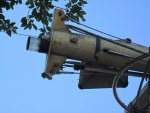
As far as weight is concerned, more significant than the size of pins and holes in tangs is how best to rebuild the masthead crane and in what material. I might start a different thread about that -- I have a couple of ideas, but more ideas are always useful. This whole thing has motivate me to fix the web site which I had broken because at least I can put pictures there. You can see what's going on at the masthead here; rigging
 
Very different from the masthead on mine, which I assume is the original Proctor.
 

Attachments

  • 164026_BoatPic_Masthead.jpg
    164026_BoatPic_Masthead.jpg
    72.9 KB · Views: 6
  • 260546_b16633c354d8bb0a99dc0a5bfdc3fa4f.jpg
    260546_b16633c354d8bb0a99dc0a5bfdc3fa4f.jpg
    30.2 KB · Views: 7
  • 303654_635f452e29bc0986811554dee4f17562.jpg
    303654_635f452e29bc0986811554dee4f17562.jpg
    160.2 KB · Views: 4
Very different from the masthead on mine, which I assume is the original Proctor.

Yeah, really. Yours looks similar to what I was thinking of constructing for idea #2 in the other thread.

Mine looks closely related to this one, which is from Ceilidh on the "boats for sale" page at eventides.org.uk. That has a smaller stainless crane but it is similar in construction. Same cap on the mast with the little eyes for a block to run up a burgee or something (underneath the dodgy looking plate for holding the nav light). So clearly I don't have some mast from some random other boat.

http://www.eventides.org.uk/images9/ceilidhe 20200724_145738.jpg
 
That boat was on my list when I first started looking but went very quickly. Probably too much of a project for me anyway.

I had a similar stainless cap made for my Eventide which was then blasted to make it look galvanised to match the other fittings. That was a lovely round hollow wooden mast but the principle of the fittings for the stays would be the same. All external rigging so built in eyes for attaching blocks. I will see if I can find a photo.
 
All understood. I remember from my high school physics about torques and angular momenta and understand why we do not want to add weight far above the metacentre. Increasing pin sizes adds negligible weight. Increasing wire-end fittings and wire size could add a lot of extra weight. Fortunately, HMWPE rope is much lighter than steel so I have some margin to work with. It's possible to make it stronger and lighter.

As far as weight is concerned, more significant than the size of pins and holes in tangs is how best to rebuild the masthead crane and in what material. I might start a different thread about that -- I have a couple of ideas, but more ideas are always useful. This whole thing has motivate me to fix the web site which I had broken because at least I can put pictures there. You can see what's going on at the masthead here; rigging
The pics (last in the series), of what I presume are a twin headstay balance (?), are typical of a grossly over-engineered, badly designed and poorly executed piece of rigging. The less than perfect weld for the top attachment point stands in no relationship to the overbuilt lower portion. Furthermore, it would be quite easy to save 80% of material and weight and end up with a much superior and better performing product. This one fitting alone could easily reduce RM by some 20-30 ft/lbs.

In regards to your displacement: According to the nomograph published in Skeene's (Kinney) the "pounds per inch immersion" for your boat would be about 850 lbs. Assuming that your boat, empty tanks notwithstanding, is 1500 kg overweight, she should be floating nearly 4" below DWL.
 
Last edited:
The pics (last in the series), of what I presume are a twin headstay balance (?), are typical of a grossly over-engineered, badly designed and poorly executed piece of rigging. The less than perfect weld for the top attachment point stands in no relationship to the overbuilt lower portion. Furthermore, it would be quite easy to save 80% of material and weight and end up with a much superior and better performing product. This one fitting alone could easily reduce RM by some 20-30 ft/lbs.

You mean the triangular piece? That doesn't go at the masthead, it's unrelated. It was used to attach two stays (aft lower and intermediate shrouds) to the same chainplate. Is it a good idea to have four shrouds on three chainplates? Unclear. I agree it is strangely constructed. It is a candidate for replacement. I need to figure out where to put the intermediate shroud, which is important for balancing the inner forestay. Fortunately it's not a problem for weight distribution aloft.

In regards to your displacement: According to the nomograph published in Skeene's (Kinney) the "pounds per inch immersion" for your boat would be about 850 lbs. Assuming that your boat, empty tanks notwithstanding, is 1500 kg overweight, she should be floating nearly 4" below DWL.

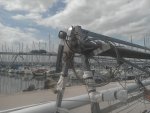
Good point... And strange because she was floating not far off the DWL (see this photo and also note that someone has raised the waterline excessively at some point which is another thing on my very long list of things to fix). You can also see, if you squint, where those triangular things are, atop the aftmost chainplate.
 
Last edited:
You mean the triangular piece? That doesn't go at the masthead, it's unrelated. It was used to attach two stays (aft lower and intermediate shrouds) to the same chainplate. Is it a good idea to have four shrouds on three chainplates? Unclear. I agree it is strangely constructed. It is a candidate for replacement. I need to figure out where to put the intermediate shroud, which is important for balancing the inner forestay. Fortunately it's not a problem for weight distribution aloft.

Was she originally built as a cutter or retrofitted at a later date and was the chainplate modified to take the extra load of the intermediate backstays? Having the intermediate backstays terminate at or near the back lowers is a common practice ( I have done that as well), but its not the best solution, as they do add considerable compression loads to the mast due to the narrow staying angle. Running backstays are better in that respect. There are a few boats that have unified chainplates, one of which are the North American Hunters; perhaps a poor example as that is one of their nororious weak spots.

Good point... And strange because she was floating not far off the DWL (see this photo and also note that someone has raised the waterline excessively at some point which is another thing on my very long list of things to fix). You can also see, if you squint, where those triangular things are, atop the aftmost chainplate.

Our boat used to be Mediterranean liveaboard. Our painted waterline is some 6" higher than her DWL. No matter that we have to carry everything with us for longterm cruising, we are still close to our DWL with almost as much anti fouling above as below the waterline. I really have no idea what people carry around with them. According to various publications our displacement is supposed to be between 7900kg and 8270 kg. I know we weigh 8.5t in full trim. I have variously been told or heard of 10t, 12t, 14t and, unbelievably, 16t and 18t (!). According to my calculations the latter would be floating 30cm below DWL. I have seen the pics of that boat and had to conclude it to be true.
 
Was she originally built as a cutter or retrofitted at a later date and was the chainplate modified to take the extra load of the intermediate backstays?

Yes, I'm sure of it. The bowsprit is original, the brass plate from the builder says "cutter", and correspondence from the original owner mentions it too. Not much doubt about this.

If there were any modifications to the rig is another question. The tangs for the intermediate shrouds are a bit weird. They are double, like the ones for the lowers, but of course only one shroud is fitted each. Maybe those were just the tangs they had lying around that day. But then again, they're pretty much the simplest pieces of sheet metal with holes I can imagine and anyways, the tangs for the cap shrouds are single, as you would expect.
 
Top