Impact of tide on RPM

I can get fascinated thinking round the physics of a fly buzzing round inside my car - until I swat it! Much the same question, minus the effect of windspeed.

My fascination in case you are wondering (and you probably arent ;)) is a genuine interest in how my engine is performing. I have found through hard experience that the sound it produces, the temperature and oil pressure, and yes, the rpm, are very good signs whether or not all is well, and usually a very good way of catching a problem before it becomes too serious. Being a little involved in aviation, and with the increasing use of far more accurate digital gauges, it is possible to monitor engine parameters very actually. For example, fuel use over a 600 mile journey can be monitored literally down to a few litres, which is kind of handy when you are in the air! I suspect most of our marine gauges are less than accurate which makes the job more difficult. I also dont know anyone who routinely checks their oil, whereas with aircraft engines it is relatively common place to send off a sample.

I had the very annoying expereince of suffering some sudden and unexpected rpm drops when motoring, always after a few hours of engine use, and usually at the most frustrating time. As with all such transient problems it proved very difficult to find the cause, and, when I did, it was the last thing expected (thanks to someone here for the suggestion). Since then everything has been really stable and the engine has always behaved predictably. I also now know what speed I should expect at different power settings, and where the temps should be. I might even get round to fitting a fuel flow meter (annoying to have to have sensors for the feed and return, but the joy of diesel engines).

Probably all a little "anal", but I as I say, I do find this insight useful in spotting the early signs of a potential problem.
 
Maybe you have been influenced by all the references to tide affecting speed by posters here that you need to question your self

One of the problems that do occur here is ability of be able to post opinions as facts

I of course would never do such a thing ??
 
It would not be wide open fuel supply. My digger recently went into a massive "race" mode & started to rev like h..ll. the driver shoved some rags into the air intake to stop it because the usual stop sequence did not work. The governor is definitely there to stop over revving & the engine will give more revs if allowed & not held back by load etc.
My very simple understanding of how a basic throttle works which could be wrong is once the engine is running, opening the throttle just allows more fuel and air in which creates more powerful explosions which speeds up the engine. Reducing throttle = less fuel so less powerful explosions so slower engine. So I thought that max throttle was max fuel. But on complicated diesel injection systems thats all different?
 
Depends on the propeller power curve :) If the propeller power curve is matched with engine power at max rpm = 3500, an increase in resistance would tilt upwards the propeller power curve which would then cross the engine power at a lower rpm; in other words the propeller would need more power at those given rpm which the engine is not able to provide --> lower rpm.
understood :D
If the engine is being used at max rpm and its rpm does not decrease with an increase in outside resistance, it means the propeller power curve is not well matched, it's "too low" : the governor keeps steady rpm increasing the fuel delivery (hence engine delivered power) up to the (new) required propeller power.
Not so much ?
 
Maybe you have been influenced by all the references to tide affecting speed by posters here that you need to question your self

One of the problems that do occur here is ability of be able to post opinions as facts

I of course would never do such a thing ?

Possibly.

I could never see a reason why the tidal flow should have any direct effect, but I am very interested in the discussion as to the elements that might result in an indirect effect. Thank you. I think the concept that everything is moving with and in the stream, so what the stream itself is doing isnt relevant, but it doesnt necessarily mean there are other factors at work which would explain my observations. Of course it might be nothing to do with external factors at all, but the discussion is very interesting (to me) never the less.

In aviation circles there has been a long running debate about the physics of an aircraft moving along a runway, but in this theoretical world, the runway is moving at the same speed as the aircraft (imagine a conveyor belt). We will not go there, but it always peeks peoples interest and again the physics are actually a little more complicated than most people at first think.
 
I have never experienced this problem and we primarily use a very tidal strait for our cruising ground.

I can also run our engine at full revs in gear whilst tied up to the dockside. I get marginally higher revs in reverse!

One of my regular routes takes me in a back eddy with about a 3 knot favourable tide dodging behind the pillar of a suspension bridge and then heading through a tidal sheer about 1 foot wide where the tide turns to dead against me at up to 5 knots. The water is visibly higher on the upside side of the suspension bridge Pier.

I can then very slowly make an early passage against the tide through the swellies using some of the other back eddy's and quite a few years of local knowledge.

Needless to say the boat SOG turns from about 8 knots to virtually 0 in a few seconds.

The engine continues at exactly the same revs.

My through hull log gives a constant 5.5 knots through the water which for an easily driven 9M boat is boat speed.

There is usually very little wind in this part of the strait. If there is any significant headwind I can't make sufficient headway past the pier as I have no reserve power to overcome the windage of mast and mainsail with only a 10 HP engine at WOT!

I suspect the OPs boat design ,Prop and power delivery are very different to mine. These are in my opinion greater reasons for his observation of revs dropping and mine of no difference!

Finally I think we have all seen published power and torque curves which often show a higher figure at slightly lower revs than WOT. I have tried the same passage at very slightly reduced revs.

Same result it just takes even longer to pass the first pier at 5 knots through the water instead of 5.5!
 
I had the very annoying expereince of suffering some sudden and unexpected rpm drops when motoring, always after a few hours of engine use, and usually at the most frustrating time. As with all such transient problems it proved very difficult to find the cause, and, when I did, it was the last thing expected (thanks to someone here for the suggestion).
Yes it has always amazed me how far offshore one can be when a bee suddenly flies past. never gave it a thought before but will watch the engine revs in future.
 
I did just ask that.

These were the answers I was expecting.

However, there is a reason for it. My max, rpm is 3.500, but when motoring against a really fast tidal stream I always see a small drop in rpm with the throttle fully open.

Sometimes you need to take a reality check and consider why something is occuring.
Six pages of discussion, wild surmise and pure fantasy and still no one has (correct me if I am wrong) applied Occam's Razor and reached the inevitable answer that physics unequivocably dictates, that the OP's observations simply cannot be correct.

No, the RPM cannot differ simply by motoring in one direction or another unless one applies other forces. And as none were stated (and the fact that they cannot always work in the same direction in conjunction with tide) the OP's premise must be false.
 
My very simple understanding of how a basic throttle works which could be wrong is once the engine is running, opening the throttle just allows more fuel and air in which creates more powerful explosions which speeds up the engine. Reducing throttle = less fuel so less powerful explosions so slower engine. So I thought that max throttle was max fuel. But on complicated diesel injection systems thats all different?


A diesel takes full air at all times, pressure can alter if a turbo fitted. Only extra fuel is added when the throttle lever opened.

Old London Black Cabs and perhaps other diesel commercial vehicles did use a butterfly in the manifold, but only to supply a vacuum for a brake servo. Not a common thing.

A purist will tell you the fuel air mixture does not explode, it just burns very fast.

Explosions do occur, known as detonation. Not common with diesel engines, mostly old generation petrol engines with pointed pistons and hemi heads.

Max throttle is usually max fuel - until the govenor kicks in.
 
If the tide is flooding, the water is likely to be colder as it rises up from the depths which don't get much sunlight.
The vessel would float higher in the colder, denser water thus suffering less skin friction, and so be able to achieve a higher speed, maybe leading to higher RPM, on a rising tide.
(This is a well known occurence, it can be a navigation hazard because the cold water drops the moist surface air below its dewpoint, causing dense, localised fog, and is not uncommon in certain spots, eg the Needles or the Chenal du Four, in early spring. )
 
Six pages of discussion, wild surmise and pure fantasy and still no one has (correct me if I am wrong) applied Occam's Razor and reached the inevitable answer that physics unequivocably dictates, that the OP's observations simply cannot be correct.

No, the RPM cannot differ simply by motoring in one direction or another unless one applies other forces. And as none were stated (and the fact that they cannot always work in the same direction in conjunction with tide) the OP's premise must be false.


I am sure other forces are, in fact, in operation.

He/we just dont know what they are................................ :cool:
 
I am sure other forces are, in fact, in operation.

He/we just dont know what they are................................ :cool:
I'm surprised nobody has mentioned Coriolis yet, it must have some effect, which depends on the heading. upon the rotating machinery.
 
Max throttle is usually max fuel - until the govenor kicks in.
Kicks in? Can the governor increase the fuel when its already at max throttle as per OP? If not when turning into the wind the boat speed will drop and the revs will slow due to the extra resistance and inability to deliver more fuel to keep the revs up?
 
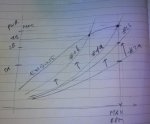
Attempt at a drawing :)
Engine power curve and a few propeller power curve, both vs rpm.
A propeller matched to absorb all the available engine power at full rpm would have a curve like #1a: they cross at MAX rpm and MAX power.
If outside resistance increases (waves, etc) the curve will tilt to #1b. The engine cannot keep constant Max RPM as it would require more power than it is capable of providing, so rpm gets lower until available engine power is equal to power absorbed by the propeller: point 1B, at lower rpm.
If the engine remains fixed at MAX rpm, it means we are moving along MAX rpm vertical line. That can be given by a propeller curve #2a, which tilts to #2b with an increase in outside resistance. Curve #2a is for a (seriously) undrpropelled boat, imagine your boat with a tiny propeller: you can bring it to max rpm without problems (of course speed will be very low), if external resistance is applied then the propeller will absorb more power which the engine will be able to give while remaining always at max rpm.

pwrprop.jpg


understood :D

Not so much ?
 
Six pages of discussion, wild surmise and pure fantasy and still no one has (correct me if I am wrong) applied Occam's Razor and reached the inevitable answer that physics unequivocably dictates, that the OP's observations simply cannot be correct.

No, the RPM cannot differ simply by motoring in one direction or another unless one applies other forces. And as none were stated (and the fact that they cannot always work in the same direction in conjunction with tide) the OP's premise must be false.
On the contrary, we have three plausible mechanisms proposed.
 
Kicks in? Can the governor increase the fuel when its already at max throttle as per OP? If not when turning into the wind the boat speed will drop and the revs will slow due to the extra resistance and inability to deliver more fuel to keep the revs up?
The maximum RPM is limited by a mechanical rev limiter. If the engine is lightly loaded, but turning at its maximum RPM, it is not necessarily receiving the maximum quantity of fuel which it is capable of burning. If a heavier load is placed upon the engine, it will maintain the selected speed (if it can), but burn more fuel.
Imagine a diesel generator, it has to turn at an exact speed to provide 50 Hz AC. It is governed to run at that speed, eg 1500 or 3000 RPM, and more or less fuel will be fed to the engine depending on the load, or lack of.
 
The maximum RPM is limited by a mechanical rev limiter. If the engine is lightly loaded, but turning at its maximum RPM, it is not necessarily receiving the maximum quantity of fuel which it is capable of burning. If a heavier load is placed upon the engine, it will maintain the selected speed (if it can), but burn more fuel.
Imagine a diesel generator, it has to turn at an exact speed to provide 50 Hz AC. It is governed to run at that speed, eg 1500 or 3000 RPM, and more or less fuel will be fed to the engine depending on the load, or lack of.
got it. So the final answer to the OP question is "It depends" :D
 
No, the RPM cannot differ simply by motoring in one direction or another unless one applies other forces. And as none were stated (and the fact that they cannot always work in the same direction in conjunction with tide) the OP's premise must be false.
Ah the physicist answer, no other forces were mentioned in the question so we can describe a perfect system!

Did it occur to you that the exam question was actually "what other forces are acting on my boat to make it use different power in each direction, all else being equal?"?
 
Top