Ideas on sole flooring

harvey38

Well-Known Member
Joined
27 May 2008
Messages
2,137
Visit site
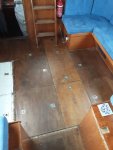
I currently cover the pictured floor with carpet tiles, looks great but totally impractical as I need access to the engines for daily checks. Ideally I'd like some form of teak and holly as it looks great but in it's current layout there are to many many panels to lift.

My thoughts are to make one panel where there are three panel which will increase panel weight but should be easy enough to lift but what to use as a top surface?

I have seen a 2mm thick product called Nautifloor that I could lay on top of new ply panels but very little information/ price available online.

The is a high pressure laminate available in teak and holly, 0.7mm thick but very hard wearing, a good price but made in Germany and the nearest I can get it means a trip to the Netherlands.

The other option is teak and faced ply from Robbins timber, expensive and but only a 1mm veneer so probably not the most hard wearing.

We already have Tek dek externally but I don't think it brings the warmth of teak and holly.

Having returned several versions of Holly and teak from ebay/Amazon, they are definitely off the list!

Your input and thoughts would be appreciated.
20210809_094145_resize_36.jpg
 
Robbins sell fake teak & holly laminate about .7mm thick that's very realistic. It's much harder wearing than the real stuff & consequently a right b'stard to cut. I redid my floor with it. I stuck it down with 3M high strength double sided sticky sheets. You only get one chance with that stuff
 
I agree that the teak and holly looks very smart when it is new, but the varnished finish will inevitably result in a very slippery surface. Ironically my wooden yacht is varnished throughout apart from the floor boards which are just raw unfinished iroko. It provides a warm feel and a non-slip surface. They are also totally maintenance free. It has always struck me a rather strange that glass fibre yacht builders normally insist on providing a varnished finish on the one place that it is going to provide a high maintenance slip hazard. Attempts to stop slipping using Griptex or non slip tape simply make the area harder to clean and unattractive. So, I would suggest that before you go down the teak/holly route you consider raw teak or iroko instead. Just an idea!
 
I go to a large carpet shop and buy an offcut of carpet with built in underlay, which I then trim to size. You need something like this underneath it:

Anti Non Slip Rug Under Mat Gripper Multi Purpose Non Slip Grip Mat Roll Liner | eBay

Because a felt backing can be slippy and if you choose a rubber backing it can stick to the floor. In theory I can afford to put down new every season but in practice it lasts till it gets a bit grubby and then another 30 quid buys new again. It will generally stay dry, unless you have a large crew of apes going in and out with wet boots.
I don't need floor covering as the woodwork is still quite presentable but there is nothing like the luxury of carpet when you are padding about in the night hours.

On the large, flat floor area shown in post 1 I think a carpet would roll back quite nicely either fore and aft or athwartships.

.
 
Robbins sell fake teak & holly laminate about .7mm thick that's very realistic. It's much harder wearing than the real stuff & consequently a right b'stard to cut. I redid my floor with it. I stuck it down with 3M high strength double sided sticky sheets. You only get one chance with that stuff
Interesting, I assumed that it was a wood veneer, maybe that is a version of the HPL from Germany?

Why is it difficult to cut?

Maybe better to spend the £££££ and get it already stuck onto the ply rather than just a 0.7mm sheet?
 
No everyone’s cup of tea but our floor is carpeted. The original one got tatty and we replaced it with a rubber-backed bathroom carpet from a local shop and had the edges bound, which looks very neat And wasn’t unduly expensive. The carpet is fairly rigid and keeps itself in place, helped by the cut-outs round the saloon table.
 
My sole boards had an accident at some point in the boat's history so I carpeted, then quite rapidly bought a spot cleaner as they really do get dirty quickly if you spend a lot of time on board. Warm though.
 
I currently cover the pictured floor with carpet tiles, looks great but totally impractical as I need access to the engines for daily checks. Ideally I'd like some form of teak and holly as it looks great but in it's current layout there are to many many panels to lift.

My thoughts are to make one panel where there are three panel which will increase panel weight but should be easy enough to lift but what to use as a top surface?

I have seen a 2mm thick product called Nautifloor that I could lay on top of new ply panels but very little information/ price available online.

The is a high pressure laminate available in teak and holly, 0.7mm thick but very hard wearing, a good price but made in Germany and the nearest I can get it means a trip to the Netherlands.

The other option is teak and faced ply from Robbins timber, expensive and but only a 1mm veneer so probably not the most hard wearing.

We already have Tek dek externally but I don't think it brings the warmth of teak and holly.

Having returned several versions of Holly and teak from ebay/Amazon, they are definitely off the list!

Your input and thoughts would be appreciated.
If you like the look of the carpet tiles and the only problem is lifting them and the panels for access, why not reduce the number of panels by making, say, 3 larger new standard ply ones then stick the carpet tiles down so each panel lifts separately with the tiles attached. You can arrange them so that some of the panel joins are the natural tile edges. I find that cutting carpet tiles leaves a nice clean edge that is not achievable with normal carpet.

Www.solocoastalsailing.co.uk
 
Last edited:
Interesting, I assumed that it was a wood veneer, maybe that is a version of the HPL from Germany?

Why is it difficult to cut?

Maybe better to spend the £££££ and get it already stuck onto the ply rather than just a 0.7mm sheet?
You stick it onto your existing boards. It is basically the same as used on Bavarias and from experience it is almost indestructible as well as being non slip to a reasonable degree. It is hard to cut because it is a hot cured resin rather like Formica.. You need to make sure your boards are completely flat with no lumps and bumps as these may show on the finished surface. The biggest challenge is to align the stripes if you are going over more than one panel.
 
I agree that the teak and holly looks very smart when it is new, but the varnished finish will inevitably result in a very slippery surface. Ironically my wooden yacht is varnished throughout apart from the floor boards which are just raw unfinished iroko. It provides a warm feel and a non-slip surface. They are also totally maintenance free. It has always struck me a rather strange that glass fibre yacht builders normally insist on providing a varnished finish on the one place that it is going to provide a high maintenance slip hazard. Attempts to stop slipping using Griptex or non slip tape simply make the area harder to clean and unattractive. So, I would suggest that before you go down the teak/holly route you consider raw teak or iroko instead. Just an idea!
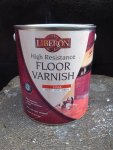
Best finish for teak and holly soleboards is heavy duty floor varnish such as used on commercial applications like village halls and other floors that have heavy use. Several brands available but I use Ronseal. I have T&K ply on my bathroom floor and it still has the original finish from 30 years ago. I also used it successfully on the boards of my old wooden boat
 
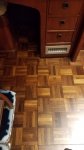
We covered ours with reclaimed teak parquet. It's a big job but gives us a 7mm wear layer on top of the old floor. We also joined a few boards where we didn't want such small floorboards. If you coat the floor with two coats of clear cote received_422277003149907.jpegepoxy then sand flat then add 3 or 4 coats of varnish you will get an excellent finish, very hard wearing and impervious to moisture.
 
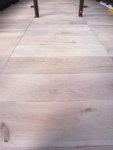
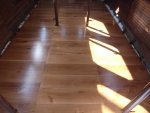
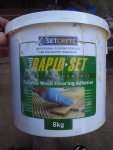
I did something similar to @geem and laminated 2mm oak on mine. Not having access to a laminate press I borrowed all the old batteries from the battery recycling in the marina and stacked them on top of the sheets after gluing. Important to tape over the seams and any knot-holes or gaps in the laminate before stacking, or glue can seep through and attach to the next panel on top... After leaving the stacked sheets to set for a couple of days I cut panels out of them, lightly sanded and varnished the oak, and painted the back and edges with several coats of Danboline. Very pleased with the result for relatively little money and effort, and it's stood up very well even after five years of wear. No sign of delamination anywhere, which was my biggest concern. The only issue I have is that the stringers are not 100% even on my old boat, so some of the panels see-saw a bit when you walk on them. Have thought of screwing them down but that seems a little drastic!

I got the oak board from here: Pack of 3 Character Grade Thin European Oak Boards

Edit: I see the price of these oak boards has more than doubled; I paid £7.80 inc. VAT for each pack of three in August 2017, or around £200 to cover the floor. They are now £18 per pack...
 

Attachments

  • floor.jpg
    floor.jpg
    479.8 KB · Views: 18
  • varnished.jpg
    varnished.jpg
    354.2 KB · Views: 18
  • polyurethane_flooring_glue.jpg
    polyurethane_flooring_glue.jpg
    390.8 KB · Views: 19
  • varnish.jpg
    varnish.jpg
    488.3 KB · Views: 11
Last edited:
Best finish for teak and holly soleboards is heavy duty floor varnish such as used on commercial applications like village halls and other floors that have heavy use. Several brands available but I use Ronseal. I have T&K ply on my bathroom floor and it still has the original finish from 30 years ago. I also used it successfully on the boards of my old wooden boat
That's very true. Many of the commercial floor finishes also comply with the appropriate standards for slip resistance but I doubt they would be effective if the floor was wet.
 
Top