Hydraulic Gearboxes

I have a PRM hydraulic box.
being British made, it leaks, my bilge is always oily and if I forget to fill it up once a year I suddenly lose drive at an inconvenient moment.
The boat was built in 1980, but the box is a 1998 replacement. 16 years and only 1500 engine hours, not good engineering really.
My PRM150 is 11 yrs old & 1100hrs no leaks, in fact we dust the bilges
 
Small gearboxes such as the Hurth zf 100 or the PRM 50/100.use small clutch plates which when locked causes the locking gear to move backwards or forwards by way of a spiral gear a bit like the Bendix gear on a starter .It is the engine torque thateffectively actuates the system.
Certainly on my old tmp hydraulic hydraulic pressure holds together two clutch plates(x2for forward and reverse) one convex the other concave which as far as I understand it the power is then transmitted through to either forward or reverse in the same way a car clutch works.
If the hydraulics pack up or loose pressure then at best you loose power and at worst no transmission whatsoever.
Mine is water cooler and the hydraulics which use ordinary engine oil operate at about 80psi
 
When discussing this it seemed that it was normal, if not universal, that hydraulic gearboxes were equally happy running in both directions whereas the mechanical ones (at least those fitted to smaller engines) were significantly de-rated in reverse. Is that purely a matter of design or is there something inherent in the design of hydraulic boxes?
 
I am reading this thread on behalf of a friend. I'm trying to understand Hydraulic gearboxes.
It might be worth me adding my own gearbox basic operation.
Sabb 18 hp. the gearbox is a part of the engine no chance to use anything else. its all mechanical no oil cooler or hydraulics. The gear stick pushes a cone clutch into position, the propeller drive shaft is pulled by the force of the prop in the water against the drive clutch and off you go.
Once under way you can relax the gear lever.
To stop you physically (its not difficult) pull the gear lever which disengages the drive.
there is a fairly solid sprung plunger device to hold it in neutral.
 
Have had both types of gearboxes in mobos
Volvo Penta chocolate teapot MS4B :(
and
Velvetdrive 72C. :)
Chalk and cheese...give me the Velvet Drive any day of the week in every single possible way.

The MS4B has the same ratio both forward and astern.
 
I have a PRM hydraulic box.
being British made, it leaks, my bilge is always oily and if I forget to fill it up once a year I suddenly lose drive at an inconvenient moment.
The boat was built in 1980, but the box is a 1998 replacement. 16 years and only 1500 engine hours, not good engineering really.

I have a PRM 100 series (not sure which actual one of the series) on my Perkins 4-107 ... and its a dream ! As I understand it ... the hydraulics cause the drive pinions to move and engage respective shafts ...

Only trouble I had was the cooler ... the tubes gave way in it and the box would empty of oil ..... When it happened - we were on our way to Swedish islands for a 10 day cruise ...
That box just kept on working ... we kept topping it up ... it kept working ...
When we got back home ... I removed the cooler and gave it to a metal work pal of mine who dismantled it ... well actually it fell apart !! He made a new one with fewer but better tubes inside.
That was 7 years ago ...... all we did was flush the box with very light oil ... suck it out with the little bit of water and refill with right oil.

I have nothing but praise for it ...
 
Last edited:
With a PRM if the oil gets low it takes a second or two to engage. If it gets really low, of course, there will be metal to metal problems, as the input shaft from the engine is still rotating
 
I'm trying to buy a BMC 1500, and the real Iffy one I'm looking at seems to have a Borg Warner Velvet drive unit, (It's defintely not a PRM 150), with 2 hoses and a selector on top of the box, rather than the side. (I've not seen it yet).
Any opinions, cos I might be able to buy back the old manual gearbox that was dumped with a badly siezed and broken engine ??
 
I have a PRM hydraulic box.
being British made, it leaks, my bilge is always oily and if I forget to fill it up once a year I suddenly lose drive at an inconvenient moment.
The boat was built in 1980, but the box is a 1998 replacement. 16 years and only 1500 engine hours, not good engineering really.
My PRM hydraulic box was new with the engine in 2007. No leaks. 2700hrs
 
I'm trying to buy a BMC 1500, and the real Iffy one I'm looking at seems to have a Borg Warner Velvet drive unit, (It's defintely not a PRM 150), with 2 hoses and a selector on top of the box, rather than the side. (I've not seen it yet).
Any opinions, cos I might be able to buy back the old manual gearbox that was dumped with a badly siezed and broken engine ??

Borg Warner velvet drives are good, used widely and like anything else mechanical can have issues but largely fine.
 
Thanks for the last few replies and can a BMC 1500 owner confirm there were only 2 types of hydraulic box fitted . I will be really happy if I can do the deal, as I just looked up the owners manual for the Velvet drive series, and all of them use engine oil and are can be left in idle with the prop allowed to spin when sailing, as that is not true for some hydraulic boxes due to lack of oil or fluid flow to the output bearing in particular. That means I can fit a shaft generator to make good use of the 3 bladed prop. They used to use a 12v starter motor off a car in the old days, and you can generate nearly 20 Amps with a good system. Alas a spinning prop generates slightly more drag than a stationary one, but you can't win them all, (The angle of attack increases if a prop starts to spin, generating more drag).
 
So how do they actually work?

Is there still a direct mechanical connection (bits of rotating metal) between the crankshaft and the prop shaft or do they use hydraulics to transfer the power (e.g. like a torque converter in the old style automatic boxes).

And if it uses hydraulics - can you go "the whole hog" and decouple the engine from the propshaft (using flexible pipes) and so save all the hassle of engine alignment? I guess that is a different sort of drive so more expensive
I looked a boat a few years ago (it might have been a scampi) and the engine was under the bunk in the front cabin... With hydraulic lines taking the power aft too a gearbox and shaft etc...(seemed daft and the seller thought it was really inefficient in terms of power)
 
I'm trying to buy a BMC 1500, and the real Iffy one I'm looking at seems to have a Borg Warner Velvet drive unit, (It's defintely not a PRM 150), with 2 hoses and a selector on top of the box, rather than the side. (I've not seen it yet).
Any opinions, cos I might be able to buy back the old manual gearbox that was dumped with a badly siezed and broken engine ??
Paragon is another one from that era
 
Thanks for the last few replies and can a BMC 1500 owner confirm there were only 2 types of hydraulic box fitted . I will be really happy if I can do the deal, as I just looked up the owners manual for the Velvet drive series, and all of them use engine oil and are can be left in idle with the prop allowed to spin when sailing, as that is not true for some hydraulic boxes due to lack of oil or fluid flow to the output bearing in particular. That means I can fit a shaft generator to make good use of the 3 bladed prop. They used to use a 12v starter motor off a car in the old days, and you can generate nearly 20 Amps with a good system. Alas a spinning prop generates slightly more drag than a stationary one, but you can't win them all, (The angle of attack increases if a prop starts to spin, generating more drag).
There were several people that marinised BMC 1500 engines so all sorts of gearboxes
 
In many hydraulic gearboxes there is a manual (mechanical) override to get you out of trouble in event of a hydraulic / clutch plate failure - two of the bolts from the upper access casing on a PRM for example - you just take the cover plate off and use two of the bolts to 'pinch' together the clutch plates as a 'get you home'. I keep a 13mm (iirc?) spanner strapped to the gearbox for this purpose - it only takes minutes to do.
 
When discussing this it seemed that it was normal, if not universal, that hydraulic gearboxes were equally happy running in both directions whereas the mechanical ones (at least those fitted to smaller engines) were significantly de-rated in reverse. Is that purely a matter of design or is there something inherent in the design of hydraulic boxes?
Not true for Hurth (although the ratios are very slightly different).
 
In many hydraulic gearboxes there is a manual (mechanical) override to get you out of trouble in event of a hydraulic / clutch plate failure - two of the bolts from the upper access casing on a PRM for example - you just take the cover plate off and use two of the bolts to 'pinch' together the clutch plates as a 'get you home'. I keep a 13mm (iirc?) spanner strapped to the gearbox for this purpose - it only takes minutes to do.
True, but beware: PRM boxes are happy running either way, so the 'get you home override' might be astern, as happened to a friend of mine, 10+nm going backwards with the occasional twirl.

Mine had an allen key clipped inside the cover
 
Paragon is another one from that era
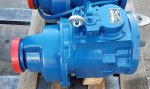
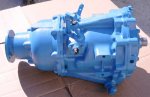
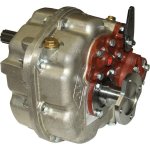
Ahhh, don't tell me there was a third type of hydraulic box fitted ! I will go Google some pics.

It really looks like the Velvet drive box, the only difference seems to be that the selector arm is different, as it's on top.
 

Attachments

  • Paragon.jpg
    Paragon.jpg
    143 KB · Views: 3
  • Velvet drive.jpg
    Velvet drive.jpg
    26.1 KB · Views: 3
  • prm-150d3.jpg
    prm-150d3.jpg
    56.8 KB · Views: 2
Last edited:
Top