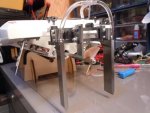
Hull shape how aware are you ?

As a totally o/t comment, I very much like those transom rudders! :encouragement:

During my boat search, I only came across a couple of f/b boats with the same setup - and it's no coincidence that they were a Baia and a Italcraft.
Can't get my head round the reason why they never became more popular also on f/b hulls... :confused:

I know a couple of Italian builders (apart the ones you mentioned) which experimented with them, but they did not like the side momentum they give.
Which is still little compared to what IPS pod give with a 15 degrees deadrise hull for e.g..
 
As a totally o/t comment, I very much like those transom rudders! :encouragement:

During my boat search, I only came across a couple of f/b boats with the same setup - and it's no coincidence that they were a Baia and a Italcraft.
Can't get my head round the reason why they never became more popular also on f/b hulls... :confused:

Yup let's drop strakes n rails -agree on that .

Rudders

Fascinating --- and baffling what's Amarti doing here ?
null_zpsjbfqg2c0.jpg

A46 --the rudders hang waaaay out at the stern on that frame .The Frame hydraulically moves via submerged rams up/down ,and there's a submerged horizontal ram .

Props are just under the transome -- as far back ,further back than mine -which are nearly under the transome ( this all mid engine straight shaft -- engines room splits the boat so they all have a big aft cabin seperate access)

Shaft angle -- thing ,--- longer ,thus lower ?
Some drag issue --- you can raise the rudders @ speed ?-- out of the prop wash ?
Lift issue ? --- by shifting the props away from the V ,deadrise minimises any potential lost lift ?
Control issue ? @ speed -in the -- 30 -40knot range ?-dip them down to turn tighter ?

Dunno ? ----any ideas ---- seems pretty unique ---nobodies copied it ?

null_zps2uvofy5o.jpg

A54 ----- went through a phase in the late 90 s


What I will say if it helps anybody ?
In mine a 42/48 it's 4.2beam -narrower ,the 46 is 4.38 --- mines a bit longer 14.5 ,the 46 is 13.somthing ?--bit shorter .

At speed say high 20's and defo over 30 's the rudders become very ineffective ,so much so to turn tight I have to throttle back and slow down to say 25 knots .Execute the tight turn then throttle up back to say 32or what ever .

Normal course adjustments on a cruise - no need to reduce speed .

So may be he wanted to put some distance between the props n rudders --if mine are too close - and ineffective @ speed

Dunno ?
The 46 and 54 were 90's mine is 2001-2004 --he dropped the hanging rudder thingy

Any how when looking at them all @ buying staged all that under water extra hydraulics ( think VP steering rams ) put me off -idea was to Goto shafts and get away from all that -leaky ram malarkey in outdrives
 
Last edited:
Perhaps the the person designing the swim platform was having an argument with the person who was designing the rudders. Or it could have been a bet

If you look carefully the bathing flatform is disproportionally longer ,to cover them .
"Rudder man "won :) - or the reasons for the rudder were more important ,look at the supports under the platform - extreme angle ?
 
If you look carefully the bathing flatform is disproportionally longer ,to cover them .
"Rudder man "won :) - or the reasons for the rudder were more important ,look at the supports under the platform - extreme angle ?
They got their inspiration from the world of remote control boats
IMG_0703.jpg
 
I know a couple of Italian builders (apart the ones you mentioned) which experimented with them, but they did not like the side momentum they give.
Which is still little compared to what IPS pod give with a 15 degrees deadrise hull for e.g..
Interesting, W.
By "side momentum", do you mean listing while steering? The IPS comparison brings that to mind.
And purely out of curiosity, can you mention that couple of builders?
 
baffling what's Amarti doing here ?
I half recall to have read that those transmissions were just meant to further increasing top end speed, without the drawbacks of full flagged surface drives/props (particularly on smallish/mid size boats).
I also believe that Amati managed to patent that solution, though I don't think there has ever been a queue of builders willing to adopt it...
Eventually, for sheer speed, the higher efficiency of surface transmission is impossible to beat anyway, still nowadays.
 
Fwiw, I also would definitely prefer to continue the debate with a cold beer in hand - either around Lérins, possibly in a day (if any! :rolleyes:) when there's enough space between all boats to have a swim, or maybe around CF, if you would fancy coming there and enjoy a more quiet environment.
But as of now, we can only continue along the lines of cold winter night armchair debates when TV is rubbish, I reckon... :D

So, ref. this point:

Funnily, I agree that the article supports your rather than PF point, but that's actually one point of the Hinckley webpage I don't agree with.
Not the only point btw - the one you quoted in the second to last para of your post #83 being something they should be ashamed to have written, for instance.

But ref rails length I disagree on two levels:
Firstly, and quite simply, there's no such thing as a fully (i.e. permanently) submerged rail, in P boats - and the faster they are, the more this is true, for very obvious reasons.
Secondly, rails are not just "spray" rails. We already disagreed to some extent on this point, but I still believe that dynamically rails can increase lift because of their different AoA vs. the water surface, compared to the same hull with no rails - even if I understand your point ref the horizontal component of the surface being the same.
And in the previous discussion on this matter, I also quoted in this post what Levi wrote about that.

But let's leave lift aside for a moment - happy to agree to disagree on that.
Another thing Levi highlighted in his book is that rails extended up to the transom (as in most of his hulls), have distinct advantages in terms of higher dynamic stability, both directional and transversal.
So, I would think that Amati had good reasons to choose "full rails" (so to speak) for his hulls, and I very much doubt that by sanding out the back half of Fiammetta rails she would go even 0.001kts faster.
Btw, you might have noticed in PF pics that the internal rail is already interrupted well before the transom, in order to minimize the water flow interference in front of the props.
It's not like Amati earned his reputation for nothing!

Besides, you can find "full rails" on just about any real fast P hull, from my old lake toy (see pic below), all the way up to 200+ mph turbine cats.
And I don't think any of those builders would have dismissed a chance to gain even a hair of additional speed by interrupting rails, if it were that easy.
Hull.jpg


All that said, I fully agree that when talking of P boats designed for cruising at a reasonable combination of comfort and speed, what we are discussing is firmly in the "hair splitting" league, and none of these effects would be relevant enough to be perceivable.
The only exception is maybe the one summarized by the "Rivale vs. Itama" comparison, 'cause you can definitely feel the difference between a true deep-V hull and a flatter modern hull designed around the interior requirements, when banging into a head sea at speed. But that's just about it.

And even in much faster boats like the Fountain above, I don't think anyone could say just by looking at her hull how "good" it is.
Sure, when you see a stepped hull, a padded keel and a notched transom you expect the hull to be fast.
But if you put it near a similar hull of another yard, you are likely to find similar solutions.
Truth is, there are only three ways to find out which performs better: test, test, test.

For this reason, my personal answer to PF question "has this post raised your awareness of hull shape" is...
...sorry, but nope. Not one iota, I'm afraid. :)
I agree most of that MapisM. A few quick details:
1. Full rails (all the way to transom) are a Good Thing if the boat is so fast that its chines out of the water at the transom. That means a properly fast boat like your Fountain. My comment that PF's itama would be better with the aft part of the rails removed is based on the fact that the boat is medium speed, and nowhere near fast enough to get her trnasom chines out of the water Soni-Levi style or Fountain style. I didn't get why you said all there is no such thing as a fully submerged rail. Loads of planning boats (mine for sure!) have the aft half of their hull permanently submerged. As I say, you need Levi/Fountain style boats to have the chine up in the air at the trnasom, surely?

2. Therefore, where you wrote: "Besides, you can find "full rails" on just about any real fast P hull, from my old lake toy (see pic below), all the way up to 200+ mph turbine cats.
And I don't think any of those builders would have dismissed a chance to gain even a hair of additional speed by interrupting rails, if it were that easy
." we are at crossed purposes. A really fast boat needs full rails, because you need to shed spray all the way back to the transom. It is only on boats with their back end permanently submerged, ie NOT really fast P boats, that you should remove the aft part of the rail (hairsplittingly, of course)

3. The post you link to where you quoted Levi was interesting, as you commented at the time, in that he made a statement with no explanation. It is possible that he meant either or both of (a) if you cut off the spray with a rail then the boat will unquestionably go faster due to pumping loss reduction, and that will create more lift, but the lift is a consequence of the extra speed, not of the rail per se. And of course it is a virtuous circle because the "free" extra lift reduces friction, which gives even more speed, and so on. Or (b) the change in direction of an upward water flow to a sideways water flow creates Newtonian lift on the rail, as mentioned briefly above by C-R, but of course that lift is being paid for with diesel and isn't "free" like the spray-deflection benefit. As I say, I'm guessing. Levi didn't explain himself.

4. You said that Levi said that full rails also increase dynamic stability. I see no plausible physics to support that, but I'd be interested to hear of any plausible analysis.

#beer, lerins or sardinia, pens and beermats:encouragement:
 
As a totally o/t comment, I very much like those transom rudders! :encouragement:

During my boat search, I only came across a couple of f/b boats with the same setup - and it's no coincidence that they were a Baia and a Italcraft.
Can't get my head round the reason why they never became more popular also on f/b hulls... :confused:
MapisM I'm pretty sure ferretti used transom hung rudders on some of their flybridge boats a while ago. Eg Deleted User's old 46 (???). The side loads on the bearings are of course much bigger than on a traditional rudder with the bearings 20-50 cm (or whatever...) apart.
 
Truth is, there are only three ways to find out which performs better: test, test, test.

And there was no one better at testing vee hulls for speed than ol' Reggie Fountain...using shareholder funds,I might add.

And what did he find? It wasn't a single silver bullet, but a cocktail of twin steps,pad, drive heights and the CG moved forward (counter intuitively).stepped hull.jpg
 
MapisM I'm pretty sure ferretti used transom hung rudders on some of their flybridge boats a while ago. Eg Deleted User's old 46 (???). The side loads on the bearings are of course much bigger than on a traditional rudder with the bearings 20-50 cm (or whatever...) apart.

Well spotted indeed sir

Infinito-019.jpg
 
Very aggressive props, must be fast

Far from it actually! My Ferretti F46 was a fat Italian mama and topped out at 27kts max and that was downhill on a good day. Otherwise though she was a lovely boat
 
Maybe Portofino's right, crappy hull:)

Of course Portofino is right. Unless its an Itama, by definition its a crappy hull. Not only that but the spray rails didn't go all the way aft so I'm very surprised it even floated;)
 
I agree most of that MapisM. A few quick details:
1. Full rails (all the way to transom) are a Good Thing if the boat is so fast that its chines out of the water at the transom. That means a properly fast boat like your Fountain. My comment that PF's itama would be better with the aft part of the rails removed is based on the fact that the boat is medium speed, and nowhere near fast enough to get her trnasom chines out of the water Soni-Levi style or Fountain style. I didn't get why you said all there is no such thing as a fully submerged rail. Loads of planning boats (mine for sure!) have the aft half of their hull permanently submerged. As I say, you need Levi/Fountain style boats to have the chine up in the air at the trnasom, surely?

2. Therefore, where you wrote: "Besides, you can find "full rails" on just about any real fast P hull, from my old lake toy (see pic below), all the way up to 200+ mph turbine cats.
And I don't think any of those builders would have dismissed a chance to gain even a hair of additional speed by interrupting rails, if it were that easy
." we are at crossed purposes. A really fast boat needs full rails, because you need to shed spray all the way back to the transom. It is only on boats with their back end permanently submerged, ie NOT really fast P boats, that you should remove the aft part of the rail (hairsplittingly, of course)

:

I don,t think it's an error by Amarti taking the rail to the to the stern .
Accepting your principles ,let's run with that ,I am ok with it now .Tnx .

It's just the threshold speed of when the rail at the stern acts as a lifting strip to gain lift and reduce overall drag or acts as a spray rail --- ?? Or does a bit of both depending on speed ?

A anecdotally ---- the Riva 52 went up to 40 knots @ 2300 rpm ( MAN 1200,s ) and it's steering was did not change noticeable in responce .ie rudders felt submerged all the time .
It healed over on turns a lot as well for more than the Itama . A small turn of the wheel off it went healing ,I just though it was a nod to "sports boats "

With as mine upwards of say only 25 knots the ruders start to lose bite .
Over 30 knots say at 37 may as well not have them ,it just runs arrow straight and flat ,with 0 trim .Making the autopilot redundant .It takes a "set " just parts the sea rock solid and smooth

So to me it's lifted the rudders so far out of the water rending them useless -- at mid 30 ,s

Infact at high speeds all the rudder does is take a knot or two off the speed. Boat still runs arrow straight ,hardley turns at all !You can feel a vibration ,presume turbulence ?

Going back to hydraulic rudder bar concept ,maybe that's it -to dip em in to stay in control at speed if you want that ,or raise em up to cut drag ,but loose out on steerage .

If so that begs the Q does the hull lift out enough to those transome chines , at speed turning em into spray rails .
Thing is they are wedge shape and will cut vertical drag as the water move up the hull at the stern They are not triangle spray deflector shape at the stern , but they are at the bow .The profile changes from bow to stern ,suggesting the function changes ?
They are not that low down we're they end wedge shape @ the stern --see previous pic and theres plenty of Hull below them kinda inbetween .

Also it turns very flat ,rolls very little ,the faster you go the stiffer it gets ,does not want to turn ---goes arrow striaght
To get it to turn at speed I find I have to throttle back a bit and can feel the rudders bite as it slows down to around 25 knots
Somthing stopping ,resisting healing - when it turns - and the rudders loose there bite as speed increases .
As I said if I have do a unplanned turn ( yachy tacking ) I have to slow down 1st then turn ,still planing just drop it down to get control .When it looks safe -- off we go again

Another thing below 30 knots you get what I consider a normal lateral spray pattern of water deflected side ways ,butter fly wing like from the middle of the boat ,where the helm is , as it gently bounces along
However mid 30 m,s the deflected wave moves right back to the aft cabin ,where the hard chines are .
The spray pattern changes ,more like long glider wings of water shooting out instead of the butterfly wing effect .
Looks quite dramatic infact
Also it's noisey you can here the hard chines at the aft cabin are now slapping ,clapping the water .It as if the chines at the stern are basically out of the water until a wave hits them-- clapping noise
Just to be clear still a smooth soft ride.
So it feels to me it actually does lift up quite a bit mid 30,s and it's behaviour changes .

I can't see down @ the transome ( B platform in the way ) at speed ,aside it's a bit dangerous leaving the cockpit @ 40 mph .

It's just I suspect those rails carried to the transome are there for reason and you may have under estimated the speeds they become useful -- on that hull .
 
Last edited:
And there was no one better at testing vee hulls for speed than ol' Reggie Fountain...using shareholder funds,I might add.
And what did he find? It wasn't a single silver bullet, but a cocktail of twin steps,pad, drive heights and the CG moved forward (counter intuitively).
Yup, 100% agreed.

Reggie was indeed famous for making countless attempts to improve his boats through trial and error.
Even back in the days when he was the one and only shareholder, TBH...
...Though you might argue that also his client have always been beta testers, to some extent! :D

As the story goes (but I heard it from a serial Fountain owner in the US, who doesn't invent silly stories for the sake of it), he made for instance countless trials just varying the outdrive(s) installations, changing the X-dimension half an inch at a time and re-testing. And it's not like changing the X-dim is a quick and easy job!

My Fever 27 was a 07 MY, one of the last built before she was phased out, leaving the 29 as their smallest boat.
X-dim was 19", and according to the performance report, out of the factory with the stock Mercury 496 Magnum H.O. (425hp) and a 24" prop, she reached 66mph.
Not too shabby - in fact, it's safe to assume that by 2007 Reggie had ironed out the hull performance in any imaginable way.
In spite of that, her previous owner tweaked her further (just a bit: CMI exhaust manifold, allegedly good for 20 to 30 more hp, and a 26" lab finished prop - nothing major), and when I bought her I managed to see 72mph with light load. A helluva improvement, at that sort of speed!
If that doesn't prove what you said ref. no single silver bullet, I don't know what else does...! :encouragement:

But ref. weight distribution (hence CoG) shifted forward, afaik that was only done on his most extreme boats, capable of 3 digits speed, where also aerodynamic begins to play a relevant role, and air alone can lift the bow too much, hence requiring trim tabs, hence increasing drag.
Not an issue on 99.9% of boats, of course! :)
 
Well spotted indeed sir
Well, you live and learn, as the saying goes! :)
I've seen several Ferretti hulls (150, 165, 175, 185, 53, 550, 57, 590, 620, 630 - and I'm probably forgetting others), but never came across the 46.
I'd be curious to know their rationale for both choosing first, and afterwards abandoning that solution... :confused:
 
I didn't get why you said all there is no such thing as a fully submerged rail. Loads of planning boats (mine for sure!) have the aft half of their hull permanently submerged.
Yeah, of course it's pretty unlikely that an 80' f/b that cruises in the 20 to 25 kts range can take off, even with the worst sea conditions.
But a sub-50' Itama (or any other similar boat), designed to handle mid 30s cruising speeds or more (depending on power and transmissions) also in some rough sea, surely can get air in just about every part of her hull, at times. That's all I meant.

3. The post you link to where you quoted Levi was interesting, as you commented at the time, in that he made a statement with no explanation. It is possible that he meant...

4. You said that Levi said that full rails also increase dynamic stability. I see no plausible physics to support that, but I'd be interested to hear of any plausible analysis.
I see what you mean. Unfortunately, I don't have his original book, just a PDF with some abstracts of the IT version.
Besides, I 'm travelling and the file is on an archive HD at home, but I'll have another look at it asap, to see if I find anything else worth reporting.

#beer, lerins or sardinia, pens and beermats:encouragement:
Anytime! :cool:
 
Top