Huge Engines on inland waterways

Bigplumbs

Well-Known Member
Joined
7 Nov 2015
Messages
8,160
Location
UK
Visit site
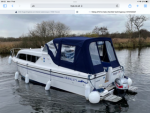
I read a lot of posts on here about people who only boat on inland waterways but they seem to have a sea designed planing boat with monster engines. The largest of my boats a little Sealine S24 is on the broads and also fits this category but I Never intended to keep it on the Broads where we bought it but that just seems to have happened.

I see many ’River designed boats’ that are the same size as my Sealine with a nice layout with low air draft and a hassle and worry free little 20 or 30 hp outboard on the back And I think that is what I should have but then I love my S24 and will get her on the sea sometime.

So I surpose my Question is why are there so many sea boats with monster worrying and expensive engines on inland waters.
 
Folks want the large amounts of interior space that only a big volumous boat can can offer, these do tend to come with powerful engines to match.
On the Thames quite a few large boats spend much of their lives stationary at the end of owners gardens/ in marinas , but many do venture out into tidal waters on a regular basis, even daring to risk life and limb visiting the Medway.
Some skippers having done just about everthing possible on salt water around the coasts of UK and across LeManche simply decide the tranquility of the inland waterways will do just fine until they go to the great marina in the sky.
Recently went to look at beautiful example of large flybridge Fairline kept on the Thames that was up for sale.
Know that the skipper had previously spent much time in the "Med" and cruising offshore in UK , eventually finished off his boating on the Upper Thames.
 
Last edited:
There aren't many actual river only boats around, most are 30+ years old, If you want something modern looking and newish there is only very expensive Dutch steel or rather budget fit out Vikings etc.. What is the River boat version of say a Sealine 34?

Its also a bit like cars, lots of very high performance capable cars are used for very mundane shopping trips etc... Why by a Range Rover when a Dacia Duster will do the same job.
 
I read a lot of posts on here about people who only boat on inland waterways but they seem to have a sea designed planing boat with monster engines. The largest of my boats a little Sealine S24 is on the broads and also fits this category but I Never intended to keep it on the Broads where we bought it but that just seems to have happened.

I see many ’River designed boats’ that are the same size as my Sealine with a nice layout with low air draft and a hassle and worry free little 20 or 30 hp outboard on the back And I think that is what I should have but then I love my S24 and will get her on the sea sometime.

So I surpose my Question is why are there so many sea boats with monster worrying and expensive engines on inland waters.
I guess people like their boat and preferred waterway.

Our plan was to buy a boat and moor it on the Thames as we love the middle and upper Thames, we ended up staying at Ramsgate as we love the place but another 2 hours drive further than we had originally planned. We've seen a lot of boats around 38' on middle Thames and wondered how they got on mooring outside of marinas but maybe they just marina hop.
 
The main reason I ask is the potential cost of fixing issues and the service cost of often twin Volvo inboards with a pair of out drives is very scary. When a smallish outboard that will push along at 6 knots no trouble is a non event cost wise comparatively. I will admit my thoughts are confined somewhat to up to 32ish foot long
 
It’s certainly a overkill solution but what’s the alternative? the first boat I put a deposit on was on the river and had a pair of v8s which I found incredulous, given the speed limits, however I didn’t want a boat designed for river use as they look awful, on the whole, and I knew I’d end up taking t boat out to sea. Quite a few of the large boats on the part of the Thames I was one did regularly leave the river and go to France/Holland.
 
The main reason I ask is the potential cost of fixing issues and the service cost of often twin Volvo inboards with a pair of out drives is very scary. When a smallish outboard that will push along at 6 knots no trouble is a non event cost wise comparatively. I will admit my thoughts are confined somewhat to up to 32ish foot long
Good luck manoeuvring a 36ft boat with a small outboard, not withstanding the fact flows can require some serious grunt occasionally.
 
There aren't many actual river only boats around, most are 30+ years old, If you want something modern looking and newish there is only very expensive Dutch steel or rather budget fit out Vikings etc.. What is the River boat version of say a Sealine 34?

Its also a bit like cars, lots of very high performance capable cars are used for very mundane shopping trips etc... Why by a Range Rover when a Dacia Duster will do the same job.

There are 13,000 boats registered on the broads.
Of those, probably in excess of 5000 are motorboats.
Of those less than 5% are sea going boats with big engines.

There are a lot that belong to the "Brundall Navy", they spend most of their year moored up in Brundall, owners drinking G&T on the upper deck.. Then once a year they'll trundle down through GY or Lowestoft and head across to the Nederlands / Belgium / France. Now we are out of the EU, I'm sure they will be back to the old tradition of coming back laden with booze..

One problem with the very big motorboats , is they can't move without breaking speed limits..
The speed limit in moorings and villages being 4mph, which is often below their tick over speed..

I've personally had problems when sailing up and down the start line in Horning , when a Big seagoing boat came down the river, he did his best, but opened the throttle just for a second or two to get out of the way. Unfortunately this left a big hole in the river behind him causing several dinghies to fall into it and hit each other..

The average motor boat on the broads has a diesel of 1.5litre for a 25 footer to 2.5 litre for a 40 footer, with outboarded boats of 25HP.. They are generally geared to a max speed of about 10mph. This allows some lee way as the max speed generally on the broads is 6mph over the ground, so you need a bit extra against the tides.
 
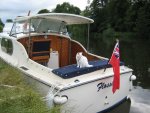
We had two Freemans, bloody lovely boats, very well built, using 4 cylinder petrol engines they were perfect for the Thames, purred along sipping around two litres an hour. Very cheap to maintain (comparatively speaking), admired by many and a huge following so great availability of spares, upgrades and knowledge. Our 26' was big enough for two adults plus cat and gave us huge fun, much better than our previous mistake we had on the Thames with 150hp petrol coupled to an outdrive. The thing drank fuel at an alarming rate even at river speeds and wandered all over the river having no keel for directional stability.
 

Attachments

  • Photo 2008-07-16 19.09.39 (2).jpg
    Photo 2008-07-16 19.09.39 (2).jpg
    930.4 KB · Views: 25
We had two Freemans, bloody lovely boats, very well built, using 4 cylinder petrol engines they were perfect for the Thames, purred along sipping around two litres an hour. Very cheap to maintain (comparatively speaking), admired by many and a huge following so great availability of spares, upgrades and knowledge. Our 26' was big enough for two adults plus cat and gave us huge fun, much better than our previous mistake we had on the Thames with 150hp petrol coupled to an outdrive. The thing drank fuel at an alarming rate even at river speeds and wandered all over the river having no keel for directional stability.

No that is a lovely boat. Lovely looking Cat also. That is the sort of thing but with an outboard
 
Each to their own but I just don't get canal 'Cruising'. Where we live we are surrounded by canals so very busy in Summer, manual locks at very regular intervals, grubby water and they trundle along at just above walking pace so covering little ground a day. The only appeal I could see would be canal side pubs but even they are declining in numbers.
 
No that is a lovely boat. Lovely looking Cat also. That is the sort of thing but with an outboard
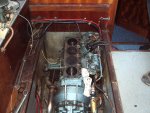
No need for an outboard on these boats as there is great access to a simple engine. One of the exhaust valves needed replacing so whipped the head off, did the valve and replaced all of the springs. The boat is still in service with no other engine issues, the boat and engine are over 50 years old!
 

Attachments

  • Photo 2007-01-09 10.37.42.jpg
    Photo 2007-01-09 10.37.42.jpg
    1,000.1 KB · Views: 17
No need for an outboard on these boats as there is great access to a simple engine. One of the exhaust valves needed replacing so whipped the head off, did the valve and replaced all of the springs. The boat is still in service with no other engine issues, the boat and engine are over 50 years old!

That is certainly an engine I can understand. Looks like the one I had in my Vauxhall Viva…………………. In the evolution of engines where or where did it go wrong. Back in those days we had never heard of Limp mode, ECU, EGR valves, Sensors, some bloke plugging it into his laptop to diagnose and replacing ‘modules’ at massive cost and it still not being fixed…………. Apparently it is progress
 
There aren't many actual river only boats around, most are 30+ years old, If you want something modern looking and newish there is only very expensive Dutch steel or rather budget fit out Vikings etc.. What is the River boat version of say a Sealine 34?

Its also a bit like cars, lots of very high performance capable cars are used for very mundane shopping trips etc... Why by a Range Rover when a Dacia Duster will do the same job.
Is there a market here to remove large but tired diesels and replace with twin electric drives for inland use?
There are clearly massive range and economic issues for electric boats in coastal and offshore boating, but they are ideal for inland use
- low speeds and modest distances ideal for electric
- low emissions and low noise
- easy access to shore power charging
- no need for fancy expensive systems & batteries - motors are cheap, and lead acid batteries are fine where weight is not an issue (and removing two diesels will require reballasting anyway)

There is an emerging market in fitting electric motors in classic cars (barking in most cases, as the engine is often a large part of the character), but converting boats for inland use could be a much better application. Do a refurb of the boat and interior at the same time and have a very attractive commercial proposition.

Add a DC generator and could be a range extender to nip across the Channel to the French canals, or North Sea to Netherlands.
 
Excuse please possibly a stupid question/s.
What's to stop fitting an aux engine (15-40hp) on a custom made bracket fixed to the swim platform?
Especially if bow thrusters are available to aid manouvreability? Want to go faster than displacement? Fire up the main and lift the aux. Even with the drag of the sterndrive the fuel saving could be significant? Could the outdrive work as a rudder so only remote throttle for the outboard is needed?
 
Top