How to wash a rope?

I coil and then use light line to secure the coils - I used electrical ties before - but found odd times - the ties caused damage ... using light line is soft and no damage. Tried a bag but it just tore open.

Rope Manufacturers do warn against contact with Chemicals .. Paint ... Bleaches etc. So IMHO - luke warm wash with only a light amount of standard wash powder and NO bleaching / softening agents.

Ropes come up clean !! Been doing it for years ...

Note that any power washing etc. drives crud INTO the layup ... trailing behind boat in SW - leaves salt in the layup .... all are abrasive to the rope internals.
 
Hydrogen peroxide will still damage nylon, though safer than, I bow to the Pilot's clarification, chlorine bleach.


But I'm recommending that damaging a product in the quest for appearance, to me, lacks much sense - and I accept - appearance rules.

Jonathan

a. I didn't say peroxide was safe for nylon, only safer. There will be some loss in strength, perhaps a few percent.

b. Here is the interesting part. I don't care about the appearance of a climbing rope, for example. But there have been tests that suggest that a clean rope wears less during rappels than a rope with imbedded grit. By extension, embedded lime can't help any rope. I doubt algae makes any difference. The other reason ice climbers wash ropes is to renew the DWR treatment; a frozen rope is a severe safety hazard. Perhaps a stiff rope on a sail boat is something of a hazard.

All that said, I almost never wash a rope, before or after I did the testing. Occationally a halyard, with the specific purpose of reducing friction on the hoist. I'll do it in a bucket and add DWR to soften the rope and further reduce friction. I sail often enough that I have never had problems with any sheet or tweaking line. I've never used a whitening agent, because it serves no positive mechanical or performance purpose.

I wash and re-treat ice climbing ropes every other season. I don't generally wash rock climbing ropes, but I would if I climbed in the desert (lots of grit).

As for temperatures and detergents, they are the same fibers used in clothes. I have been advised by NER that the only reason to use more gentle temperatures and detergents is if the rope is nearly new and spinning lubes are still present. Once the rope has been in the weather about 2-3 years, the lubes are gone and you can wash as any other nylon or polyester garment.
 
I've done it this way for years:-
1. Wait for SWMBO to go shopping
2. Put all metal wear in socks
3. Select warm 30° wash
4. Use any washing liquid and a dash of softener
5. Short spin
6. Untangle the rat's nest
7. Dry naturally

Avoid bleach
The purpose of washing is to improve appearance and to remove salt and grit from between the fibres.
 
I've done it this way for years:-
1. Wait for SWMBO to go shopping
2. Put all metal wear in socks
3. Select warm 30° wash
4. Use any washing liquid and a dash of softener
5. Short spin
6. Untangle the rat's nest
7. Dry naturally

Avoid bleach
The purpose of washing is to improve appearance and to remove salt and grit from between the fibres.

Absolutely
 
I've done it this way for years:-
1. Wait for SWMBO to go shopping
2. Put all metal wear in socks
3. Select warm 30° wash
4. Use any washing liquid and a dash of softener
5. Short spin
6. Untangle the rat's nest
7. Dry naturally

Avoid bleach
The purpose of washing is to improve appearance and to remove salt and grit from between the fibres.
No1 the most important bit, wash cycle of 45minutes is about the right time for her to go shopping and I’m back sat in chair relaxing as if nothing has gone on, it’s as if the nice pile of clean ropes have just sorted themselves out
 
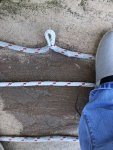
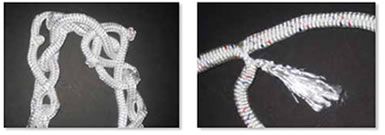
One aspect is to make sure the wash cycle is 'gentle' to avoid herniated rope ... (braid)

Until a week ago this was the emergency Dyneema Forestay. It's now a 7m shorter spare mooring line. Ho hum.

Pete
 

Attachments

  • Forestay.jpg
    Forestay.jpg
    434.4 KB · Views: 15
In the darker recesses of my memory were horror stories of un restrained ropes destroying washing machines?

But maybe that's my imagination.

Jonathan

Yes. NER confirmed this. The old central agitator type. The rope can wrap around and ruin the agitator gear box. The other thing that can happen is strands getting into the water pump and ripping out the seal.

Whippings and splices can be milked loose. The core can even come through the cover.

Practical Sailor Images. New rope, professional splices, gentle cycle. We were pre-washing ropes before starting the bleach tests. All of the ropes were ruined, so we had to start over using pillow cases. New ropes are far more vulnerable to this than old ones. It is the back-and-forth milking.
Rope_Hernias.jpg.optimal.jpg


I did a lot of washing testing for NER and broke several machines. There really is no good reason not to put the rope in a pillow case. You might get away without... or you might not. Your funeral. In a bag it is perfectly safe and will come just as clean.
 
Last edited:
Until a week ago this was the emergency Dyneema Forestay. It's now a 7m shorter spare mooring line. Ho hum.

Pete

I've been boating since I was ~5yrs old ... I'm now 66yrs old ... In all those years I have seen many people incl. my Father .. Uncle ... fellow Club Members and myself washing ropes in machine. Suitably bound to avoid tangling - the process works .....
In all those years - I have only once had herniated rope - and that was my fault for cutting the spare part of the zip tie .... being jagged - it snagged ..... and is why I changed to using small gauge line .... string.
 
I've been boating since I was ~5yrs old ... I'm now 66yrs old ... In all those years I have seen many people incl. my Father .. Uncle ... fellow Club Members and myself washing ropes in machine. Suitably bound to avoid tangling - the process works .....
In all those years - I have only once had herniated rope - and that was my fault for cutting the spare part of the zip tie .... being jagged - it snagged ..... and is why I changed to using small gauge line .... string.

The risk factors are:
  • New rope (Spinning lubes--but why would you wash nearly new rope? I did so for testing.)
  • Dyneema core (Slippery. Don't wash it in a machine IMO, or use a pillow case.)
  • Not in pillow case.
  • Very old rope. But these were shot anyway.
Unless at least 2 of these are true the risk is very low. I have washed many, many ropes without a pillow case. But I did not photoshop the pictures, and the rope was bound (of course--I hate working out tangles).

But mostly, I find washing ropes unnecessary. Just hang them so that they can dry.
 
I haven't worked it out yet why - but my boat suffers green mould very easily where she moors (at bottom of my garden). Far more than she ever did while in UK.

I replaced all running rigging last year and already I have a few spots ... so the act of washing 'new' rope may come about later this year or at least beginning of next season. (I regard rope as 'new' for its first couple of years, because generally cordage on a boat is oversized).
 
I put the ropes in the bath to soak for a week. After this length of time Mrs E asked me to put them in the washing machine.
Took me ages to clean the bath.

I also just tied the ends of the ropes together and got no tangles.
 
Top