How to solve the breather pipe pressurising the water tank

Yes the filler pipe can put hydrostatic pressure on the tank.
Yes that is one ton per sq m, for every metre of standpipe height.
Yes a flat top tank will bow.

That is why tanks are made from strong materials like stainless. And why well designed boats mount the tanks with space to distort.
And maybe have baffles which hold the tank in shape.

Some boats have the breather lower to avoid issues. One of my boats had it over the sink.
 
But in the cases being reported in this thread the problem is not that water (or fuel) blows back on deck. What is happening is that the tank itself if expanding fit to burst.

I've never heard of anything like it unless the filling system is sealed.

Richard

Point I am making is that the weight of fuel up the pipe creates a pressure of sorts & contrary to what people suggest the air does not always immediately pass back up the pipe. Depending on the way the tank is constructed liquid passed down the pipe could be effectively applying pressure by hydraulically pumping it down the supply pipe & once in the tank it is being trapped & cannot return. The next tranch of water repeats the cycle every few seconds.
perhaps there is a non return valve in the neck of the filler where it enters the tank. Water in the air breather could be restricting release of air from the tank
 
Last edited:
Yes the filler pipe can put hydrostatic pressure on the tank.
Yes that is one ton per sq m, for every metre of standpipe height.
Yes a flat top tank will bow.

That is why tanks are made from strong materials like stainless. And why well designed boats mount the tanks with space to distort.
And maybe have baffles which hold the tank in shape.

Some boats have the breather lower to avoid issues. One of my boats had it over the sink.

I've not checked your calc but 1 ton per sq metre is around 1.5 psi so a trivial pressure above atmospheric.

Richard
 
I've not checked your calc but 1 ton per sq metre is around 1.5 psi so a trivial pressure above atmospheric.

Richard
An Avon rubber dinghy is quite hard at 3PSI which is its recommended max inflation pressure. So compare that
Plus you do not need a ton of water to give 1.5psi. You only need a small diameter pipe & your 1 metre head ( assuming your calc for 1M is correct) that is how hydraulics get to work. A 10mm diam breather pipe full of water ( or possibly- I think- with water trapped in the top part due to surface tension where a kink occurs) will balance a 1.5 inch filler pipe of the same head & if both have the end in the fluid then the pressure applied by whatever head is applied will be applied to the containing vessel. if that vessel is flexible then it will expand in reaction to the pressure
 
Last edited:
Am I right in thinking that the OP has two water tanks, with one filler, and crucially only one breather?

I have two tanks, and only a single filler, but each tank has its own breather, from the top of the tank. A pipe joins the supply cocks on the two tanks, and the supply to the pressure pump is teed from this pipe. When I am filling, I open the supply cocks on both tanks, and fill until both tanks are full. Air comes out of both breathers. There are no problems with this.

Perhaps if the OP could describe his pipework layout, or even better show it with a diagram, we might be better able to help.
 
I've not checked your calc but 1 ton per sq metre is around 1.5 psi so a trivial pressure above atmospheric.

Richard
1.5psi is trivial until you've got a few thousand square inches. Then it packs a punch.
You are right 1m of water = 0.1bar =1.5psi near enuff.

Force = pressure x area


But, if the OP is filling from a hose with some pressure behind it, perhaps shoving a 3/4in hose into a 1in filler, it's easy to get more pressure from the incoming water, as the excess water builds pressure as it escapes from the filler hose.
My hose pipe at home has about 4 bar behind it. Luckily, most marina hoses are feeble?

It's not right, the breather should let air out until the tank is full.
 
I had an issue where one of two tanks had (I discovered after several years!) probably never completely filled.

The situation was single conventional deck filler, short c38mm hose, Y fitting, twin c38mm hoses to each of two tank via somewhat convoluted runs.

Both tanks had small vents c10mm, joined together at a T fitting on top of one tank, and then single small (c10mm) vent tube up to outlet (in coaming a few inches above deck filler).

The angling of the filler Y fitting tended to favour flow in the direction of one tank rather than the other, so that No. 1 tank would fill (with, meanwhile, only minor flow going to second tank). Once No.1 tank was completely full the water would start rising in both its filler and its vent tubes. Once its filler tube backfilled to the Y fitting all the flow would have gone to the No.2 tank, but by now there was no escape for the air from that tank (because the water level in the shared vent tube was already equal to that in the filler) so the tank would swell and make a loud bang sound, any more water added would just back up to deck level.

For years we assumed the 'bang' meant full of water, but eventually realised it was partly air. When I tried removing the vent pipe from the T fitting we were able to get more water in.

I concluded the solution would be have separate vent tubes for each tank all the way up to the vent outlet (i.e. have the T fitting at the vent outlet height, not tank top height, or just have two completely separate vent outlets). The No. 1 tank would then fill, its vent and filler would have water up to the Y fitting, water would then flow to No.2 tank, but the difference would be that air could now escape from its vent and the water could enter the tank until it was full.
 
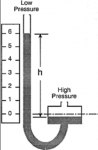
I checked my figures and they seem to be right. It is surprising the effect that the small mass of water in the head has but it is also how this type of manometer works
snip_20180119082844.png
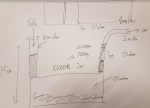
Here is a bad sketch, the filler is not sealed (at least until it backs up), the breather is shown exiting vertically but it actually is horizontal and has a slight dip due to the floor boards, hence the problem
snip_20180119083142.png
It is actually a set up of 2 tanks with an interconnected breather via a T near the tanks as described in the post above. I hadn't considered the possibility of incomplete filling of one tank due to pressure imbalance of the breathers, I will try exiting them both at deck level. My colleague in the office just suggested a good solution beyond very slow filling, insert a second pipe down the filler (a length of hosepipe) into the air space then the filler will never block. I am curious now as to whether my tanks can take more than 300 litres.
 
Last edited:
A thought experiment might demonstrate why the pressure is trivial from a 1.5m height breather pipe and cannot possibly cause a tank to swell.


Think of a tank filled slowly without a breather so the air escapes up the filler and leaves a tank full. The only pressure on the tank is the water filling it. As with a flexible tank this is a real pressure but not huge. Imagine a breather pipe full of water but not connected yet to the tank. The weight of water in the breather pipe can be held with one finger on the bottom end of the pipe - there are not tens let alone thousands of kg force on your finger. Now attach it to the top of the main tank. The force upwards from the full tank is nil as the breather pipe is on top of the water level. The weight from the water in the breather pipe doesn't magically get greater. This remains true whether the main tank is 10 litres or the size of a swimming pool.

The only temporary blowback you get up a filler pipe with a blocked or too small breather pipe is due to the pressure of the water mains hose pressure compressing the remaining air in the main tank and equalises as soon as you switch off the mains hose.
 
1.5psi is trivial until you've got a few thousand square inches. Then it packs a punch.

I'm not really sure how that is relevant to the subject under discussion .... but it's perhaps worth remembering that 1.5 psi above atm is about what a human can blow from their diaphragm/lungs. I've you've done any pressure work you'll know that human beings are pathetic in this regard and can barely blow up a balloon sometimes. :ambivalence:

There is absolutely no chance that this pressure will do anything to a water tank, unless its walls are as thin as a balloon. :)

Richard
 
Last edited:
I'm not really sure how that is relevant to the subject under discussion .... but it's perhaps worth remembering that 1.5 psi above atm is about what a human can blow from their diaphragm/lungs. I've you've done any pressure work you'll know that human beings are pathetic in this regard and can barely blow up a balloon sometimes. :ambivalence:

There is absolutely no chance that this pressure will do anything to a water tank, unless its walls are as thin as a balloon. :)

Richard

What part of force = pressure times area do you not understand?

A water tank with flat, unstiffened sides in say 2mm stainless does not take much force to bow the sides out of shape.
 
What part of force = pressure times area do you not understand?

A water tank with flat, unstiffened sides in say 2mm stainless does not take much force to bow the sides out of shape.

Absolutely so but that is nothing to do with atmospheric pressure if there is an unobstructed breather pipe while it was being filled. The pressure is due to the weight of the fluid being constrained by the size of the tank and the tiny weight of the fluid in a full breather pipe adds nothing noticeable to that pressure.
 
Absolutely so but that is nothing to do with atmospheric pressure if there is an unobstructed breather pipe while it was being filled. The pressure is due to the weight of the fluid being constrained by the size of the tank and the tiny weight of the fluid in a full breather pipe adds nothing noticeable to that pressure.

I don't think you will get through Rupert. I've been on this thread since the start but the level of misunderstanding about pressure is profound. :)

Richard
 
The only way you could make your stainless steel tanks bulge in an open system is if they had walls as thin as coke tins. You must be pressurizing the system somehow. If the breather is clear then you should hear/feel air coming out as you fill, or if the water level has got to the breather hole in the tank, have water coming out. If the breather is blocked then I would expect water to start coming out of the filler around the hose. If you have very high water pressure coming out of your hose, a blocked breather, and no gap round the filler then I can see it happening. If you have a small gap round the filler hose and blocked breather I would expect you to feel/hear air coming out the filler hole or be getting water blowback (tank may not have much water in it if the filler is low down on the tank.

The pressure exerted on your tank by a 1.5m water head in a 1.5" dia pipe is negligible. Air pressure is not relevant (the outside of your tanks are at air pressure) its the weight of the water in the column, about 1.4Kgs in this case and that is spread over the surface area of the tank. That won't do anything.
 
Absolutely so but that is nothing to do with atmospheric pressure if there is an unobstructed breather pipe while it was being filled. The pressure is due to the weight of the fluid being constrained by the size of the tank and the tiny weight of the fluid in a full breather pipe adds nothing noticeable to that pressure.


The pressure is the same whether it comes from a full breather pipe or the full filler pipe.
 
Perhaps the simplest answer is to repeat - pull the system apart until you find the blockage

Exactly, the breather either does not drain at all or goes to the bottom of the tank.
Even if the breather is blocked, air will normally belch out of the filler, if that goes to the air space.
If you fill a tank fast, the speed of the fluid will generate some pressure, often enabling the fluid to spurt back.
 
The pressure is the same whether it comes from a full breather pipe or the full filler pipe.

Not quite if diameter of the breather pipe is different to the filler pipe as there will be a different weight of fluid but I'm splitting hairs as the extra pressure of either weight is trivial compared to the weight of the fuel in the tank.
 
Top
