How to solve the breather pipe pressurising the water tank

I seem to have started quite a discussion about pressure. Yes the filler is more like 6 cm id.
There are no obstructions beyond water, I had replaced the breather system when I first noticed the problem as I mistakenly thought it must be blocked.
As for the pressure arguments I think that how a head of water pressurises a tank is less to do with its weight. It is the the difference in atmospheric pressure from the top of the column to the bottom. Imagine if I angled the breather at 20 degrees at the same pressure, it would fill to the same vertical height though the weight of the water would be higher.
If the atmospheric pressure changed so would the height of water (like a barometer, hey just thought of a new use for my problem!)
 
Last edited:
I seem to have started quite a discussion about pressure. Yes the filler is more like 6 cm id.
There are no obstructions beyond water, I had replaced the breather system when I first noticed the problem as I mistakenly thought it must be blocked.
As for the pressure arguments I think that how a head of water pressurises a tank is less to do with its weight. It is the the difference in atmospheric pressure from the top of the column to the bottom. Imagine if I angled the breather at 20 degrees at the same pressure, it would fill to the same vertical height though the weight of the water would be higher.
If the atmospheric pressure changed so would the height of water (like a barometer, hey just thought of a new use for my problem!)

That would be more correct if you left out the word "atmospheric" making the highlighted phrase read, " It is the the difference in pressure from the top of the column to the bottom "
The pressure difference being equivalent to the height of the water column.


I think you may have partly answered your question yourself in the opening post. Also pointed out by another in the middle of the thread somewhere.

When you start filling t he water lying in the horizontal section of vent pipe is pushed into the vertical section where its head pressure prevents air escaping from the vent.

Get rid of that horizontal section, arranging the vent pipe so that no water is trapped in it , and there is a good chance you problem will be reduced if not eliminated

However it is still a mystery why air is not escaping via the filler unless you are filling at a high rate from a fairly large diameter hose. If that is the problem filling at a more controlled rate should, in conjunction with sorting out the run of the vent, solve the problem
 
"a millimetre square pipe 1m high will exert the same pressure on a metre square tank as a metre square pipe above the same tank,"

Absolutely ! That is correct, not nonsense at all.

Basic school boy stuff, used by me in the oilfield for most of my working life.
The good old baccie chewing Muricains taught me the "27" of water head equals 1psi". They used to drawl and spit baccie juice, dressed in their denim bib and braces with their CAT hats on, looking like hayseeds but they knew a thing or two about liquid pressures and flows in pipelines!
Stu
 
a wee thought experiment to help you out here (and ruin skipper_stu's fun)
So you have a tube full of water that is not flowing because of back pressure from a tank. ie pressure in tank = pressure at bottom of tube.
Now, instead of doubling the size of tube, you add 3 more at different locations (but all with their bottom ends at the same height in the tank)
Your dislike of me in the Lounge because of our politics shouldnt spill over to the technical sections. What ever you say it wont change physics, the pressure in psi of a column of water is entirely dependent on its height no matter what its size.
Stu
 
.
Now, you agree that adding more identical tubes increases the pressure in the tank, and therefore at the bottom of the first tube.
How does that not push the water back up the tube?

Adding more tubes does not increase the pressure. It is the head of water above the top of the existing fuel in the tank that makes the pressure. If you had 10 pipes with fuel in they would all find the same level & the pressure under each pipe would be the same. Now if you blocked off those pipes & just ahd 2 at the same head it would still be the same pressure.

One further point which I think escapes forumites - I believe it is head above the top of fuel in the tank not head above the bottom of the pipe . That means the pressure is the same if the pipe goes one inch into the fuel or 20 inches into the fuel
 
There would be no measurable change in air pressure unless your column were several metres high. About 10 metres would be needed for any conventional instrument to detect any difference. It's only the weight of air after all. ;)

Richard

Well to disprove that i would suggest that you look at an Avon rubber dinghy as I suggested earlier. The max working pressure is 3PSI & that seems pretty hard to me so if one can recognise 3 PSI then one should equally be able to recognise 1 PSi . That pressure on the side of a flat unsupported tank would be enough to flex it. Whether it is as much as the OP suggests I do not know, but my SS tank does go bang as I fill it when the sides pop with 75 litres of water in a 100 litre tank
 
Your dislike of me in the Lounge because of our politics shouldnt spill over to the technical sections. What ever you say it wont change physics, the pressure in psi of a column of water is entirely dependent on its height no matter what its size.
Stu

I know that we both know the truth here... The "fun"... well, it did seem like you were giving enough rope......
 
Well to disprove that i would suggest that you look at an Avon rubber dinghy as I suggested earlier. The max working pressure is 3PSI & that seems pretty hard to me so if one can recognise 3 PSI then one should equally be able to recognise 1 PSi . That pressure on the side of a flat unsupported tank would be enough to flex it. Whether it is as much as the OP suggests I do not know, but my SS tank does go bang as I fill it when the sides pop with 75 litres of water in a 100 litre tank

Once again, I've no idea how that relates to the Op's point. :confused:

The reduction in atmospheric pressure at 10m high is a reduction of around 1/1000th i.e. barely detectable.

When you fill a large tank with water, the weight of water is considerable and could easily cause the tank sides to bulge if they are flexible enough. What we are talking about in this thread is the additional pressure that a column of water a metre or so high in a breather will generate ...... and that is negligible.

Richard
 
No 1 PSI will be generated by .7 Metres of head -so 10 M of head will generate a surface pressure on the tank of 14.28 PSI. hardly negligible
That is how hydraulics work. You pump a low pressure in through a small pipe into a large pipe & the large pipe then moves a big load but the pressure on the pump does not have to be that high.

We're talking about a 10 metre head of air in relation to the OP's post #61.

Richard
 
Last edited:
Once again, I've no idea how that relates to the Op's point. :confused:

The reduction in atmospheric pressure at 10m high is a reduction of around 1/1000th i.e. barely detectable.

When you fill a large tank with water, the weight of water is considerable and could easily cause the tank sides to bulge if they are flexible enough. What we are talking about in this thread is the additional pressure that a column of water a metre or so high in a breather will generate ...... and that is negligible.

Richard

I am not sure if I understand what you are saying and agree with you or not

BUT

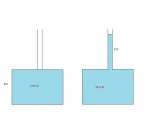
If you have two identical tanks, A & B, say a metre deep, each with a stand pipe on the top, one, A, is just full to the top of the tank and the other, B, has the water level one metre up the stand pipe.

water pressure.jpg The pressure at the bottom of B will be twice the pressure at the bottom of A despite the fact that the weight of water in the standpipe is minute compared with the weight of water in the tank itself.
 
Last edited:
I am not sure if I understand what you are saying and agree with you or not

BUT

If you have two identical tanks, A & B, say a metre deep, each with a stand pipe on the top, one, A, is just full to the top of the tank and the other, B, has the water level one metre up the stand pipe.

View attachment 68697 The pressure at the bottom of B will be twice the pressure at the bottom of A despite the fact that the weight of water in the standpipe is minute compared with the weight of water in the tank itself.

But I've already explained that the additional pressure exerted by the 1 metre of water standing in the vent pipe will only equate to a pressure of the same amount that a human being can blow ..... which is trivial. Any water tank 1 metre high and designed to be robust enough to hold hundreds of litres of sloshing water is not going to be troubled in the slightest by you or I blowing into it.

If the filling point is sealed, even a low pressure pontoon hose will "blow" 10 times harder than a human being and will clear the vent pipe of water without breaking into a sweat, although it will, of course, replace it with more water.

If the filling point is not sealed, the excess air/water will simply find the easiest way out.

Richard
 
Last edited:
I am not sure if I understand what you are saying and agree with you or not

BUT

If you have two identical tanks, A & B, say a metre deep, each with a stand pipe on the top, one, A, is just full to the top of the tank and the other, B, has the water level one metre up the stand pipe.

View attachment 68697 The pressure at the bottom of B will be twice the pressure at the bottom of A despite the fact that the weight of water in the standpipe is minute compared with the weight of water in the tank itself.

I think you are wasting your time. There are none so blind, as those who will not see. To some people pressure and force are interchangeable terms. :D
 
I think you are wasting your time. There are none so blind, as those who will not see. To some people pressure and force are interchangeable terms. :D

Probably. I really don't understand why people are blowing into their tanks ......... Too much sun or too much cheap Croatian wine ???
 
All this theory is wonderful but the fact still remains that the OP and coincidentally myself have the problem of the tank(s) swelling when being filled. See how I am avoiding making this too technical? Theory says that it can't happen but err, sorry, it does. Even after fitting an additional vent which didn't make much difference (and before the technicals jump in, yes I have checked that the vents are clear) I have decided to live with the ongoing problem.
To recap I have a 450l rigid plastic tank, no baffles, in the bilge. As it empties the top of the tank drops some 75mm. It has a 38mm filler from deck and an 18mm vent to the hull some 500mm below the filler. Both of these enter the tank at the top 50mm apart to the front of the tank which is midships. I have also installed an additional 18mm vent from the top of the tank diagonally opposite the other vent. This is roving and valved so that I can play with levels. Interestingly I have found that this will spit water even when held some 500mm above the top of the still filling tank. I have deduced that if you try to fill too fast, the air displaced from the top of the tank ie; above the rising water level in the tank, cannot exit the vents fast enough to prevent the tank ballooning. (see still not technical). The sagging lid of the tank also creates random air pockets which stifles the venting. I have seen this when I took the whole floor up. However if I reduce the flow of the tap to a painfully slow rate the tank does not ballon. Another interesting point is that filling when the boat is being rocked on a windy pontoon alleviates the problem, probably because the disturbed flow in the filler tube allows some venting and because of the distribution of the air trapped at the top of the tank.
I am certain that the problem is that the VOLUME of air trying to get out of the vents is too great for their ability. Think- inner tube - pin prick - bike pump - tube inflating but slowly deflating too. Against - inner tube - 50mm slit - bike pump - tube not inflating at all. I have proven this somewhat by filling with the 200mm access hatch removed, when the tank doesn't balloon but it won't fill to capacity because the top of the tank is sagging 75mm. And of course the hatch is a pain to get to.
Hope this helps, apologies to the technical conspiracists��
So, in summary, you can theorise all you want (especially from afar) but sometimes things don't follow the norm.
 
Last edited:
All this theory is wonderful but the fact still remains that the OP and coincidentally myself have the problem of the tank(s) swelling when being filled. See how I am avoiding making this too technical? Theory says that it can't happen but err, sorry, it does. Even after fitting an additional vent at a lower level which didn't make much difference (and before the technicals jump in, yes I have checked that the vents are clear) I have decided to live with the ongoing problem.
To recap I have a 450l rigid plastic tank, no baffles, in the bilge. As it empties the top of the tank drops some 75mm. It has a 38mm filler from deck and an 18mm vent to the hull some 500mm below the filler. Both of these enter the tank at the top 50mm apart to the front of the tank which is midships. I have also installed an additional 18mm vent from the top of the tank diagonally opposite the other vent. This is roving and valved so that I can play with levels. Interestingly I have found that this will spit water even when held some 500mm above the top of the still filling tank. I have deduced that if you try to fill too fast, the air displaced from the top of the tank ie; above the rising water level in the tank, cannot exit the vents fast enough to prevent the tank ballooning. (see still not technical). The sagging lid of the tank also creates random air pockets which stifles the venting. I have seen this when I took the whole floor up. However if I reduce the flow of the tap to a painfully slow rate the tank does not ballon. Another interesting point is that filling when the boat is being rocked on a windy pontoon alleviates the problem, probably because the disturbed flow in the filler tube allows some venting and because of the distribution of the air trapped at the top of the tank.
I am certain that the problem is that the VOLUME of air trying to get out of the vents is too great for their ability. Think- inner tube - pin prick - bike pump - tube inflating but slowly deflating too. Against - inner tube - 50mm slit - bike pump - tube not inflating at all. I have proven this somewhat by filling with the 200mm access hatch removed, when the tank doesn't balloon but it won't fill to capacity because the top of the tank is sagging 75mm. And of course the hatch is a pain to get to.
Hope this helps, apologies to the technical conspiracists��
So, in summary, you can theorise all you want (especially from afar) but sometimes things don't follow the norm.

If I can take a stab at this ...... if the top (presumably in the centre of the top) is 7.5 cm lower when the tank is empty compared to when the tank is full, then it is not what I would describe as as rigid plastic tank. My plastic tanks are each 400 litres but they are rigid, translucent polypropylene. Whether they are full or empty they are exactly the same size as far as the naked eye can see, although, in reality, they will be a few mm "fatter" when filled.

With a tank with a "floppy" top, I can envisage that the top flexes upwards when being filled unless the filling is very slow. With such a large area of unsupported flexible sheet I can imagine that you would need a very large vent to stop it bowing whilst being filled and it's always going to bow once filled.

This might upset Vic, but I bet you could "inflate" the top into its bowed-out shape purely by blocking one vent and blowing into the other with the tank less than full and the filler cap in place. :)

Richard
 
Last edited:
Top