
Captain Crisp
Well-Known Member
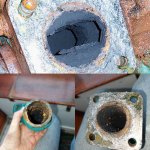
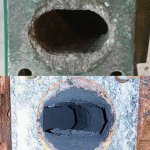
Hi, after much jiggery-pokery I got the exhaust elbow off my VP MD 2010, only to discover that most of the build up is in the actual engine side... what do I do? Chip it out? How?
Cheers!
Cheers!

Yes... not sure I'm qualified to remove the whole manifold yet... do I need to worry about knocking bits of rubbish back into the engine at all?Primary cause is not running the engine hard enough and hot enough.
No magic way of removing except chipping it away but not easy with the manifold in place.


+1. But it would be much easier to do if you can get the manifold off.; you really don't want bits of crud dropping into the cylinders or getting into the valve gear. The workshop manual will be a great help. On mine (Volvo Penta 2003), the exhaust manifold is part of the cylinder head, so you have to get a gasket kit to do that.If your going to do it in place, then push a wad of rag tied to a piece of string as far down as you can and then when you have finished draw it out with the string and you should then bring any debris out with it.
Given the location in the manifold rather than the elbow, the deposit is probably almost pure carbon. I'd give a blow torch a go and see if it could be burnt off. If not, chipping and chiseling is the only way; carbon is insoluble in almost everything.I tried chipping the carbon from a discarded exhaust elbow to keep as a spare. Within minutes I cracked the casting. I suggest that one might look at something like a Dremel with a grinding attachment of some sort, rather than something involving impact. Certainly on an expensive component like a manifold. The carbon deposit was rock hard. I tried a strong solution of Hydrochloric acid, as I had some that I had obtained commercially years ago & it did nothing. If forumites know of a chemical remedy, that actually works & is easily obtainable, then I suggest that is the way to go.
Oolitic limestone (as in the Jurassic limestone that extends from Yorkshire down to the Jurassic Coast of Dorset) is calcium carbonate chemically precipitated from seawater. The process is happening today in places like the Bahama Banks - shallow seas with high evaporation rates. There may be a biological aspect as well.As an side - I have a suspicion precipitated calcium from seawater varies around the world, I believe in the Gulf of Mexico there are high concentrations (and maybe the Red Sea). In some places the concentrations are so high the calcium precipitates out as a continual process, building up new limestone beds. Possibly also high around limestone and chalk coastlines - Dover? compared with the Western Isles of Scotland. The problems may be partially regional.
Jonathan

I have decoked cast iron exhaust elbows with a Dremel. Worked well.I tried chipping the carbon from a discarded exhaust elbow to keep as a spare. Within minutes I cracked the casting. I suggest that one might look at something like a Dremel with a grinding attachment of some sort, rather than something involving impact. Perhaps one of those drill bits for enlarging holes at an angle shaped like a sherbert on a stick.
Certainly do not try hammering on an expensive component like a manifold.
The carbon deposit was rock hard. I tried a strong solution of Hydrochloric acid, as I had some that I had obtained commercially years ago & it did nothing. If forumites know of a chemical remedy, that actually works & is easily obtainable, then I suggest that might be the way to go.
Not so sure. Of course you're right about the relative concentrations, but it is also fact that calcium carbonate precipitates out of seawater before magnesium carbonate, though there is a degree of co-precipitation. I think that calcium carbonate is less soluble than magnesium carbonate. But in places where carbonates are being deposited from seawater (e.g. the Bahama Banks) it is mainly calcite and aragonite being deposited, not dolomite.Maintaining the thread drift.
I may well be incorrect in suggesting that the blockage in the exhaust elbow is carbon bonded with a salt of calcium. Apparently a typical analysis of seawater contains 1272 ppm of Magnesium and only 400 ppm of calcium - suggesting that magnesium may be the bonding agent. For decades the high levels of dissolved magnesium in seawater resulted in extraction as a tonnage process of the Mg at Hartlepool (as MgOH or MgO). There were similar plants using the same process in a variety of locations round the world.
Both as carbonates are soluble in a variety of acids - so whether it is calcium or magnesium does not really matter.
Jonathan