How to make a teak caprail curved in two planes

Keith-i

Well-Known Member
Joined
4 Jul 2012
Messages
1,473
Location
Jersey
Visit site
I need to replace the aft coaming caprail on my boat which is curved in two planes. I have already fitted new 'teak' cappings to the sides which were simple and straight. However the rear capping is curved both up and out. As I understand it you cannot steam bend teak so would need to have a plank about 220 wide to be able to cut out a curved piece (when viewd on plan) and hope that it would conform to the curve in the horizontal plane. Is there any method to making up a curve from smaller segments as my supplier cannot provide anything more than 150 wide.The profile is roughly 70x45 with a 20x20 groove routed along the base which fits over the coaming. I am expecting to make a top piece that will be screwed amd glued to a pair of battens to make up the require 'U' shape.
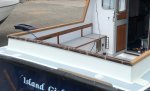
 

Attachments

  • Aft caprail.jpg
    Aft caprail.jpg
    464.6 KB · Views: 83
Are you sure about not being able to steam teak? I've never steamed teak (plenty of other species but not teak) but I'd be surprised if it can't be done.
In other applications this sort of profile is often made up as an engineered board shaped with bandsaw and spindle moulder. Smaller pieces are glued together to form an oversized board that is then shaped. I've only ever done it for non marine furniture and joinery. Depending on the adhesive you will have more or less visible glue lines and differences in grain direction will be visible.
 
Difficult to see the angles from your picture. However in terms of the vertical plane you would be able to bend that curve without any steam. Clamp the middle section and then work outward clamping it down. If it proves difficult you could make a temporary mould of the transom and pre bend off the boat. In terms of the horizontal bend it is likely that you could edge set without any steam. Worse case split the length into smaller pieces and scarf them to create the bend. Easiest way to get the correct angle is to draw a joiners rod of the curve and match the pieces to that.
 
I need to replace the aft coaming caprail on my boat which is curved in two planes. I have already fitted new 'teak' cappings to the sides which were simple and straight. However the rear capping is curved both up and out. As I understand it you cannot steam bend teak so would need to have a plank about 220 wide to be able to cut out a curved piece (when viewd on plan) and hope that it would conform to the curve in the horizontal plane. Is there any method to making up a curve from smaller segments as my supplier cannot provide anything more than 150 wide.The profile is roughly 70x45 with a 20x20 groove routed along the base which fits over the coaming. I am expecting to make a top piece that will be screwed amd glued to a pair of battens to make up the require 'U' shape.

I have exactly the same problem as you on my Roberts 43ft ketch.

I think I'll have two battens front and back of the f/g toe rail. Hopefully I can bend them in two planes both vertically and horizontally. They will be glued and bolted to the transom. Then I will cap the transom toe rail with three pieces. I think our plans are similar? This photo shows the curves in both planes.

imgonline-com-ua-resize-hMIaOxjiXGF.jpg
 
I've read lots about being unable to stream bend teak, especially kiln dried teak.

That said, having tried it, I found it certainly is possible and it looks like the curve you're dealing with is a fair bit less than what I managed when I steamed a replacement toerail for our s&s34

I'd give it a go, I think you'll be surprised what's possible.
 
Rather than make a box you can use a length of clear polythene tube at least 3 times the dia. of the timber, just a long narrow bag that you put it in, it heats up quickly is easy to seal and open, you can see and feel whatis going on and it can be done right beside the coaming it is to go on.
 
Last edited:
If you're going to steam it then there are other forums - woodworking & furniture making that are worth looking at for more detail.
The preparation is critical so that you're able to move from steamer to former without hesitation.
The easiest formers to use have a "gate" at one end that you can shove the material in, confident that it'll be held before having to form the bend & start clamping.
The former needs to be slightly tighter than you want the finished rail as it will relax slightly once the clamps come off... Even if its been held in the former for a week it'll relax.
You can't have too many clamps.
Don't be tempted to put a clamp half way or at the far end to help manage the process, far better to have two pairs of hands one to yard on the timber, pull it round the former & hold it there (in welders gauntlets) while you clamp from the gate to the far end.
The material to be steamed & pulled round the former needs to be longer than the finished length as you're going to need something to hold on to while the last clamps are being done up.
Given the oily nature of teak & it's resistance to moisture I'd allow it to stream for quite a while longer than the times recommended for oak & Ash & other more easily steamed species. Normally that would be avoided as it might weaken the material but in this case its not forming anything structural so give yourself the best chance of success & give it more time.
Hope that helps, there's been tons written about steam bending some of it v scientific others less so, both have merit as it's both an art and a science. Great fun to do and quite forgiving. If it doesn't follow the former properly first time just bung it back in the steamer.
Good luck.
 
Will be tricky steaming on the boat now that you have fitted and mitred the side cappings. As suggested earlier you need to be over length so that you have some leverage. When I did toe rails I started in the middle and use spanish windlasses at either end to gradually pull the ends into the curve.

Suggest you make up a solid jig and build up the rail off the boat. You will then be able to cur rhe ends to fit the mitres on the side cappings.
 
When I laminated the deck beams I made up a heavy former and bent the strips of timber and glued the strips.
I'm now wondering if I had (say) 6 strips of ¼ in. timber and not only bent them vertically but as well as horizontally around a former would that work? Maybe I could use the yacht itself as the former although that may be difficult working at that height?

There's a video on bending teak


Main Cabin - deck beams.jpg


Hope that helps, there's been tons written about steam bending some of it v scientific others less so, both have merit as it's both an art and a science. Great fun to do and quite forgiving. If it doesn't follow the former properly first time just bung it back in the steamer.
Good luck.

Thanks for the detailed response. My plan is to build a former in my workshop.
Suggest you make up a solid jig and build up the rail off the boat. You will then be able to cur rhe ends to fit the mitres on the side cappings.
Yes, I have no intention of trying to do this on the boat! It will be well worth the effort of building a jig/former. I know the exact angles the mitres were cut at so I can replicate the reciprocal cuts on the new piece.

I'm now wondering if I had (say) 6 strips of ¼ in. timber and not only bent them vertically but as well as horizontally around a former would that work?
I'm not sure that will work on my piece which needs to be 70mm wide unless I use a few narrower pieces and glue them together. It's a pity the timber is so expensive as otherwise I wouldn't mind a practice run or two.
 
______________________________________________________________________________________________________________________________________
coopec said:
I'm now wondering if I had (say) 6 strips of ¼ in. timber and not only bent them vertically but as well as horizontally around a former would that work?
______________________________________________________________________________________________________________________________________

I'm not sure that will work on my piece which needs to be 70mm wide unless I use a few narrower pieces and glue them together. It's a pity the timber is so expensive as otherwise I wouldn't mind a practice run or two.

I was using Nyatoh timber for my caprail until imports of tropical timbers were banned because a lot of it was being illegally logged. I then had to find a substitute timber so went to a specialty timber supplier, told him the sad story and he suggested Meranti.
Meranti is so similar to Nyatoh only an expert could tell the difference. (I'll be using Meranti and it is probably half the price)
 
I was using Nyatoh timber for my caprail until imports of tropical timbers were banned because a lot of it was being illegally logged. I then had to find a substitute timber so went to a specialty timber supplier, told him the sad story and he suggested Meranti.

Meranti is so similar to Nyatoh only an expert could tell the difference. (I'll be using Meranti and it is probably half the price)
Personally I'd avoid Meranti esp. Light or dark red. The white is a possibility but v poor steam bending caricteristics and the yellow is as bad as the reds.
I am biased & sat is only a personal opinion, I've worked with the stuff on and off for years in my small furniture & Joinery business and loath it in all its forms.
I'm really surprised that a timber merchant would recommend it for boat work, were they selling their stock rather than the best thing for the job?
& while I'm opinionating; we shouldn't be using any tropical hardwoods unless they're reclaimed/salvaged. I don't think there's any such thing as a sustainable logging industry in the tropics.
 
Personally I'd avoid Meranti esp. Light or dark red. The white is a possibility but v poor steam bending caricteristics and the yellow is as bad as the reds.
I am biased & sat is only a personal opinion, I've worked with the stuff on and off for years in my small furniture & Joinery business and loath it in all its forms.
I'm really surprised that a timber merchant would recommend it for boat work, were they selling their stock rather than the best thing for the job?
& while I'm opinionating; we shouldn't be using any tropical hardwoods unless they're reclaimed/salvaged. I don't think there's any such thing as a sustainable logging industry in the tropics.

I'm not steam bending the Meranti and at this stage I've only used it internally. Apparently it is OK for outside work.

You are probably right saying "we shouldn't be using any tropical hardwoods". At this stage I'll use it if it has been legally logged. (I'm more than happy to use treated pine for anything around the home)
 
Difficult to see the angles from your picture. However in terms of the vertical plane you would be able to bend that curve without any steam. Clamp the middle section and then work outward clamping it down. If it proves difficult you could make a temporary mould of the transom and pre bend off the boat. In terms of the horizontal bend it is likely that you could edge set without any steam. Worse case split the length into smaller pieces and scarf them to create the bend. Easiest way to get the correct angle is to draw a joiners rod of the curve and match the pieces to that.
Rods… What’s a rod? – Rowden Atelier
This is the only info I could find using the search term ""joiner's rod".
 
@coopec, technically it's a Hardwood, but there aren't many softer less durable hardwoods (poplar's in there with a shout).
Lots of external Joinery is made with meranti but I think it's only a cost thing. So that the manufacturer can claim that its made of hardwood. It seems as though 9 out of 10 bits of external Joinery that I have to repair /replace because of rot are meranti. I'm not trying to bash what you've done but if you can find something else to use externally then I think you'll find it lasts longer.
 
Top