How to fit a rubber bulb primer into a metal fuel line?

Even though you squeeze the bulb more or less flat, air gets trapped at the "top" ?

Doesn't seem to bother the millions upon millions of diesel cars that have them fitted horizontally.
 
It's a rubber bulb, it will prime the fuel system perfectly OK if it is mounted horizontally. Why wouldn't it ?
Think of all those outboard motors ..... prime .... bulb drops back into the well ... start and enjoy

Never seen an outboard priming bulb set up to be only vertical ...
??? When I prime I certainly do not think .... Oh - I MUST hold the bulb vertically ... I just pick it up and squeeze .. and like yesterday - it was horizontal when priming.

Because the little valves are not sprung,. They rely on gravity to make them fall closed on to their seats

You dont want your priming pump full of air either. Does not matter so much with a carb on a petrol engine but introducing air into diesel system with a priming pump would be rather counter productive

One sees the advice to point an outboard priming bulb upwards quite regularly on the specialist outboard engine forums That's advice coming from experienced outboard technicians .... people who actually know what they are talking about.

In the OP's case, if the bulb is to be fixed in position , as opposed to flapping around in the bilges, it makes sense to mount it in the orientation in which it will work best ........ that is vertically, outlet uppermost.
 
Even though you squeeze the bulb more or less flat, air gets trapped at the "top" ?

Doesn't seem to bother the millions upon millions of diesel cars that have them fitted horizontally.
Mounted vertically on my last diesel car
 
Because the little valves are not sprung,. They rely on gravity to make them fall closed on to their seats

That's nonsense.

So, if i go out this week and buy a brand new primer pump, connect it to a length fuel pipe, stick the other end in a can of diesel and orientate the bulb so that the outlet is at 6-o-clock, it won't prime ? Care to put some money on it ? Let's say the loser make a £50 donation to the RNLI ?

You dont want your priming pump full of air either. Does not matter so much with a carb on a petrol engine but introducing air into diesel system with a priming pump would be rather counter productive

Where is this air magically coming from ?

The bulb should be fitted between the tank and the primary filter. With the fuel supply shut off, where does the air come from ?

One sees the advice to point an outboard priming bulb upwards quite regularly on the specialist outboard engine forums That's advice coming from experienced outboard technicians .... people who actually know what they are talking about.

One sees all sorts of advice on internet forums, take this one for instance..............

I started working on engines in the early 70's, i might just know what i'm talking about too.
 
Because the little valves are not sprung,. They rely on gravity to make them fall closed on to their seats

If that were true ... then many would not work ...

There is no need for springs ... - the action is by what are termed 'flapper valves' .... flaps that have a one way function. They close by way of the material used and by flow of the product.
 
You are both correct the valves do not have springs as such but rely on the spring in the rubber to initially close the valve and then its kept closed by and pressure/head of the liquid.

The inlet valve of the henderson pump works in the same way.

The problem comes when the rubber loses some of its lasticiancy by the loss of plasticizer. This can be seen when rubber cracks.

I have had this happen with henderson pumps and I have an outboard bulb at home that I tried to transfer some petrol into my SWMBO's petrol car.

A new priming bulb will prime in most positions when new but at it loses plasticity lesser so.

The point about positioning the bulb upwards with the output at the top the valve will naturally close under gravity and will work even when the elasticity is lesser than when new.

BTW paul I had my first motorcycle in 1964 and car 2 years later when I started tuning BMC a series engines from then onwards.

My first boat was an outboard motor boat that I fitted a 1100cc Ford crossflow and used it until I sold it in 1982 when I moves to South Africa to project manage several major engineering projects.

Just consider you do have an amount of experience but others also have similar experience but different and overlapping knowledge and qualifications.

You probillary have a lot of knowledge and experience by doing others will have knowledge and experience by doing and qualifications and some will have greater knowledge that in areas than you.

I don't knock it, I embrace it as it expands my own knowledge and be careful when challenging others knowledge as they may just know more than you.
 
Of course they do. Do you really think an engine needs some sort of magical marine version of priming the fuel system ?


Nope I am sure anything will do, but think you will find non fire rated marine hose and the bulb will be frowned upon, hence me mentioning it further back up the thread, and everyone getting very upset for some reason!
 
Nope I am sure anything will do, but think you will find non fire rated marine hose and the bulb will be frowned upon, hence me mentioning it further back up the thread, and everyone getting very upset for some reason!

Nobody got upset. From time to time in these forums there are people who make unsubstantiated claims about insurance companies. There's rarely any evidence provided to support these claims, so they are generally treated as scaremongering.

In your case, I'd have thought that most boat fires result in significant damage and that the markings on fuel hoses might not survive.
 
If that were true ... then many would not work ...

There is no need for springs ... - the action is by what are termed 'flapper valves' .... flaps that have a one way function. They close by way of the material used and by flow of the product.
I now know that they are ball valves and they they do (usually/sometimes) have weak springs
 

I know he is from Oz but gravity still works in the southern hemisphere.


If you read my reply .. I did not say that ALL bulbs are not ball valve equipped .............. I disputed that all were. I know I had an old one I destroyed ages ago because it hardened and I couldn't get it disconnected to fit replacement ... it did not have ball valves ... it had flappers.
Unfortunately being a while ago and I binned the bits - otherwise I would show them here.
 
If you read my reply .. I did not say that ALL bulbs are not ball valve equipped .............. I disputed that all were. I know I had an old one I destroyed ages ago because it hardened and I couldn't get it disconnected to fit replacement ... it did not have ball valves ... it had flappers.
Unfortunately being a while ago and I binned the bits - otherwise I would show them here.

Nigel I don't dispute that as I know very well that there are many ways of designing for the same effect.

The main point is that locating the bulb vertical is In my view is better as you have gravity assisting the valve closing no matter how it is designed.
 
Nope I am sure anything will do, but think you will find non fire rated marine hose and the bulb will be frowned upon, hence me mentioning it further back up the thread, and everyone getting very upset for some reason!

I suspect that a fuel primer bulb, designed for erm.... priming fuel and fitted to vehicles manufactured by a great many of the Worlds car and boat manufacturers would hardly be an issue.
 
Nigel I don't dispute that as I know very well that there are many ways of designing for the same effect.

The main point is that locating the bulb vertical is In my view is better as you have gravity assisting the valve closing no matter how it is designed.

Many of the Worlds car manufacturers seem to consider it OK to mount horizontally, but what do the likes of Ford, Renault, Peugeot, Citroen etc know.
 
Many of the Worlds car manufacturers seem to consider it OK to mount horizontally, but what do the likes of Ford, Renault, Peugeot, Citroen etc know.

The only bit I will concede on this - we use setups that usually do not have pumped fuel lines. EG - my Perkins has a tank that in use - the mid level is about level with the fuel filter on engine ... so its gravity fed and when fuel is low - its drawn by the engine mounted 'lift pump' ... there not being any pump in the tank.
But most cars have a pump at the tank to feed the system.
Also the car usually stays reasonably level unlike a boat that can roll / pitch etc.

I keep meaning to fit a manual prime pump to my system as well as a stop cock ... yes I know why don't I have one !! Its never had one ... which of course means I change filter when tank is low !!
If I fit a prime pump .. it will be fitted whichever way suits the space its located in !! given where my fuel lines are - most likely horizontal !!
 
Many of the Worlds car manufacturers seem to consider it OK to mount horizontally, but what do the likes of Ford, Renault, Peugeot, Citroen etc know.

May be so. Just because some car manufacturers do it that way does it mean that we all must do it that way as in my view vertical is a better way of fitting it.

It can be more of a problem at sea that on the road in the UK.

As I have said before its up to the OP to chose what suits him and his setup.

On my boat both my electric primer pumps and my newly fitted bulb primer are mounted vertical so should I change then because you say Many of the Worlds car manufacturers seem to consider it OK.

I have three stages of fuel filters. sediment filter, Primary on each of 3 tanks and twin secondary with changeover valve.

My 4x4 only has one filter is that OK by you.

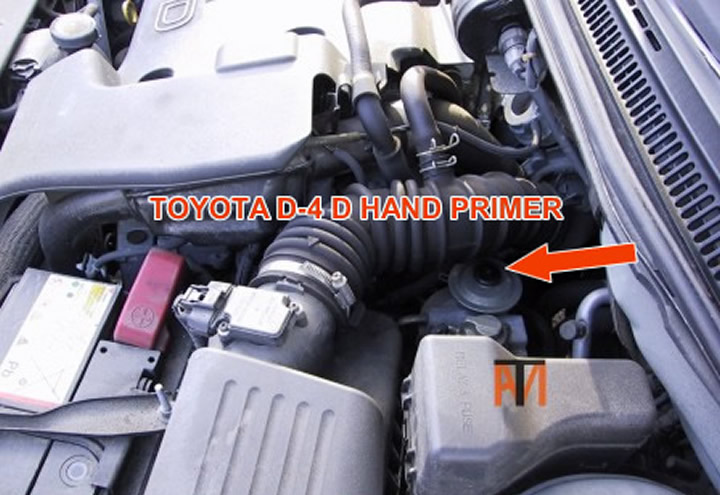
My Toyota diesel has this kind of hand primer pump. I have never needed to use it in the last 8 years of use offroad in Africa.

Toyota%20D4D.jpg
 
Last edited by a moderator:
May be so. Just because some car manufacturers do it that way does it mean that we all must do it that way as in my view vertical is a better way of fitting it.

You're free to fit yours wherever and however you choose, i've not said otherwise. In fact, what i said in post #20 was "There is also no need to mount fuel primer bulbs in an particular orientation. "

I'll stick with that.

My Toyota diesel has this kind of hand primer pump. I have never needed to use it in the last 8 years of use offroad in Africa.

That doesn't surprise me Roger. The D4D is a common rail, direct injection engine, the electric pump in the tank will eliminate the need for hand priming in most cases.
 
Top