How to cut a slice off a brass block

crown22

Well-Known Member
Joined
19 Jul 2004
Messages
292
Location
Manchester
Visit site
Hello Everybody,
I have an oblong brass block 56 by 56 by 120 mm.I need to cut a "slice" 12mm off one side to reduce it to 44 by 56 by 120mm.
It's for my tiller attachment winter project. Would this be something best done on a milling machine? Not quite
sure if I trust myself to do it with a hacksaw.Anybody know anywhere I can get this done in the NW
England area?Thanks in advance
 
Hello Everybody,
I have an oblong brass block 56 by 56 by 120 mm.I need to cut a "slice" 12mm off one side to reduce it to 44 by 56 by 120mm.
It's for my tiller attachment winter project. Would this be something best done on a milling machine? Not quite
sure if I trust myself to do it with a hacksaw.Anybody know anywhere I can get this done in the NW
England area?Thanks in advance

Power hacksaw or metal-cutting bandsaw at your local metal merchant. You can keep the offcut for another project.
 
Sliding compound mitre saw, you can buy specialised 'soft metal' cutting discs, bought my DeWalt secondhand for £120 to build glass / anodised aluminium / stainless balustrade , came with Inox disc, paid £30 for 'soft' disc, reluctantly sold the lot for £120 when I was finished, dead easy, dead square, wish I could have justified keeping it
 
I would use a hacksaw with a coarse blade and a file. I'm sure you could do the same.

Mark out and centre-pop a witness line a millimetre or so on the safe side of the where you intend to finish and saw to that. Then use a large bastard file.
 
I would cut it off with a power hacksaw, a drop saw (with a blade for cutting metal) and you could take it to a machine shop where they would charge you and an arm and a leg.

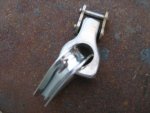
But you can do anything if you are really desperate. I needed a way to join up steering cable to the motor cycle chain within the pedestal. I saw what I wanted but they were about $450 each so I fabricated up a couple from some spare rudder stock stainless steel using an angle grinder, bench grinder and bench drill..


Steering  thumbnail.jpg
 
Last edited:
I would use a hacksaw with a coarse blade and a file. I'm sure you could do the same.

Mark out and centre-pop a witness line a millimetre or so on the safe side of the where you intend to finish and saw to that. Then use a large bastard file.
I'd use a hacksaw too but I'd scribe all round using an engineer's square and a scriber. I wouldn't centre punch the line and don't understand the reason for that ? Start sawing on the top far corner then bring the saw down to the line on top and follow the lines down. Keep an eye on the far side as it's easy to wander...

Boo2
 
I'd use a hacksaw too but I'd scribe all round using an engineer's square and a scriber. I wouldn't centre punch the line and don't understand the reason for that ? Start sawing on the top far corner then bring the saw down to the line on top and follow the lines down. Keep an eye on the far side as it's easy to wander...
I would do exactly the same as above, except i would cut each corner in turn, bit by bit, until the cut met in the middle of the scribed line, (each to their own)
 
Use 4 pieces of scrap steel to guide the hacksaw blade. That way you can concentrate on sawing not worrying.

I have a 2' x 1/16" teak plank in my scrap bin cut with a hand saw years ago using the same method. Serves me right for buying the wrong size in the first place.
 
Doesn't it rather depend on how perfect and clean a cut is required?

I've had a lot of satisfactory results using an angle grinder (not a bench grinder), then a rotary sander for removing sharp edges.

On the other hand, if, in due course this substantial block of brass is effectively going to need hollowing-out to make room for a tiller and rudder-stock-top, it may indeed be easier to pay a workshop to make all the cuts with total precision.
 
Last edited:
You could either have it milled off, easy but wastes all the offcut or better still sliced off either by metal cutting bandsaw or by a cut off blade in a milling machine.

I can do the above for the cost of a donation to the RNLI & return postage or machine to sketch/plan if needed.
 
Hello Everybody,
I have an oblong brass block 56 by 56 by 120 mm.I need to cut a "slice" 12mm off one side to reduce it to 44 by 56 by 120mm.
It's for my tiller attachment winter project. Would this be something best done on a milling machine? Not quite
sure if I trust myself to do it with a hacksaw.Anybody know anywhere I can get this done in the NW
England area?Thanks in advance
If you get it sawn really accurately, you could have a useful offcut maybe 10mm thick. The less precise you get the cutting done, the smaller and less useful the offcut.
What's it worth to you vs the cost of getting it done?
I could do it in the mill, but I'd have to buy a bigger slitting saw to cut 28mm deep.
I'd probably take around to a mate who has a power hacksaw, but that will lose about 3mm in the cut, then allow a mm or two to face the block afterwards.
If I had no access to machine tools, I'd just hacksaw it and true it up with a belt sander.

A metal cutting blade in a DIY mitre saw is an option.

Dinghyman's offer sounds pretty good, unless you can find nearer and avoid the postage.
 
Portaband and a vise. Around here, someone in most boat yards has one. Every pipefitter or steel worker has one. Darn handy tool, many variations. Cuts stainless like butter without work hardening.
30161_6236N-lg.jpg
 
Portaband and a vise. Around here, someone in most boat yards has one. Every pipefitter or steel worker has one. Darn handy tool, many variations. Cuts stainless like butter without work hardening.
30161_6236N-lg.jpg
That's a very handy looking tool, which I have never seen mentioned previously. There are no UK hits on the first page of a Google search so I guess they are rare over here.
 
^^ You will love it! Clean cuts.

Last year I had to cut a 1" stub of solid stainless rod off a stainless tube pulpit. It had it off in less than a minute, with only a light guiding touch, leaving less than 1/16" to clean up with a grinder. Try that with a hacksaw! And because the blade is one-way, not back-and-forth, they last a long, long time. The better brands are rugged and last a lifetime for most folks, and often a lifetime for pros.
 
^^ You will love it! Clean cuts.

Last year I had to cut a 1" stub of solid stainless rod off a stainless tube pulpit. It had it off in less than a minute, with only a light guiding touch, leaving less than 1/16" to clean up with a grinder. Try that with a hacksaw! And because the blade is one-way, not back-and-forth, they last a long, long time. The better brands are rugged and last a lifetime for most folks, and often a lifetime for pros.
When I fitted my Aquadrive I cut my 1 inch prop shaft three times with a hacksaw. I cannot claim it took one minute each but not a lot more than two minutes. 300 series stainless steel is not difficult to cut.
 
The point of using a band saw would be to take advantage of a guide fence which gets the cut in the right place to sub-millimetre precision. I can't see that happening with a hand-held bandsaw.
Obviously if you've got to hack off lumps of steel many times every day, a power tool is desirable.
But for a one-off, a hand-powered tool will be fine.
 
That's a very handy looking tool, which I have never seen mentioned previously. There are no UK hits on the first page of a Google search so I guess they are rare over here.
Used by most pipe fitters and industrial electricians, the battery ones are even better, cost about £450 but cut so quick and square. As they cut at 45 degrees will cut very deep, the 4” ones are the most popular as they cut unistrut. Also not classed as hot works so no fire permits are required on sites, I’ve only seen the Milwaukee ones
 
Top