How to connect cables to solar panel?

slawosz

Well-Known Member
Joined
26 Sep 2018
Messages
625
Location
London
Visit site
Hi,
I bought solar panel, but there are no cables connected. What is the best way to connect them? I checked online and looks like I have to do them myself....
 
Choose the cable in mm sq to match the output in Watts. Make sure you have the polarity correct, and try and waterproof the access points.

How many Watts is the panel ? How many panels ? Are you using them in series or parallel ?
 
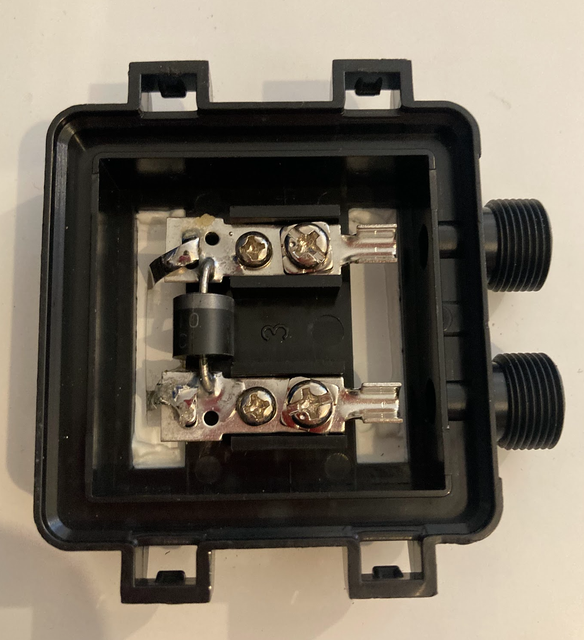
I think the op is just not sure of which contact on the SP.

In my opinion your best option is to get hold of some 6mm solar panel cable and solder this to the screw tags on your solar panel.

The negative terminal is the one with the silver marking nearest to it on the blocking diode.

The positive is obviously the one nearest the bottom of your picture.

For further info I would generally follow below but not knowing the size of panels doesn't make this wrong.

These cables should either be different colours or identified at both ends prior to feeding through a deck gland to your controller.
If you have two panels and are using a basic PWM controller they should be wired in parallel.
It is unlikely your controller will accept two 6mm cables in which case you need to pair the positives and the negatives with a through crimp covered with shrink tubing and then have a short length of 6mm to your controller.

I would recommend one of these for deck glands.
Index Marine Side Entry Twin Cable Gland - 3-6mm Cables | Force 4 Chandlery

You should fit an inline fuse in the positive of the correct rating (max 20 amp for 6mm) for the connections from the controller as near to the battery bank as possible.
Connect controller to battery before PVs or risk damage.
Steve.
 
Hi,
for now just one panel, 30W. Its to keep battery bank (220AH) in total, alive. I know its not much for such a battery size, but I don't use much electricity either. Battery bank is future proof - if I would add chartplotter/AIS I will add more solar. Or if I notice that batteries are not properly charged.
How would you waterproof the connection here? Sikaflex or something else?

I am bit confused as my previous panel came with cables.

Connect controller to battery before PVs or risk damage.
What are PVs?
 
The OP's pic is an inline blocking diode connector usually fitted in series with the +ve output from the panel (unless it is fixed to the back of the box which is unclear from the pic).

For a small 30w panel, a simple PWM controller and 4mm cable would be fine as long as the cable run is not too long. Info here...
 
The OP's pic is an inline blocking diode connector usually fitted in series with the +ve output from the panel (unless it is fixed to the back of the box which is unclear from the pic)

That diode is in parallel with the 2 output terminals with the crimp connectors.
Must be a bypass diode not a blocking diode. Best bet is to simply put a multimeter across the 2 terminals and confirm neg is at bottom, pos at top.
 
Hi,
for now just one panel, 30W. Its to keep battery bank (220AH) in total, alive. I know its not much for such a battery size, but I don't use much electricity either. Battery bank is future proof - if I would add chartplotter/AIS I will add more solar. Or if I notice that batteries are not properly charged.
How would you waterproof the connection here? Sikaflex or something else?

I am bit confused as my previous panel came with cables.


What are PVs?
Solar panels or PhotoVoltaics
For your purpose I would just direct connect your little 30W panel direct to to your battery bank with a pair of crocodile clips. Fuse the positive with a 5 amp fuse.
 
As Alan S says, if you are still not sure , put the panel in the sun and use a multimeter across the terminal screws. Around 21 volts (for most panels, check the label) if you have the positive side of the multimeter touching the positive terminal, -21 volts if you are the wrong way round.

I don't think you need to seal it in - well I never have and I've not had a failure in ten years. If you want to though, use silicon sealant, not an adhesive.

Theoretically you could get a maximum of around 1.5 amps with a 30W panel, so you can use pretty light-weight cable. But this panel will at best deliver maybe 5 amp-hours on a sunny day in the UK. This will barely serve to keep the battery alive while you are off the boat, and give you nothing extra. My guess is you'll eventually want a bit more power, so install heavier cable now to spare having to do it again later.
 
Last edited:
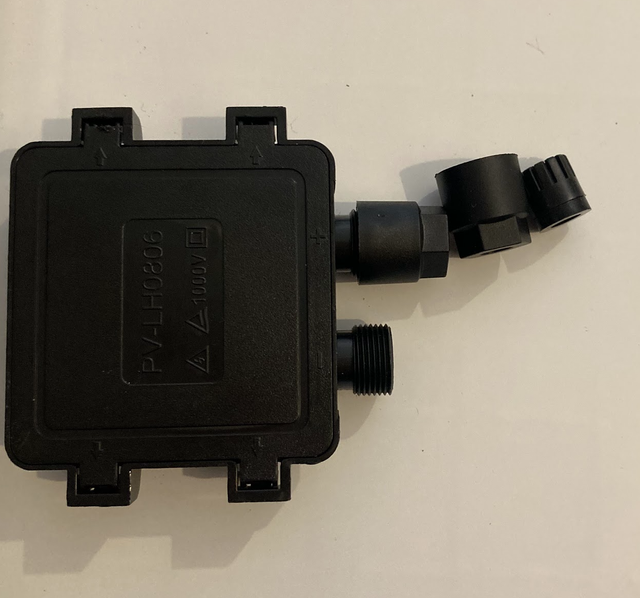
Right, I should add in my first post that I wasn't expecting panel without cable. I will just add ring terminals to the cable. And use mastic to waterproof the connection. The cover actually has positive and negative marks.

Theoretically you could get a maximum of around 1.5 amps with a 30W panel, so you can use pretty light-weight cable. But this panel will at best deliver maybe 5 amp-hours on a sunny day in the UK, which will do little more than keep the battery alive while you are off the boat. My guess is you'll soon want a bit more power, so install heavier cable now to spare having to do it again later.

Yes, I am aware of this. Problem is the space. 5A a day will be plenty to keep battery relatively happy. I will add another panel if it will turn out to be not enough.
 
Top