How to choose a boat , what to look for

I was going to ask portofino what his view is on the relatively new (well I guess they're not really new,but newly popularised) style of twin step, plumb bow,no flare on the bow,very narrow entry style hulls?

They look very different to those Grady white more traditional hulls in the video.
Well if you take this ( sorry not stepped , come to that later )
8CE3B876-51AD-489F-B832-CD07FA94FE72.jpeg
The guy coverers them the vid.
La Rague at other end of bay of Cannes is Dutch family run .I have watched theses since there berth .They sell them .
As the GW guy says no significant front spray rails they are very wet , very wet .I have witnessed them spraying all the folks sat in the cockpit.
Wind and boat wake around Cannes means it always wavey on the run back .
Then the V or deadrise .Look at station 5 .pretty flat .The final deadrise is poor . 10 ish + or minus 2 ?
They all slow down drop off in waves .They look at me gone out as i cruise past while they have to slow in the same conditions.Same Dir

You should be able to tell us the difference between your GW esq Windy hull and your axopar ….trying to balance the size difference.
Is the Axopar a wetter ride ? Spray on the helm . See the free board reason in the vid .If you are going down the wave piercing route like the cat Marc C has dragged in it’s gonna be wet Dashews 70 ftr is another example with its 10 cm thick armoured front cabin glass ……water bashing into it as the now stuffs .


Steps introduce air under the hull to decrease friction .You go faster for a given Hp in the conditions PeteM earlier described pancake flat .But they don’t work in waves big seas relative to the boat size .
If the waves block the air vents Infact the opposite happens they induce drag and it slows . Assuming you did not throttle back anyhow in the waves for another reason .
You find them on low free board boats like the super hawk 43 .

Whats your experience with the axpopar s steps in waves or turning sharp and submerging them ?
 
You should be able to tell us the difference between your GW esq Windy hull and your axopar ….trying to balance the size difference.
Is the Axopar a wetter ride ? Spray on the helm .


I'm not sure I have enough experience of different hulls to be able to attribute different characteristics to the various elements of each hull, but if the wind was blowing strongly perpendicular to the direction of travel the windy could be a surprisingly wet ride. It would do a great job of directing the spray away from the boat most of the time , but that spray would still go quite high in the air and if the wind was blowing across the boat, it would get blown back into the cockpit, which would be exacerbated because the boat would lean quite heavily into the wind - you could use the trim tabs to correct lean, and reduce the spray being blown into the boat, but it would take a few seconds to do this when rounding a headland (ie changing the boats direction of travel), so there would be a short period when you got a soaking - you could preempt this to a degree.

The axopar is a bigger boat than the windy, so with increased size alone comes an increased ability to handle waves, but there are a few characteristics (not all good though) that stand out about the axopar:-

  • Firstly when accelerating onto the plane it stays incredibly flat, there is virtually no bow lift - I attribute this to the lift generated by the steps - but maybe thats wrong .
  • Once you are on the plane , those steps (I assume its the steps doing this) generate an amazing amount of lift and give an almost stern high/bow down attitude if you dont trim the engine up . This is kind of the opposite of the more traditional hulls I have driven. If you trim the engine up on the axopar the bow lifts a little - but not by as much as you might see the bow lift on a more traditional hull.
  • Its generally a drier ride than the windy - despite having a lower freeboard, you can still get some spray in the boat , but not as often as I saw in the windy, maybe the axopar does a better job at directing the spray down back into the water rather than away from the boat?
  • It slams a lot less than the windy - not sure how much this improvement is due to size and how much to different hull designs. Axopar is 22 deg deadrise at the transom , windy was 20 deg, but it cant all be down to deadrise. Wife very happy about this bit, think I would struggle to sell her a less capable hull in this regard in the future
  • Its a more challenging boat to drive in a following sea than the windy - it really wants to bury the bow, there seems like there is very little buoyancy in the bow, I put this down to the lack of flare at the front, and the lack of "natural" bow lift (ie its the flip side of the coin to having a very level ride). A load of engine trim is required to keep the bow up, and you need to be careful with the speed.
  • Its remarkably fuel efficient at speed - 27-30 knots seems the most efficient speed . 50lph at 30 knots.

I havent seen any significant issues/negatives from the steps when turning, or in a big sea, but to be honest, there have not been many occasions when I have needed to go much lower than 20 knots. its happy cruising at 30 knots, and can still handle your average med mid summer afternoon chop at this kind of speed. There was one point last week were there was a fairly odd sea state (mid afternoon, and a load of wakes all at the same time) , so I dropped the speed right down to 15 knots, and here it felt slow, ponderous, underpowered, heavy. It was quite an odd feeling, so I speeded up again (back to over 20 knots) and it felt much better, so maybe that was an effect of the steps not being able to work? Note to self : keep the speed high - unless in a following sea.
 
Last edited:
@J interesting.Arh the Axopar s OB s trim angle , or what the gauge says messes up the comparison.
The 22 from 20 dead rise shift is not linear .In the equation of vertical acceleration ( Va) there is a iirc a Sq or cube in one of Lindsay Lords ( Harvard professor of naval architecture at the end ) equations . So a move from 20 to 22 makes a huge difference to Va NOT approx 5 % the obvious linear maths .
Or 12 to14 or what ever .It’s not to be under estimated .

You wife and indeed my wife or any passenger can feel this decrease of Va and like the ride .

This is the point I was try to get over to MapishM, it’s a certain rate of vertical acceleration that makes them uncomfortable, untenable leading to throttling back slowing down or in his case turning back .

Keep the wave hight , Dir out of it .

I have talked about the V , but the vid brings in another factor and he goes over it .The round bottom where sides meet .I call it a bell shaped bottom .A deep v hasn't got a knife razor sharpe edge the bottom of the hull is round bell shaped .
This aids a soft landing .As well as stopping it leaning one way or another needing one tab working hard in a beam wind .

So your boat and mind get better at speed , sure they take off but importantly they land softer on the bell bottom .
No crash bang etc .The bottom cushions the fall .

Yes speed firms it up they get more stable develop a set .
Arguably my 42/48 s has pretty extreme stakes with widen as they run back and the lift created is massive the boat feels like it risers up more from 26 to 24 knots . The 42/48 is the only one with a 23 * dead rise btw .Other Itama are like yours 22 .

My dead , lethargic area is 20-25 knots .This makes cruising in Co problematic. Feels heavy needs continuous steering input , rolls more , is not running at a great AoA a bit bow high .It will do it but its not optimised for it .

Mine runs level even x winds tend not to alter its set once up around 30 knots .
The rear chine flats are pretty wide , wider than others I have seen in yards .= lift and anti roll/ tilt at speed .

I want to get into the 26-32 knot area they are on the VHF calling to slow down , drop the rpm s as either it’s slamming there Va s getting to them or the engine temps are rising or both .Talking other none Itama .

Goldilocks porridge and all that .

Glad you ( wife ) enjoys low Va it’s nice.
 
@J re down wind runs in waves .You might have to ease back to prevent broaching as it the bow stuffs and the stern is picked up by the following wave …..you are in trouble.
Or just pre plan and avoid said conditions having to run fast , down wind in wave s

The worst I have done is out run a Mistral a F 6 rising to 7 from Boubas neck of the woods to Cannes .
60 miles in 2 hrs doing 30-34 knots over the ground surfing , sitting on top of waves .
When it did go down , either from my speed or the waves slowing under me the flair and bow bulbous ness just spread the waves it kept arrow straight the bow never submerged .I was wondering if the stern would start to come round but it just ploughed on .

Crossing the bay of st Tropez the port motor dropped rpm by say 150 and the speed dropped for a few miles .
I couldn’t slow it it would be dangerous .We thought we had a pot wrapped round and was dragging a string at 30 odd knots .

Next morning was all intent to phone the ins Co and request a free lift and Inspect of the stern gear as I was convinced there must be some thing wrong .
But it felt ok on marina manoeuvres etc a lot of FRFRF etc .
Snorkelling showed nothing wrapped round per se but scratch marks where a wire had indeed wrapped around the hub .
The cut less bearing had slid down its tube by 10 mm towards the prop .
Sill felt firm no vibration etc .The Yard next haul out pushed it back up .

Thats the issue with big waves taller than the boat you can’t see out , see anything around you .
 
This is the point I was try to get over to MapishM, it’s a certain rate of vertical acceleration that makes them uncomfortable, untenable leading to throttling back slowing down or in his case turning back.
Porto, I appreciate you are only interested in your own posts, but could you please read my post #32?
What part of "I DID NOT TURN BACK" is so hard to understand, exactly?
 
Porto, I appreciate you are only interested in your own posts, but could you please read my post #32?
What part of "I DID NOT TURN BACK" is so hard to understand, exactly?
Was on your del trip some where , not that bit I remember it reading it .Or some other trip ?
You interjected that vid not me .
Aside my scientific point about Va stands , and what’s seems a tiny difference in deadrise makes a huge difference in waves .

Linsay Lord did a lot of tank tests with acceleration monitors in 1/8 scale hulls .
Its in his book this book .
5831A649-980B-4933-8E8B-ED431DF11875.jpeg
There was no trial and error .guess work with life size hulls like Elassar infers ^^^ He did the maths worked the formulas. Albeit formula he produced to figure out how planing boats works and what improves them .

Folks commenting on here about hull form in a dismissive way belittling it are like folks back in the day when capernicous did the maths about the Earth rotating round the sun or Darwin on evolution back in his day .
Imagine explaining Darwinism to 18 C uneducated farmers trying to breed stock .

Julians knows there a bit more to it .
You see it every day out there .Some boats floundering in a chop , slowing , others slicing through .All family boats not silly stuff Marc used as an example , or your FB designed for Monaco / Venice endurance racing .Or your lake cats doing 100 mph or what ever .
Talking ave bod stuff in any marina .
You average typical med ( inc U.K. ) marinas stuff .
Its why ribs punch far above there weight and length in a chop , ride wise Your eyes aren’t deceiving you, they have the same spine architecture as you and me they are not nutters on opioids to numb the pain .You must have seen them appear effortlessly glide past almost horizontal while you are climbing up and falling of waves or what ever ? Like slamming .
Its not luck , it’s not trail and error it’s a mix of those 7 ingredients in the GW vid .
There Va at that speed largely ( but not solely ) is attributable to the V and deadrise as the guy in the vid said .Jeeeez !

Even a 80 ft Magnum has a 24 degree deadrise . Big 80 ft Otams as well .Yes as you go heavier jump from 50 to 75 double or te ble the weight then you can drop a degree on the deadrise .I think the Itama ( Marco Cassalli )with its V 16 MTU 1820 Hp pair has a 20 degree DR .
But the 62 or older 54/56/60s Amarti have 22 degrees .

Again a slight tweak to the porridge recipe, buts it’s same basic ingredients. Discovered by Lindsay Lord and used over and over again by the great hull builders .

Do everyone a favour read the book before commenting .
 
Last edited:
Was on your del trip some where, not that bit I remember it reading it . Or some other trip?
You interjected that vid not me.
That was the only video of my boat in somewhat rough seas that I took during my delivery trip, and I linked it strictly in reply to your post #25, where you reported something related to myself. Something that you actually made up, just because it fitted your narrative nicely:
"I remember on your del trip from Sicily to Sardinia you posted a vid of a head sea about 1/2 way across of your boat rising and crashing and eventually you bailed out ( the human comfort thingy ) and turned around."

Now, I am positive that over 20+ years of forum membership I never wrote - neither here nor in any other forum - what you pretend I did, for the very simple reason that it never happened.
Then again, Alzheimer is very subtle.
So, if you stand by your words, please take a few minutes (among the many hours that you spend browsing the net for all sort of BS) to find where I said what you pretend I said, and post a link.

If you'll find anything like that, I'll eat my hat.
But if not, pleeeeeaaase, do all of us a big favour and STFU.
 
it’s all getting a bit heated peeps!
so what do you guys make of the Botnia Targa range. They seem to punch well above their weigh.I’ve looked closely at the wet bits which don’t seem to be anything special or am I missing something?
 
That was the only video of my boat in somewhat rough seas that I took during my delivery trip, and I linked it strictly in reply to your post #25, where you reported something related to myself. Something that you actually made up, just because it fitted your narrative nicely:
"I remember on your del trip from Sicily to Sardinia you posted a vid of a head sea about 1/2 way across of your boat rising and crashing and eventually you bailed out ( the human comfort thingy ) and turned around."

Now, I am positive that over 20+ years of forum membership I never wrote - neither here nor in any other forum - what you pretend I did, for the very simple reason that it never happened.
Then again, Alzheimer is very subtle.
So, if you stand by your words, please take a few minutes (among the many hours that you spend browsing the net for all sort of BS) to find where I said what you pretend I said, and post a link.

If you'll find anything like that, I'll eat my hat.
But if not, pleeeeeaaase, do all of us a big favour and STFU.
Bit OTT ^^ .
Well if it wasn’t you it was some one similar.Apologies etc .
The point was with some hulls you don’t have to slow down like you did , Va and all that .
If you could have gotten faster if the Va was within human tolerance and boat well built which it is them fine .It slammed as well at a certain times in the vid .
The fact you didn’t turn back is irrelevant to the thrust of the debate namely the GW vid and the 7 reasons .

They are not my reasons btw , it’s not me in the vid .But having more than a cursory interest in hull form I thought I would share it .Anyhow ribs .Tiny light weight surly you must have seen them slicing through chop as if it’s not there ? …..and wondered why ?
 
Last edited:
it’s all getting a bit heated peeps!
so what do you guys make of the Botnia Targa range. They seem to punch well above their weigh.I’ve looked closely at the wet bits which don’t seem to be anything special or am I missing something?
Back on topic great Q btw , it’s it the same ingredients as the vid
They have majored on low centre of gravity and low weight to ballast ratio .
This rules out over tall trendy fly bridges with hard tops that temp you at static shows .

Targa 44 (2011-) Captain's Report | BoatTEST

This bit here …..
“ ballast"/displacement ratio that approaches 50%.
This low CG and high "ballast"/displacement ratio combined with the boat’s relatively high freeboard means that it was designed for snotty seas and heavy weather.

Also like for like length wise they are narrow beamed , again the swing o meter hangs towards sea worthy ness away from interior accommodation…..given choices .
 
Last edited:
it’s all getting a bit heated peeps!
so what do you guys make of the Botnia Targa range. They seem to punch well above their weigh.I’ve looked closely at the wet bits which don’t seem to be anything special or am I missing something?
Basically they have a design like the guy in the video explains. Downside to the big flared bow is windage, a pain manoeuvring in a wind.
 
We have had good weather too except on 2 days the run 30 miles from Portofino to Portovenere a pre booked over night hard to come by .
We over took a lot of other stuff all sizes cruising through at 28 knots .
Wasn’t forecast …..Twas a big fetch reflecting off the Cinque Terre huge cliff .

Second humping 70 miles across the bay of Genoa 8 am depart in a F5 , 2-1/2 hr later dead pan calm off Loano like the conditions you describe .
But you have to go through the middle bit .
Time restraint re getting guest to an air port and all that that entails .You can’t just sit it out .
The F5 started on the port bow 1/4 , then went beam then veered to following port stern 1/4 .
We never slowed down of changed course .

Wind finder , passage weather + others all used btw .Pretty useless on the day imho .Ok but not that brilliant to rely on .
That's very impressive, Have you evey checked the stringers on your boat?
 
That's very impressive, Have you evey checked the stringers on your boat?
Yes .You can access under the soles and of course see all in the ER , which occupies about a 1/3 of the boat .
You can access / sight stuff like under the galley , under saloon seating and under the heads cabinetry and under the beds .
Nothings to my knowledge unstuck .They are heavy boats mines 18000 kg dry .So in some ways it wastes its seemingly high Hp on pushing this as well as a 23 deadrise .

A squadron 58 for example has the same Hp more or less .

It lands softly which I guess in sone way assists keeping it falling to bits in a chop .
As I said it’s the vertical acceleration, another fancy name for slamming that’s reduced for its ride size through chop .
On the Itama FB forum , quite a few 90 s modals are being re fitted , bringing up to date .Nothing is mentioned about stringer repairs .
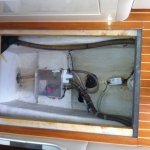
515E6884-2692-4A2B-8097-13F7AD46021C.jpeg
Not the best pic ,It’s approx station 4 .1 being the bow and 10 the transom btw .But it illustrates the size of the stuff ,That’s a off the shelf shower sump box .So hopefully it shows the scale?
But note the size of the longitudinal “ beams “ either side of it .They are about a foot or more deep + 4 inches wide .
That black thing in the ground our flat ( middle of pic ) is the depth sounder sensor .They have dug into the solid hull to make a flat .Station 4 takes a lot of hits so to speak up wind .

The GW vid ^ shows those little devils in relative big seas for there size .

A good barometer is the Genoa boat show ,From mid afternoon it’s becomes a wet show the boats almost all take punters out .
Its interesting to see which fold , decline when the wind + chop gets up and which carry on .
 
Bit OTT ^^ .
Well if it wasn’t you it was some one similar.Apologies etc .
The point was with some hulls you don’t have to slow down like you did , Va and all that .
If you could have gotten faster if the Va was within human tolerance and boat well built which it is them fine .It slammed as well at a certain times in the vid .
The fact you didn’t turn back is irrelevant to the thrust of the debate namely the GW vid and the 7 reasons .


They are not my reasons btw , it’s not me in the vid .But having more than a cursory interest in hull form I thought I would share it .Anyhow ribs .Tiny light weight surly you must have seen them slicing through chop as if it’s not there ? …..and wondered why ?

But what’s the fridge like? And the showers? It’s far more important than the crap you bang on about for most of us.
 
There’s two bathrooms with showers and the one on the bathing platform . 14 M 42/48 ftr .
A std domestic under the counter fridge stainless steel lined fridge in the galley and a smaller waeco one under the cockpit seat in the cockpit .Both the usual 24 or 220 v .
In the med in marinas a lot just shower / hose themselves down on the dock or bathing platform with the dock hose …..I think that’s just to cool or wash hair if it’s salted up .You tend to be in the sea every day , well we are .
.They were all bespoke , with slight changes built to order .
There is indeed a ensuite shower room on some off the master separate to the heads .
The bigger ones obviously more versatile . Folks live on them for weeks and travel far .
Indeed we had a 28 day stint . For Med use I don’t think any accommodation compromises show up as it’s an outside life .
There are compromises of course there are on any boat , but as the GW guy said at the top of this thread it’s great to have a smooth comfortable ride it virtually makes poring over weather and wave forecast redundant.
Just adds to the versatility the ability to go out when others are weather bound .There’s always bays, headlands and islands to tuck up in and watch the white horses .

You can have both that’s the point .Start at the bottom the hull . When broken down hull design is basic as the guy said , it’s scientific as Lindsay Lord figured out designing his rum runners in prohibition and MTB after Peal Harbour .He set up the first course and school of naval architecture at MIT after the war .

I know Darwin was ridiculed for writing “ origin of species “ and his followers.

The book Lindsay wrote is a real eye opener .
Take Va - vertical acceleration for example, just one characteristic.It’s slamming the point MapishM made ( I think ? ) re it’s the people / crew that give up first in a big chop , I mean going fast in a chop not slowing .Or indeed slowing dropping of the plane and being roller coasted up and down uncomfortably.

The Hp bit was calculated its not guess work wait and see on the hull#1 sea trail .

Amarti and indeed Ferretti with itama and Rivas just power them up to get near 40 knots and operate in the 30-40 knot range .
I tested a new Itama 62 with MAN 1360 V12 s I managed to trim it out to see 42 knots at WOT .
Fairlines GT 62 iirc nudges 32 knots at WOT .
Just read the new Preditor eq size from SSkr with iirc IPS 1200 s so presume D12/13 s ?? on pods they boast 38 knots and that’s with the twin counter rotating prop IPs malarkey.
A 60 ft eq Riva will see 40 knots on shafts easy lightly loaded.

Lord in a test tank made scale hull modals and fitted accelerometers to the inside of the hulls .Then ran them in various “ seas “ He could or the tank could changes the wave height and frequency etc etc .
Its by messing about with the stuff the GW guy was talking about in the opening thread vid he figured out where this magic “ I have had enough slow down ” or “ turn around “ or “ we not going out in that “ point was .
I think the rig did 1/8 scale so pretty big .

The same equations and tables are available to all .

Bottom line it costs more imho in terms of production time and materials + bigger engines and all that brings in to build them strictly to L Lords , Hunt , Levy , Amarti , Theodali ( Magnum ) , the things the GW guys tried to illustrate.

Or turned around it cost less to fit IPS , flatten the deadrise to facilitate , mess with the speed beam ratio to get a wider mid cabin
Loose lifting strips in lieu of flatter aft sections , fit liners , opt for smaller engines , tanks etc etc .

Google Otam for example price up a 58 ……Otam have gone further they are all carbon fibre inc the 80 .Less weight = more speed .But the hull shape is all there as the GW said .just larger .
As you enquire look at the fridges and shower on say a 58 :)
 
There’s two bathrooms with showers and the one on the bathing platform . 14 M 42/48 ftr .
A std domestic under the counter fridge stainless steel lined fridge in the galley and a smaller waeco one under the cockpit seat in the cockpit .Both the usual 24 or 220 v .
In the med in marinas a lot just shower / hose themselves down on the dock or bathing platform with the dock hose …..I think that’s just to cool or wash hair if it’s salted up .You tend to be in the sea every day , well we are .
.They were all bespoke , with slight changes built to order .
There is indeed a ensuite shower room on some off the master separate to the heads .
The bigger ones obviously more versatile . Folks live on them for weeks and travel far .
Indeed we had a 28 day stint . For Med use I don’t think any accommodation compromises show up as it’s an outside life .
There are compromises of course there are on any boat , but as the GW guy said at the top of this thread it’s great to have a smooth comfortable ride it virtually makes poring over weather and wave forecast redundant.
Just adds to the versatility the ability to go out when others are weather bound .There’s always bays, headlands and islands to tuck up in and watch the white horses .

You can have both that’s the point .Start at the bottom the hull . When broken down hull design is basic as the guy said , it’s scientific as Lindsay Lord figured out designing his rum runners in prohibition and MTB after Peal Harbour .He set up the first course and school of naval architecture at MIT after the war .

I know Darwin was ridiculed for writing “ origin of species “ and his followers.

The book Lindsay wrote is a real eye opener .
Take Va - vertical acceleration for example, just one characteristic.It’s slamming the point MapishM made ( I think ? ) re it’s the people / crew that give up first in a big chop , I mean going fast in a chop not slowing .Or indeed slowing dropping of the plane and being roller coasted up and down uncomfortably.

The Hp bit was calculated its not guess work wait and see on the hull#1 sea trail .

Amarti and indeed Ferretti with itama and Rivas just power them up to get near 40 knots and operate in the 30-40 knot range .
I tested a new Itama 62 with MAN 1360 V12 s I managed to trim it out to see 42 knots at WOT .
Fairlines GT 62 iirc nudges 32 knots at WOT .
Just read the new Preditor eq size from SSkr with iirc IPS 1200 s so presume D12/13 s ?? on pods they boast 38 knots and that’s with the twin counter rotating prop IPs malarkey.
A 60 ft eq Riva will see 40 knots on shafts easy lightly loaded.

Lord in a test tank made scale hull modals and fitted accelerometers to the inside of the hulls .Then ran them in various “ seas “ He could or the tank could changes the wave height and frequency etc etc .
Its by messing about with the stuff the GW guy was talking about in the opening thread vid he figured out where this magic “ I have had enough slow down ” or “ turn around “ or “ we not going out in that “ point was .
I think the rig did 1/8 scale so pretty big .

The same equations and tables are available to all .

Bottom line it costs more imho in terms of production time and materials + bigger engines and all that brings in to build them strictly to L Lords , Hunt , Levy , Amarti , Theodali ( Magnum ) , the things the GW guys tried to illustrate.

Or turned around it cost less to fit IPS , flatten the deadrise to facilitate , mess with the speed beam ratio to get a wider mid cabin
Loose lifting strips in lieu of flatter aft sections , fit liners , opt for smaller engines , tanks etc etc .

Google Otam for example price up a 58 ……Otam have gone further they are all carbon fibre inc the 80 .Less weight = more speed .But the hull shape is all there as the GW said .just larger .
?
 
Top