
How tight to torque my chainplates

iamtjc

Well-Known Member
Joined
21 Sep 2018
Messages
87
Visit site
I have replaced my chainplate U-bolts (actually V-bolts). The new ones are bedded in Butyl sealant, the excess of which is slowly oozing out as I tighten them down.
They are not fully tightened down yet.
There are countersunk holes and the U-bolts have a domed recess, so there should be space enough that the butyl doesn't all squeeze out.
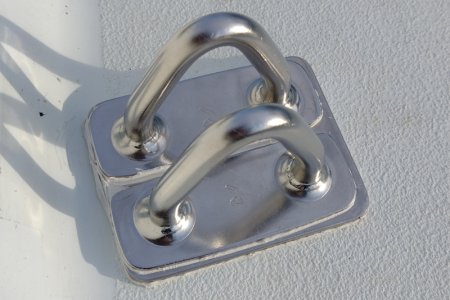
IMG_20260107_143716012 sm.jpg
Under the deck in a stainless backing plate with a welded rod transferring the pull to a bulkhead.
The deck is around 15mm thick. It is solid with fibreglass skins and a Lantor Coremat core impregnated with resin.
I have had 3 concerns.

1) To avoid galling - having read the forum, I plan to loosen the nuts one by one and do the final tightening using Tef-Gel as an anti-seize. I saw Loctite Molypaste recommended but could only find it in larger packaging that made even Tef-Gel seem cheap.

2) How much to torque the bolts. It's my rigging so I want them tight but I don't want to crush the deck. The U-bolts are 10mm 316 stainless.

3) How to ensure they don't come undone if the butyl oozes more in hot weather and relieves the tension in the bolt. There isn't room between the bottom of the deck and the headlining for a second nut or similar.

Any thought and suggestions are welcome.
 
a. Also, go slow when tightening. Galling is about heat.

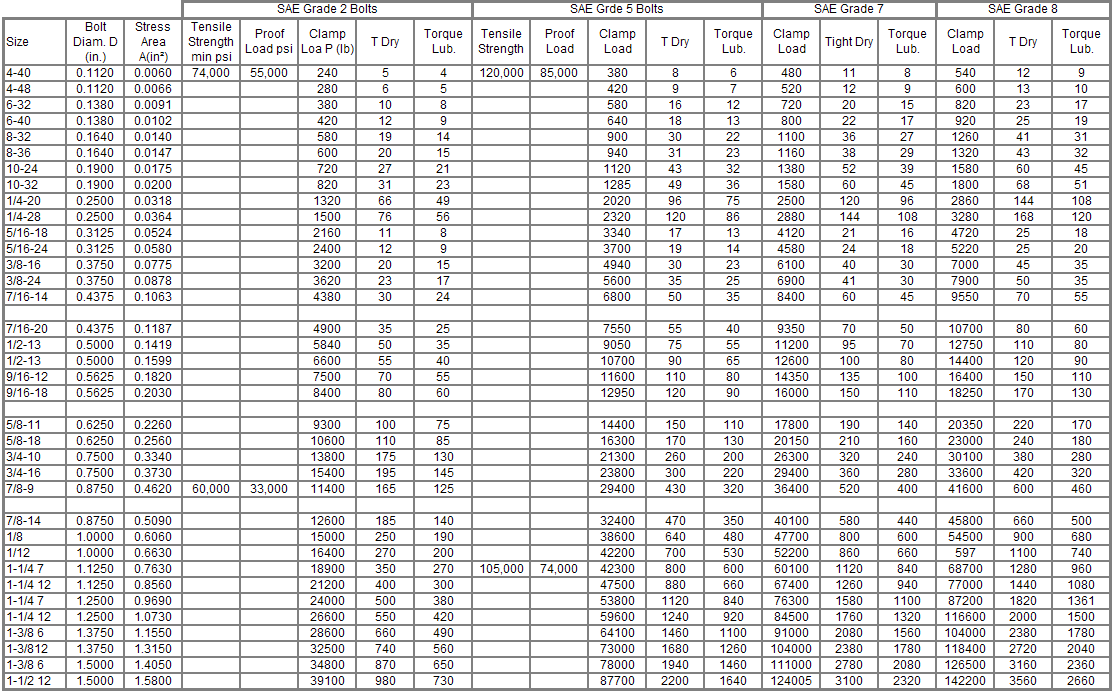
b. The compression load should be taken by the cylinder of epoxy used to seal the core. If the bolts are not tight enough (pre-load) to handle 100% of the MAX sailing load, including all shock loads, they will move. Bolt torque is about pretensioning the bolts so that they do not stretch under load. Hopefully you know the load for your rig. Typically, it is 15% of the breaking strength of the wire. Double that for the sailing load (30% of BS), since it is all on one side. You want the total clamping force ( two bolts) to equal 30% of the BS of the wire.

The same is true, by the way, of standing rigging. It should be tight enough that the lee shrouds are not slack hard on the wind.

Example: If it is 1/4" wire, 30% BS is 2500 pounds. If the bolts are 1/4"-20, about 49 ft-pounds (lubed) (1320# clamp load each, 2640# for the pair) should get you there. Pretty snug, SAE standard torque (316 is typically a little stronger than grade 2, but not grade 5)

Yes, that will crush a cored deck if you have not replaced core. Backing plate too. You have some distribution on the top. Curiously, because of preload, the compression on the top is the same as the bottom on the lee side when sailing.

tightening-torque_orig.gif
 
AS I understand it bolts/metal with repeating loads no loads are stretched to give permanent load so that additional load adds to stretch but loss of load dose not result in no stretch. This to reduce risk of fatigue failure.
Now this works well in things like cylinder head bolts where the bolt is stretched against the solid strength of the cylinder head.
However in OP case I don't believe the deck or indeed the cylinder of epoxy has any where near the crushable strength required to stretch the metal of the vee bolts to avert fatigue failure. This follows for stretching the wire itself against a non solid boat structure.
You simply need to have metal strong enough to not stretch under rig loads. The tightening of the nuts is purely a function of stopping them from loosening. This might best be achieved by using nyloc nuts, lock wire through holes in the nut pins through the exposed bolt part or even epoxy or sealer. (my opinion) ol'will
 
I know this may wrankle some die-hards ... but I would not bother with torque figs ... I would tghten the fixings until sealant is squeezed out .. metal plates are basically closed up to the GRP .... and make nuts reasonably tight ....
After a short period of use - go round and check all is tight with a spanner again ...

You are not talking cylinder head bolts on an engine where temp changes require torquing of fastenings to counter ...
 
I know this may wrankle some die-hards ... but I would not bother with torque figs ... I would tghten the fixings until sealant is squeezed out .. metal plates are basically closed up to the GRP .... and make nuts reasonably tight ....
After a short period of use - go round and check all is tight with a spanner again ...

You are not talking cylinder head bolts on an engine where temp changes require torquing of fastenings to counter ...
I hardly ever bother with torque specs, so much so that if I didnt already have a torque wrench I doubt I would buy one.

A calibrated bungee or bit of bicyce inner tube used with ordinary spanners would serve my needs quite adequately and fits in places my torque wrench wont. (eg car cam pulley bolt)

I thought that was die-hard?
 
AS I understand it bolts/metal with repeating loads no loads are stretched to give permanent load so that additional load adds to stretch but loss of load dose not result in no stretch. This to reduce risk of fatigue failure.
Now this works well in things like cylinder head bolts where the bolt is stretched against the solid strength of the cylinder head.
However in OP case I don't believe the deck or indeed the cylinder of epoxy has any where near the crushable strength required to stretch the metal of the vee bolts to avert fatigue failure. This follows for stretching the wire itself against a non solid boat structure.
You simply need to have metal strong enough to not stretch under rig loads. The tightening of the nuts is purely a function of stopping them from loosening. This might best be achieved by using nyloc nuts, lock wire through holes in the nut pins through the exposed bolt part or even epoxy or sealer. (my opinion) ol'will
I agree. Our shroud plates are through bolted and exactly the way the OP describes. However, they have locknuts on them to stop them undoing.
 
I agree. Our shroud plates are through bolted and exactly the way the OP describes. However, they have locknuts on them to stop
I have replaced my chainplate U-bolts (actually V-bolts). The new ones are bedded in Butyl sealant, the excess of which is slowly oozing out as I tighten them down.
They are not fully tightened down yet.
There are countersunk holes and the U-bolts have a domed recess, so there should be space enough that the butyl doesn't all squeeze out.

View attachment 205621
Under the deck in a stainless backing plate with a welded rod transferring the pull to a bulkhead.
The deck is around 15mm thick. It is solid with fibreglass skins and a Lantor Coremat core impregnated with resin.
I have had 3 concerns.

1) To avoid galling - having read the forum, I plan to loosen the nuts one by one and do the final tightening using Tef-Gel as an anti-seize. I saw Loctite Molypaste recommended but could only find it in larger packaging that made even Tef-Gel seem cheap.

2) How much to torque the bolts. It's my rigging so I want them tight but I don't want to crush the deck. The U-bolts are 10mm 316 stainless.

3) How to ensure they don't come undone if the butyl oozes more in hot weather and relieves the tension in the bolt. There isn't room between the bottom of the deck and the headlining for a second nut or similar.

Any thought and suggestions are welcome.
I am no expert but I replaced all mine with tbe same u bolts 100mm bluewave. I found the knes I did with buyyl it just keep oozing out till all gone. I did the back stay and the 2 main side ones with sikaflex. The ones do e in sikaflex I found could be torqued without it all.oozing out.
 
A caution about torque forces!
While it may not apply here, as one does not want to crush the GRP, nevertheless one should not forget that locking compounds act initially as thread lubricants before setting under anaerobic conditions. This results in less frictional force and more of the torque is converted into force stressing the fastner. The tables for torque forces usually apply only to dry threads and the application of fluids can reduce the frictional component by up to 50%.
 
Posts 5and 6 sound like the way I would go…

Watch the squeeze of butyl….
You still want some there (2mm say) . None left is wrong, too much means play in bolted down plates.
 
Posts 5and 6 sound like the way I would go…

Watch the squeeze of butyl….
You still want some there (2mm say) . None left is wrong, too much means play in bolted down plates.
This seems to imply essentially no tension on the bolt due to torquing it down (assuming there are no 2mm spacers) since I would guess any compressive force is going to cause butyl to creep, so in practice residual butyl would just be taking up irregularities in the deck.

Note that

(a) This IS, as I said, a guess. I dont know it for a fact.
(b) I suppose it may be fine with no compressive forces at all, (and thus no butyl bulge) with bolt tension simply reflecting the rigging tension.
 
This seems to imply essentially no tension on the bolt due to torquing it down (assuming there are no 2mm spacers) since I would guess any compressive force is going to cause butyl to creep, so in practice residual butyl would just be taking up irregularities in the deck.

Note that

(a) This IS, as I said, a guess. I dont know it for a fact.
(b) I suppose it may be fine with no compressive forces at all, (and thus no butyl bulge) with bolt tension simply reflecting the rigging tension.
I may have written badly…

Say 6mm of burly applied, bolt plate down until only 2 min or butyl remains and clean up.

Common sense about the TIMING of the tightening / compression and squeezing of the butyl is important of course.

There may be other better answers.

A bit of reading later…the op may have it right at post 9, use sikaflex not butyl. No leaching out of sealant means no wobble, flex, reduced tension, Callie what you will.
 
I think my post (#2) was not understood.

If the bolts are not torqued to the max windward sailing load, several things will happen. This is because that at this torque the compression on the deck will be ZERO when sailing (the bolts hold the load with nothing left over to compress the deck).
  • The upper plate will be pulled away from the deck, leading to leaks. This is due to bolt stretch.
  • The bolt will cycle, leading to fatigue. Crevis corrosion is one problem with chainplates, but it is made FAR worse when combined with load cycling. A little corrosion, then stretch. A little corrosion, then stretch. The key to long life is avoiding stress cycling.
The fatigue limit for SS, in the absence of corrosion mechanisms, is about 40-60% of BS. The shrouds are generally sized for 30% standing still and about 40-60% max cycle when sailing. This is why we replace them on a cycle. This is why you don't want them flapping loose when beating.

Bottom line: the bolts will be at the recomendeed torque when sailing. You can't change that.

You can tighten them less if you want, thinking this is better for the boat. It is not. If the deck cannot take the static compression load, fix that. BTW, new balsa end grain is about 1400 PSI. Combined with backing plates and an epoxy seal (a tube, not just some seal) this is not too much. As this was designed this way, however, I seriously doubt the deck is cored in that location. That would be quite dumb.
 
If the bolts are not torqued to the max windward sailing load, several things will happen. This is because that at this torque the compression on the deck will be ZERO when sailing (the bolts hold the load with nothing left over to compress the deck).

??????? You write as if the sailing load will add compression of the deck if not torqued to xx figure.

How ? Think of the fittings that have no deck plate .. are bolted through deck with nothing but the washer / nut below and only bolt above deck. With your argument - they supposedly would not work..... or are a risk !

There is no reason to 'torque' such fittings ..... reasonable use of standard tools to tighten until sealant is pressed out - fitting is flush with deck . underdeck surfaces .... and as I said before - short while later after sailing ... go round with spanners again to check all is still good.
 
??????? You write as if the sailing load will add compression of the deck if not torqued to xx figure.

How ? Think of the fittings that have no deck plate .. are bolted through deck with nothing but the washer / nut below and only bolt above deck. With your argument - they supposedly would not work..... or are a risk !

There is no reason to 'torque' such fittings ..... reasonable use of standard tools to tighten until sealant is pressed out - fitting is flush with deck . underdeck surfaces .... and as I said before - short while later after sailing ... go round with spanners again to check all is still good.
NO, I never implied sailing loads would add compression to the deck under the shroud fittings. Total bolt clamping force - rig tension = deck compression. If the total bolt clamping force equals the rig tension there is ZERO deck compression when sailing to windward. If the shrouds are slacked off the compression is the bolt clamping load. If the rig is properly tensioned (and this is confusing) the compression on the deck will only be half of the bolt clamp load, because the other half is transferred to the shroud. If the total clamping load is less than the rig tension when sailing, the bolt load will increase to equal the rig tension, the bolts will stretch, and the sealant will try to peel from the deck. Not a lot, but there will be some negative force. The bolts will move, if only a little. They will stretch with each cycle, accelerating corrosion. IF the bolts were only finger tight, the bolt would take the full rig tension, but a considerable upward pull would also be exerted on the deck, depending on the relative stretch of the bolt, sealant, and deck materials.

I didn't invent the torque tables. I'm just explaining what they mean. It's not about "good and tight" or not loosening. These figures prevent movement cycling and fatigue. That is why they were developed.

It's one of those zero-sum games. Draw a picture, perhaps. Engineers do that all the time.

[Someone noted that lubed and dry torque figures are different. Yes. That is in the chart, dry vs. lube.]

---

And we're not talking about stanchions, cheek blocks, or other fittings. They all have their own math. Chain plates are the simplest case, because we know the rig tension.
 
Last edited:
Don’t know if I have missed anything in this discussion but the critical thing must be the bar transferring the load to the structure? And that needs to be tight/loaded when the plate is installled? Does it have a toggle or also just bolted in place. For my penny worth a high modulas sealant adhesive done up gently then tightens down when set. Not enough info otherwise to offer more solid advice? As say have I missed something?
 
Just a thought problem for you ....

If tightening the fastener from just snug to full torque requires about one turn of the wrench (0.056-inch for a 5/16-inch fastener), how much is the fastener going to move through the deck when the sailing load comes on? Easy. The same amount less the bolt stretch your lighter torque created. About 0.04-inch, perhaps. There is no mathematical way around this, you are just are not observing it. That movement will be taken up by sealant moving. If you squeezed it flush (which takes very little torque) there isn't enough sealant thickness to tolerate that much movement. Eventually, when the sealant ages, it leaks. Butyl probably does a little better, but the bolt can move laterally, stretching the hole, since there is negative compression and nothing to hold the bolt in one place.

Other applications are different from rigging.
 
Bottom line: the bolts will be at the recomendeed torque when sailing. You can't change that
Surely you could change the torque just by turning the nut?

Perhaps you mean the bolts will inevitably be subjected to the rigging tension when sailing?

But AFAICT you could still change the tension in the bolt, by pre-tensioning it (assuming the deck can take it), and the rigging tension would then be added to that pre-tension
 
Top