How strong a halyard for MOB retrieval?

Lot of theories.

a. OSHA and ISO require ~ 4500-5000 pounds. Very conservative. Climbers don't fool with anything smaller than 8mm (3000 pounds) even for relatively static loads (not falls). You have to allow for (cumulatively) knots, chafe, sharp edges, dynamic loads, and the weight of gear and water. An old 6mm (1600 pounds new if high quality) halyard is dodgy for breaking. I wouldn't climb an old 6 mm halyard on a good bet.

b. They use 4:1 purchase for dinghy motors. 6"1 for dinghies on davits, with one on each end. Prima facie evidence that it will not lift a big wet guy unless the tail goes to a winch.

d. Angles. It is not a straight lift. The head pulley will bind some. Part of the lifting force is pushing the sailor against the boat (do the trig).

Test your theory. Can you hoist a big person, with a weak crew member (the big strong overweight guy is the one who fell in)? Is the winch purchase sufficient? For example, if you struggle to hoist a small person in shorts up the mast, while they help, you won't lift a big wet guy in waves with friction over the side. How many crew are on hand? If you cruise as a couple, can your wife hoist you over the rail while the boat is wallowing? Will they stay in the lifting harness or slide out (easier to slide out than you think--try it--also, being lifted by a harness really hurts--people flinch and lift their arms, and then slide out).

Do you have a ladder? You may quickly find that in many cases it is far more practical. (You can keep the rope on them, certainly).

Try it all. We have, and it is a hard grind. Try it this week, not "sometime."

---

Same with jacklines. Try them. Get used to using them. Do they tangle? Do they feel natural (practice more)? Are you too near the edge? You will learn that the best cure is to tether when working, and otherwise, to really focus on movement, like a climber without a rope. Plan. Move smoothly from hold to hold. Practice.
 
How would you stop the boom crashing about in a seaway if disconnect mainsheet? With weight of dropped sail ours would be a danger unless got prefitted gybe preventer ropes as well ready to go.
Preparing for recovery isn't going to be instantaneous. The method that I described assumes the MOB is conscious and able to assist.
Having returned to the MOB and throwing a line so he doesn't go anywhere, the main has to be droped, a preventer attached, the kicker released and the topping lift put on a winch.
Only then can the mainsheet be released and inverted, the boom swung out and tethered and the mainsheet lowered. If it won't reach, the topping lift will have to be let out to lower the boom. Then when the MOB is attached the initial lift can be done on the winch to raise the topping lift, then on the mainsheet.
Note: This is a general method, it might not suit all boats, indeed, on my boat with a high freeboard and a long extendable stern ladder, I would walk the MOB round to the stern and let him climb up the ladder.
 
I think Monty's idea of bringing casualty to stern to use a ladder is pobably the best. What would really help is if you can get a line top him from topping lift or main halyard to aid in the climb and provide a back up. Now there is a real danger of the rising and falling of the stern hitting casualty. Something to consider however the risng and falling may aid in getting up the ladder. All assuming he is capable. ol'will
 
I think Monty's idea of bringing casualty to stern to use a ladder is pobably the best. What would really help is if you can get a line top him from topping lift or main halyard to aid in the climb and provide a back up. Now there is a real danger of the rising and falling of the stern hitting casualty. Something to consider however the risng and falling may aid in getting up the ladder. All assuming he is capable. ol'will
A stern ladder is a killer in a rolling sea and an MOB unlikely in flat calm. By the time one gets casualty to the stern its unlikely they will have much strength to climb any ladder unless in warm waters.

We have emergency ladder nearer midships where someone on board might just about be able to reach the casualty and an 8 to 1 handy billing on the otherside but attaching anything to the casualty unlikely unless they are already leashed on.

Basically if I fall in I assume I will be dead, but wife will feel worse if she doesnt try and rescue me. Different maybe with six strapping lads on a racing yacht
 
A stern ladder is a killer in a rolling sea and an MOB unlikely in flat calm. By the time one gets casualty to the stern its unlikely they will have much strength to climb any ladder unless in warm waters.

We have emergency ladder nearer midships where someone on board might just about be able to reach the casualty and an 8 to 1 handy billing on the otherside but attaching anything to the casualty unlikely unless they are already leashed on.

Basically if I fall in I assume I will be dead, but wife will feel worse if she doesnt try and rescue me. Different maybe with six strapping lads on a racing yacht
Thats the reality for all of us here I daresay. Well ok, flaming sails with a crew, but pretty much everyone else. We have a nominal strategy, but the only way to find out if it really works is to try it at sea. Not sure what the coroners verdict would be if it didn’t. On the basis of ‘simple is good’ we have a long enough main halyard to reach the water at either side or stern. I think a 2:1 8mm dyneema line is string enough, taken to the jib winch. But the best plan is to clip on offshore, and don’t find out if the plan works.
 
A few years ago, I think USA race to Bermuda, skipper fell overboard. Fully crewed boat got back to him quickly, and adopted stern recovery. They could not lift him in, the stern was a serious collision risk, and eventually the skippper died in the water exhausted and drowned.

Then again, many years ago, reported in YBW magazine, a MOB happened between Ireland and Lands End (IIRC) and he successfully got returned onboard via the stern.

Even more years ago, man fell over on a calm day, got secured to the side, wife could not get him onboard, he died, also reported in MCA MAIB report, and YBW magazine.

So it depends. I think the first thing is to have a default position on MOB recovery. Get your boat set up and practice it, along side the pontoon, on your mooring, at anchor. Time how long it does to get the kit set up and connected to your simulated MOB. Trial and error, iterate, sort it out. Do all this before you even work out your preferred method for returning the boat to the MOB. Don’t watch others do it on their boat and then wonder how you would do it, that’s a cop out. Try it on your own boat, using your kit.

My efforts, centre cockpit, 41’, old boat low freeboard, resulted in Lifesavers being fitted (link in earlier post). I can actually reach down and grab a lifejacket collar and manipulate a line onto the lifting strop, after all it may be another boats MOB I have to recover. However, only in a flat clam leaning over works, if the boat is rolling, no chance, and rolling is common, doh! Using a halyard on a winch requires two persons to recovery the MOB, they will swing wildly and risk smashing against something on the boat, which I think was the issue in the first example, so if you sail two up, you need to address that, maybe a guide ring around the halyard, in my case the solution was the 8:1 tackle previously described as my usual crew complement is my wife and I.

My pontoon neighbor, has a large boat, and his solution is using the powered winch. We discusssed connecting the POB and he bought the lifesavers. Now he has a solution for that using his method.

It is a very low risk thing, MOB, but it does happen, and the death rate due to unable to recover MOB onboard, anecdotally appears to be higher than failing to get back to the MOB. I spent a few days at anchor, trying different days, me in my wetsuit, wife on deck, working out how to get fatso back on board. We had a good laugh as well and have a degree of confidence now, but understand that the confidence is misplaced because reality may be different.

Go on, just try it, you know it makes sense.
 
I also quite like the idea of the 'lay in a sail' method.
The sail foot is tethered either on the boom or along the guard rail and a halyard, attached to the sail head is lowered into the water.
The MOB is dragged horizontally into the fold in the sail and the sail head is winched up.
 
I also quite like the idea of the 'lay in a sail' method.
The sail foot is tethered either on the boom or along the guard rail and a halyard, attached to the sail head is lowered into the water.
The MOB is dragged horizontally into the fold in the sail and the sail head is winched up.
We tried that in an MOB drill. Even working together with my missus we could not get casualty into the sail. Ok when he crawled in but thats not the idea

Wife could not lift casualty with 4 to 1 mainsheet (and as others have said an unsecured boom in a rolling sea is a way to increase casualty numbers), or spinnaker winch. So I bought 6 to 1 handy billy permanently half rigged
 
My default halyard to raise the MOB lifting tackle is the spinnaker halyard because it’s on a swivel block at the mast head.

One person can retrieve the MOB and move them around the side deck, even lowering through fore hatch, or main hatch on my centre cockpit.

It takes less than two minutes to rig up.

The hard part of the MOB recovery is securing the MOB once along side. Many boats have high freeboard and reaching down to connect to the lifejacket’s lifting strop, is very difficult. This is why I use Lifesavers on all my life jackets. They float free when the lifejacket inflates and can be easily hooked up with boat hook and secured to the boat, ready to be used to lift the casualty in.

They are an easy solution to an awkward problem, and I always recommend them in this type of discussion.

MOB Lifesavers | MOB Retrieval for lifejackets

I have no association with the company except as a customer.
That really is an excellent demo.
Where can I buy one of them Emilys?
 
A stern ladder is a killer in a rolling sea and an MOB unlikely in flat calm. By the time one gets casualty to the stern its unlikely they will have much strength to climb any ladder unless in warm waters.

We have emergency ladder nearer midships where someone on board might just about be able to reach the casualty and an 8 to 1 handy billing on the otherside but attaching anything to the casualty unlikely unless they are already leashed on.

Basically if I fall in I assume I will be dead, but wife will feel worse if she doesnt try and rescue me. Different maybe with six strapping lads on a racing yacht
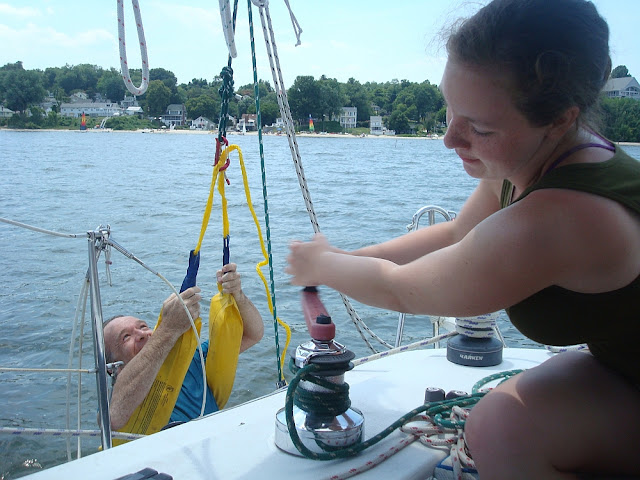
I've used a boarding ladder in 8' seas. I was clearing a fouled prop. Stimulating (so was working on the prop) but not deadly. It depends on the boat and which way it is lying to the waves. This is one way that multihulls are much easier. And people have been pounded to death on beam recoveries to; the boat drifted over them and smashed them. I think there need to be several plans, depending on the boat and conditions, and you shift gears.

This is a UK forum, but much sailing is in warm seas. Or perhaps the crew member was wearing a dry suit (smart) and would be warm for 12 hours at least, even in very cold waters. I once did an 8-hour, 0C test, in outdoor waters, in a dry suit. My body temperature actually went up. The rule for kayakers is to dress for the water, not the air. I do wear a dry suit sometimes, and if I were bow crew in a cold water race, no question. The way I see it, every cold water boat should carry at least one dry suit. I have boarded ladders, in seas, in a dry suit. You have to time it for the rise.

Not an emergency ladder, an installed ladder. Both ABYC and ISO, for nearly a decade, have required real ladders, with at least 22" in the water, that can be deployed from the water without help. A basic safety requirement. If you do not have one, add one. The recommendation is actually for 32 inches in the water, and since about 1990, I have extended the ladders on 3 boats to meet this standard, for safety. The ladders I mentioned boarding were this longer length. Basic safety gear IMO. No excuse not to.

A very common way to get a line to an MOB, and to hoist them, is a Lifesling (mostly US) or similar system (there are other manufacturers of similar systems). Many successful deployments in real MOBs.

A random video that gives the idea.

Yes, don't fall off. Move and think like you are singlehanding and there will be no rescue.

Yes, this is warm water, but it verified the purchase of the hoisting system, with daughter hoisting dad. I think warm water sailors have a different relationship with water, big waves, and swimming skills than many UK sailors. We grew up surfing. Getting knocked around while swimming, and swimming tired, are normal.
Winching+Dad+on-board+with+Lifesling%252C+low+res.jpg
 
Last edited:
I think warm water sailors have a different relationship with water, big waves, and swimming skills than many UK sailors. We grew up surfing. Getting knocked around while swimming, and swimming tired, are normal.
I believe it to be the same for people who have done any serious scuba diving over a period of years. Being in the water is not alien.
 
I believe it to be the same for people who have done any serious scuba diving over a period of years. Being in the water is not alien.
I’m a strong swimmer, experienced in cold water swimming, but swimming in clothes, not a wetsuit, in British waters, after possibly a traumatic, certainly surprising fall I don’t particularly rate my chances.
 
On keeping the arms down - I was told that you could not just put a running bowline round a person under their arms to lift them as it would crush their chest. As we had a crane to hand I tried it on me. It was painful but 100% better in an emergency than drowning.
 
On keeping the arms down - I was told that you could not just put a running bowline round a person under their arms to lift them as it would crush their chest. As we had a crane to hand I tried it on me. It was painful but 100% better in an emergency than drowning.
A running bowline is a type of noose. Depending on where it rests, you will not be able to breath at all. About the same as drowning.

Perhaps you were lucky about where you put it. Armpits you can breath, any farther down, not so much. Also it is a matter of how long. 20 seconds is one thing (and it will seem like a very long time), several minutes (muscles give out) is another.
 
Top
