How fast can you go with 3.5hp (on water)?

Note also that a flat bottomed boat, like the Bolger one above, has high initial stability, but terrible secondary stability. Not good in any significant waves.
With slim, light, flat-bottomed boats, the design limitations really kick in when you have waves of just the wrong size right on the beam. The flat bottom stays more or less flat on the surface of the water, so you roll appallingly with each passing wave. Not such a problem under sail because the sail keeps you at a steady angle of heel, but under oars the boat quickly becomes unmanageable.
 
With slim, light, flat-bottomed boats, the design limitations really kick in when you have waves of just the wrong size right on the beam. The flat bottom stays more or less flat on the surface of the water, so you roll appallingly with each passing wave. Not such a problem under sail because the sail keeps you at a steady angle of heel, but under oars the boat quickly becomes unmanageable.
I'd also note that free surface instability is very evident if you get water in them - I've had an involuntary bath as a result of that!
 
So much good advice and various exciting alternatives here...thanks for all the thoughts, and please chip in with any more.

Reflecting on recent years, I spent far more time tinkering than afloat, in various boats, so even though my eyes are popping out at the elegance of the Bolger designs and the idea of building one, I reckon I should try something modest.

I'm still tempted to construct a lightweight plywood slight-V hull that I can strap under the Redcrest, incorporating a transom that will eliminate the torque-driven hogging of the inflatable's hull.

53640903486_e8e9bff977_z.jpg


I realise I could achieve that by inflating the fifty year-old tubes to the pressure recommended by Avon, but it wouldn't make the flat rubber bottom any better for speedy motoring, nor (I suspect) would the old boat live much longer, driven so hard. Whereas, with a new hull and transom....

...it's extremely appealing to think of a slouchy old grey round-tail jumping up on the plane and scooting along faster than it was ever designed to. It would also remain tough, practical and very cheap, but about fifty times more entertaining.

Is it best to start by constructing a mock-up that fits the form of the inflatable, then the real thing using the dimensions and curves learned?
.
 
My old Lodestar is an F1 car when compared with the Avon. I still remember a previous Avon with the outboard trying to drill the prop. through the floor on part throttle. :D:D All the floor did was to bulge aft to create drag. The Lodestar's rigid transom, V-hull forward and very taught floor make it easy to plane with a light load. I'd doubt the Avon would plane unless the crew all jumped into the water, even then it would be more likely to just stand upright and destroy the outboard when it went under. I'd agree that the existing hull and transom won't work.
 
So much good advice and various exciting alternatives here...thanks for all the thoughts, and please chip in with any more.

Reflecting on recent years, I spent far more time tinkering than afloat, in various boats, so even though my eyes are popping out at the elegance of the Bolger designs and the idea of building one, I reckon I should try something modest.

I'm still tempted to construct a lightweight plywood slight-V hull that I can strap under the Redcrest, incorporating a transom that will eliminate the torque-driven hogging of the inflatable's hull.

53640903486_e8e9bff977_z.jpg


I realise I could achieve that by inflating the fifty year-old tubes to the pressure recommended by Avon, but it wouldn't make the flat rubber bottom any better for speedy motoring, nor (I suspect) would the old boat live much longer, driven so hard. Whereas, with a new hull and transom....

...it's extremely appealing to think of a slouchy old grey round-tail jumping up on the plane and scooting along faster than it was ever designed to. It would also remain tough, practical and very cheap, but about fifty times more entertaining.

Is it best to start by constructing a mock-up that fits the form of the inflatable, then the real thing using the dimensions and curves learned?
.
I wonder if you could find a hull from a scrap rib, cut out the bit you need
 
If you do decide you want to build a long, skinny plywood box, I'd happily draw basic plans for it! They'd obviously come with a hefty disclaimer about performance, safety and longevity... But I have books with numerous designs to pull construction details from.
 
Excellent! I must admit I found a tiny aluminium RIB for sale with a quoted maximum power of 7.5hp...

...I looked at the weight of the average 4-stroke 6hp...about 26kg...

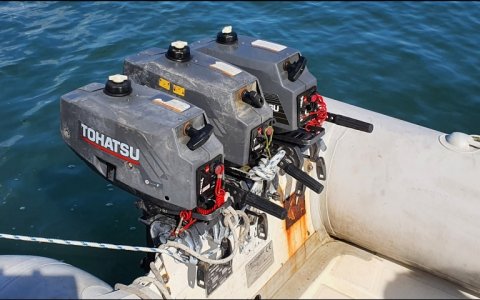
...while my Tohatsu 3.5hp two stroke is 13kg. Multiple small engines definitely crossed my mind!
 
Last edited:
Excellent! I must admit I found a tiny aluminium RIB for sale with a quoted maximum power of 7.5hp...

...I looked at the weight of the average 4-stroke 6hp...about 26kg...

...while my Tohatsu 3.5hp two stroke is 13kg. Multiple small engines definitely crossed mind!
And you can pick them up for relative peanuts too. You do need a wider transom for multi engines though. And here we all are telling you to build it narrow.
 
Umm...what's that, which is available for peanuts? Surely you don't mean the powerful, increasingly-rare portable two-strokes?

I looked on ebay and saw a handful that looked good (but far from new) at stunning high prices. As I understood it, if they're cheap, they need work, and spare parts will total as much as a good example.

Granted there are still plenty of old ones out there, but I thought a good example was like gold.

Or did you mean the mini-RIB is cheap as chips?

It would certainly be an easier (and quicker) answer than spending most of the summer in the garage, covered in sawdust and epoxy.
.
 
And you can pick them up for relative peanuts too.
Really? I know they're getting a bit long in the tooth now, but my OB mechanic reckoned they were well worth hanging on to and spending whatever is necessary to keep 'em going because they're so much lighter than 4T engines, and they don't care how you put 'em down. Certainly, someone thought mine was worth nicking :mad:
 
Really? I know they're getting a bit long in the tooth now, but my OB mechanic reckoned they were well worth hanging on to and spending whatever is necessary to keep 'em going because they're so much lighter than 4T engines, and they don't care how you put 'em down. Certainly, someone thought mine was worth nicking :mad:
Nobody seemed to want my Yam 2hp. Perhaps I’ll try again. I’ve got a Mercury 4 long shaft too. All surplus to requirements.
 
Both might be of interest to me.
Question is, how old and how clean are they, and just how many peanuts d'you want for them?
 
1980 ish for the Yam, 1990 the mercury. The yam is a decent runner, the mercury has a prob with it’s diaphagm pump. Nuts wise, not thought recently but I’m not a greedy person.
 
That sounds very fair, I'll think it over.

To be honest, my eyes popped open at the age of them. I daresay new service kits keep them running fine with care, but, wow! I thought my my 2006 Tohatsu 3.5 was ancient. :LOL:
 
Last edited:
The rest of the world is still buying tohatsu 3.5 and yamaha 2 hp. A New 3.5 is around £950 and a 2hp yam just over £500. (Uk prices)
 
I had my 3.5 serviced by Fairweather at Fareham. It wasn't cheap - well over £100 - but I didn't grudge a penny.

They said it hadn't revved its full range when I brought it in. I'd used it without knowing it ought to be better, so I'm going to enjoy its improved performance.

That's part of why I wanted something better than a Redcrest to use it on.
 
Multiple small engines definitely crossed my mind!
I wouldnt bother. We had 4 tohatsus but could only fit 3 on the transom. The propellors were very close to hitting each other. Controlling them was borderline dangerous and while it did give more thrust the top speed gain was not worth the effort.
The 3.2m rib surprised me at doing 9 knts with one engine but only 12knts with 3.
Better off with a 6 than 2x 3.5. You will go a lot faster.
I know a really skinny guy who's dingy planes with him and a 3.5, but add just a few kg of tools and it won't plane.
 
Top