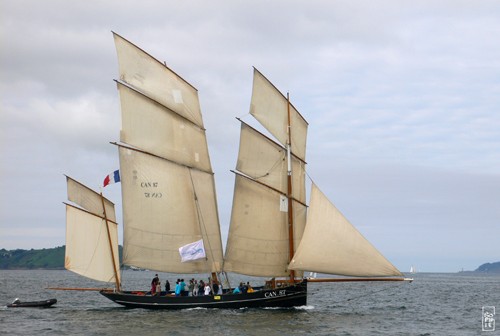
How do you tack a lugger?

A dipping lug is tacked by dipping the yard under and around the mast, either on the go or by dropping the sail.

My son teaches on small, open decked dipping lugs on the E coast of Scotland. I can ask him for the gory details if you are interested!
 
But Tom Cunliffe made the point that the halyard acted as the weather shroud to hold the mast up. Presumably if you have to dip the gaff to tack, you could also take the halyard across to the other side. Then fire up the steam winch to harden it in!

Wouldn't have liked to short tack one of them up a narrow channel!
 
You may be interested in this.

These guys are beating hard to get out of the creek, but wear round rather than tacking. There is a single moveable shroud. Unfortunately I lost most of the critical moment behind the jetty; that is when the sail is flipped back on itself, gybing the sail.

P3230076.jpg


P3230077.jpg


P3230078.jpg


P3230079.jpg


P3230080.jpg


P3230081.jpg
 
I sail a dipping lug every weekend. We tack by swinging the yard to vertical to push it behind the mast and forward again on the other side, then it has to be lowered all the way and the halayard/shroud swapped over. There is also now a twist in the halyard which has to be taken out. The sheet swaps sides, then up it goes again. Yes, it is very labour intensive compared to flicking over a tiller on a sloop, but it takes good teamwork, timing, and communication, and is kind of *the point* of sailing these boats. We race a 27ft one with a crew of four which is poetry in motion because everybody has to do their job perfectly, there are no spare hands, literally. Very satisfying when it works out. Also the prospect of having an unstayed mast, if you back the sail, does wonders for your wind awareness!
 
I sail a dipping lug every weekend. We tack by swinging the yard to vertical to push it behind the mast and forward again on the other side, then it has to be lowered all the way and the halayard/shroud swapped over. There is also now a twist in the halyard which has to be taken out.

Ignorant question follows ... why not have shrouds as well?
 
Ignorant question follows ... why not have shrouds as well?

These are minimalist boats. There is not one piece of timber, rope, or canvas that is not in some way essential. They evolved as fishing craft which had to be simple, rugged, and easy to build and repair. So why have any additional ropes or wires? Short-tacking was pretty much unheard of, you set out on one tack and came home on another.

A more technical reason is that there are no spreaders so if you had shrouds, you would affect the sail shape and cause extra chafe. The only way to avoid this would be a longer mast (timber being like gold dust out here- we have almost no trees on the islands) or spreaders, which requires more materials and introduces another failure point.

There is actually a smaller (19ft I think) dipping lug boat out this way which has a rather more evolved rig: she has a pair of running shrouds which you can tension and let off as required, so not affecting sail shape. But it's all a bit of a luxury to introduce extra blocks and cordage and not really keeping with how these boats evolved.
 
Anybody with a 1950's lifeboat ticket would have some idea how to tack with a dipping lugsail.
Dont know when they dispensed with the rig, Barker and Dobson's Barley Sugars & Conny Onny !
 
I sail a dipping lug every weekend. We tack by swinging the yard to vertical to push it behind the mast and forward again on the other side, then it has to be lowered all the way and the halayard/shroud swapped over. There is also now a twist in the halyard which has to be taken out. The sheet swaps sides, then up it goes again. Yes, it is very labour intensive compared to flicking over a tiller on a sloop, but it takes good teamwork, timing, and communication, and is kind of *the point* of sailing these boats. We race a 27ft one with a crew of four which is poetry in motion because everybody has to do their job perfectly, there are no spare hands, literally. Very satisfying when it works out. Also the prospect of having an unstayed mast, if you back the sail, does wonders for your wind awareness!

Very interested to hear that there is still active sailing in these boats. What form does it take? How many active boats are there?
 
I sail a dipping lug every weekend. We tack by swinging the yard to vertical to push it behind the mast and forward again on the other side, then it has to be lowered all the way and the halayard/shroud swapped over. There is also now a twist in the halyard which has to be taken out. The sheet swaps sides, then up it goes again. Yes, it is very labour intensive compared to flicking over a tiller on a sloop, but it takes good teamwork, timing, and communication, and is kind of *the point* of sailing these boats. We race a 27ft one with a crew of four which is poetry in motion because everybody has to do their job perfectly, there are no spare hands, literally. Very satisfying when it works out. Also the prospect of having an unstayed mast, if you back the sail, does wonders for your wind awareness!

It's somewhat easier with the Cornish arrangement of the rig. The peak of the yard is dipped until the yard is vertical, the sheet unhooked, then the yard is passed round forward of the mast (neatly bringing the bow through the wind as efficiently as a backed jib would) while the halyard and burton (shiftable stay) are moved to the new windward side, the sheet on the new winward sideatttached then up goes the sail again. A bit slow if singlehanded but the old Looe lugger "Guide Me"'s crew have mastered the art so well that if you blink you miss it.


As regards fixed shrouds they are ok with standing lug where the tack of the foresail is at the base of the mast allowing the sail to set inside the shrouds but with the dipping lug's tack at the stem the sail would have to set outside them but would foul them when sheeted hard in. This problem has been overcome with the little Beer luggers by setting the tack even further forward with an iron bumkin so the foresail can always be outside the shrouds (like a genoa).

cawsandbestresized.jpg

I never did manage to train the dog to tack the foresail!
 
These are minimalist boats. There is not one piece of timber, rope, or canvas that is not in some way essential. They evolved as fishing craft which had to be simple, rugged, and easy to build and repair. So why have any additional ropes or wires? Short-tacking was pretty much unheard of, you set out on one tack and came home on another.

A more technical reason is that there are no spreaders so if you had shrouds, you would affect the sail shape and cause extra chafe.

Thanks. The later picture of a Cornish lugger makes your second point clear - my imagined sail shape was rather out ...
 
Very interested to hear that there is still active sailing in these boats. What form does it take? How many active boats are there?

We have four community boats ranging from 16ft to 33ft all rigged as dipping lugs, plus another two which are privately owned. They get a lot of use and the largest one has been right down the west coast to Islay.
[shameless plug]
For anyone interested there's a documentary covering the building of the 33ft lugger, An Sulaire, available from the boat's website, for about £15.99
[/shameless plug]
 
Its bugger to tack is a lugger
Don't try it if you're in a rush
the yard can get cought in the rigging
when you drop it down when you're dipping
and if the wind comes abaft
you'll end up on your ass
its a bugger to tack is a lugger

Ohlay
 
Guide Me I have seen use two mainsails to really speed up tacking. Simply drop one and hoist the other.


I've seen that, if I recall correctly it might have been when tacking with a jib set, it would seem to involve more work than dipping the lug as it has to be rehoisted from deck level.

Cancalaise sets her sails standing though I seem to remember seeing old paintings of similar vessels with a greater distance between the foremast and the stem/foresail tack suggesting they must have shifted the yard when going about (though rigs seen in old paintings often seem to be incorrectly portrayed)
 
Last edited:
I read an account a few years ago of the voyage of a replica arab trading dhow from Muscat to China. They hadn't been built that size for several generations, so sailing tradition was a bit rusty.
The yard weighed several tons, and had to be brought into the vertical position and swung across by half a dozen men. Failure to time the move right with wind and waves risked crushing several to death.
 
The guy in the picture built this 37' Cornish Smuggling Lugger solo, with his own hands.


IMG_0078.jpg


Maiden passage Plymouth - Oban continuous. Some will recognise the outliers of Easedale, south of Oban....

Yes, he's using his mobo, like ET.

:)
See this video on Youtube on how to tack a Beer Lugger:

http://www.youtube.com/watch?v=Y-Gp71JdmPs&feature=related

The yard and sail are pulled around, forward of the mast, with the mainsheet. This is the way to go with a small rig. Such a simple and practical arrangement lost in time. I wonder if any of larger luggers used this arrangement. Hard to picture doing this with a block and tackle set up on the mainsheet. Or Maybe they unhooked the block, hooked on a single mainsheet, then hooked the tackle up again after tacking?
 
Top