I will not try to second guess the advice on materials, but if you choose dyneema or spectra there is a way to save lots of money.
Our halyards are dyneema, but only the bit that holds the sail and is inside the mast.
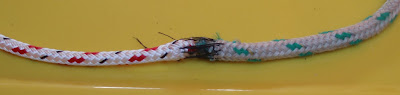
Once the sail is up, there is a whole load just coiled on a cleat on the mast and tha does not to be in the top class material. We have a loop in the end of the dyneema and then an extension piece in cheap rope attached with a lashing. Once the sail is up, we then take of the extension piece and store it below.
I will not try to second guess the advice on materials, but if you choose dyneema or spectra there is a way to save lots of money.
Our halyards are dyneema, but only the bit that holds the sail and is inside the mast.
Once the sail is up, there is a whole load just coiled on a cleat on the mast and tha does not to be in the top class material. We have a loop in the end of the dyneema and then an extension piece in cheap rope attached with a lashing. Once the sail is up, we then take of the extension piece and store it below.
Does that give you much advantage? Dyneema is very useful for racers who are using the halyard tension to trim their sails, in particular to de-power them when the wind increases. What you don't want when the wind increases is the halyard stretching and allowing the point of maximum draught to come aft in the sail and increase drag & heel. Which is why low stretch is important.
With the proviso that I have no knowledge of the sort of sailing you do, it still doesn't sound like you need Dyneema, even for half a halyard.
The above is good advice and I agree with all of it except that I didn't use tape (makes the joint a bit unwieldy for getting the rope through the masthead sheave) done it myself - only 6mm ropes on my boat though - but the theory should be the same....
I do what you do, then add some tape as Croc describes just to smooth the join and to stop it catching. It's important not to use too much tape of course otherwise it makes it unwieldy.
And it is better to pull it back and try again if it stops rather than using brute force.