How do i replace my halyards?

mattnj

Well-Known Member
Joined
26 Jul 2007
Messages
1,362
www.red-data.co.uk
I have searched and surprisingly nothing came up...

I am looking to replace the main and genoa halyard next weekend so a few questions, is dyneema worth the 3x price difference and where is it most important, main halyard or genoa halyard (if i had to choose to dyneema just one of them)

And, the most important thing is how do i pull the new ones into place, it looks like the best bet would be to cut the shackle off the main and attach it somehow to the new halyard tail and the pull it up to the top of the mast and then down the mast and back to cockpit, but how do i actually do that, sew them together? if so what do i sew it with? and tips/tricks and do i use tape or heatshrink tube over the stiching? Obviously if i get it wrong the mast will have to come down...

any tips appreciated...detailed please as i really dont have a clue here :-)

oh and finally how do i identify if my exisitng halyards are dyneema or not? I am assuming not, but who knows!
 
Last edited:
Use a mouse (thin) line. Sew it to the new hayard(s) with sail twine. I wouldn't bother with Dynema unless you have a racing yacht. I'm not sure why you said cut the shackle off the main - surely the pin unscrews.

Please shout if you need more.
 
Choice of Dyneema depends on how much you value the lower stretch and less weight against the cost!. For normal cruising probably not worth it but racers seem to like it - or maybe its just the pretty colours!

Spot on with your plan for replacement if you are leaving the mast up. You can either butt the two ends and sew them, covering the joint with tape or if you are really posh sew loops onto the ends and tie them together. Taping over the join helps them run over the sheaves and not get snagged inside the mast.
 
ok, so is that 2 different methods there:-

option1: Run a mouse line first then use that to pull the new one through

or

option2: attach the new to old and pull through in 1 go?

Have i read that correctly?


The reason to cut the shackle off.....is that i cant see how to pull the new one through otherwise (if i go from a pre-spliced one with a shackle on the splice)

Sorry, realise i should have said Dehler 38, 10mm line and its a cruiser/racer
 
The reason to cut the shackle off.....is that i cant see how to pull the new one through otherwise

Pull it the other way? :D

EDIT: Just realised you're buying one with a shackle already on the end; I read "go from" to refer to the old one.

Pete
 
Last edited:
Pull it the other way? :D

Have you two bits of rope that are long enough? Pull one length through "the other way" i.e pull from the shackle end. Then attach to that the new rope and pull it back the other way. Result - two bit of ropes with shackle splices still in place.

I was going to say it was lateral thinking but it's vertical thinking really :)
 
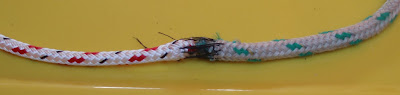
Sew together with very strong whipping twine (Old end with shackle cut off and old halliard heat sealed butted up to new heat-sealed end...butted up because few headsheaves have enough space to take two widths of halliard alongside each other.). Make sure there are several treads of the strong whipping twine because it is a bugger to sort out if the joint breaks. Wrap the joints and twine up in PVC tape as suggested to keep everything tidy but not so much it will not run round the sheaves in the mast.
Before you start pulling make sure all the other halliards and internal mast ropes are tied off tight so your new halliard does not pick them up on its journey through the mast. I do not think it matters if you pull the new rope up from the top or down from the bottom which ever way you do it the tricky part is getting the joint through the top sheave...so a slow steady pull.
I cannot see the point of a mouse if you already have a halliard in place . The old halliard is likely to be stronger than the mouse line.
Low stretch rope is slightly more important on the genoa than the main if you want windward performance.
Which ever way you do the pull it is nervewracking until you have the rope through the top sheave.... but as always Perfect Preparation Prevents PissPoor Performance. Good luck
 
mattnj

You pull the end with the shackle on to put a mouse line up the mast. You pull the mouse line to put the new halyard in. It's much easier to make the eyes and fit the shackles at home in comfort.

I have eyes in the tails of all my halyards, uphauls and topping lift. That makes it very easy to take them out each winter for a wash and storage somewhere clean and dry. I suggest that you sew a temporary eye in the old halyards and put permanent ones in your new ones.

1. Heat seal the tail of the new halyard.

2. sew through several strands of waxed whipping twine (at least size 4) (that will also do for the old halyards that are coming out).

3. work a few half hitches around the eyes on the new halyards.

In future, just tie your mouse line (at least 2x the height of the mast :D) to the eye and you can pull the halyard out whenever you like. Make sure that the line you use for the mouse is not so thin that it can skip the sheave and jam between sheave and the cheek of the sheave box at the top of the mast.


Edit:

Just read croc's post. I use this technique every winter and have done for several years. A mouse line will go round a sheave easily, and the halyard will follow without a problem as long as the mousing eye is close to the end of the halyard. You'd have to be very strong indeed to break a mouse line - the weak point is the mousing eye, and if you break that then there's something wrong in your mast anyway.
 
Last edited:
Make sure that the line you use for the mouse is not so thin that it can skip the sheave and jam between sheave and the cheek of the sheave box at the top of the mast.

thanks everyone for that, perfect and i get a picture too....

what is the idea mouse size then please?

We use it all year round so not sure i will be pulling them out each year...
 
Be cautious about using splices on halyards. If the existing halyards are spliced and the splices do not get jammed or damaged by the mashead sheaves, then you can use spliced halyards, but be careful that the new splices are no longer than the old. In my opinion tying the halyard shackle with the halyard knot illustrated in the Selden rigging instructions is a better idea, and allows you to shorten the halyard easily, or turn it end for end, if it suffers wear from the sheave.
 
Be cautious about using splices on halyards. If the existing halyards are spliced and the splices do not get jammed or damaged by the mashead sheaves, then you can use spliced halyards, but be careful that the new splices are no longer than the old. In my opinion tying the halyard shackle with the halyard knot illustrated in the Selden rigging instructions is a better idea, and allows you to shorten the halyard easily, or turn it end for end, if it suffers wear from the sheave.

my worry about that is that from memory the genoa especially is very close to the splice entering the mast (it has a ball on the end) and im assuming that a halyard knot is longer that a splice, so if i go for a knot, i dont reckon the luff will go tight....how much longer is a knot vs a splice (if at all)
 
we use 2mm cord for our mousing lines... handy to have a spool of it onboard for unexpected emergencies anyway.... you can then sort out a fraying halyard etc at sea if neccessary, and its amazing how often a length of 2mm line is useful for some unexpected other purpose!
 
Cheap but chunky

thanks everyone for that, perfect and i get a picture too....

what is the idea mouse size then please?

We use it all year round so not sure i will be pulling them out each year...

You need to ensure its big enough not to be capable of getting jammed down the side of the mast head (or foot) sheaves. Otherwise anything cheap will do...polypropylene washing line or whatever ...
 
I take out all my halyards every year, six of them in all, and replace with 6 mm polypropylene for the winter. Heat seal the end of the polypropylene, then push a piece of stainless wire through it, then through the end of the halyard. Bend the wire back on itself to make a paperclip sort of shape and wrap a bit of electrical tape around the ends to stop them snagging on anything.
 
my worry about that is that from memory the genoa especially is very close to the splice entering the mast (it has a ball on the end) and im assuming that a halyard knot is longer that a splice, so if i go for a knot, i dont reckon the luff will go tight....how much longer is a knot vs a splice (if at all)

Usually the problem is the other way round, in that the splice is too thick to go round the sheave for several inches above where a knot would be. The halyard knot takes up little space, say one inch, and if there is not room for that then you need to lower the foot of the genoa. A splice does not end where the eye is closed, but often extends anything up to a foot up the rope, thickening it and making it harder to bend, ideally the splice should not pass round a sheave. Usually with furling gear you have a choice over how high you fit the furling drum and could adjust it in need to accomodate a knot.

The Selden rigging instructions are here, and contain their advice on the matter. Look on pages 14 and 15 of the English version and you will see their illustrations showing the knot, and showing splices stopping short of the mast sheaves.
 
I have searched and surprisingly nothing came up...

I am looking to replace the main and genoa halyard next weekend so a few questions, is dyneema worth the 3x price difference and where is it most important, main halyard or genoa halyard (if i had to choose to dyneema just one of them)

And, the most important thing is how do i pull the new ones into place, it looks like the best bet would be to cut the shackle off the main and attach it somehow to the new halyard tail and the pull it up to the top of the mast and then down the mast and back to cockpit, but how do i actually do that, sew them together? if so what do i sew it with? and tips/tricks and do i use tape or heatshrink tube over the stiching? Obviously if i get it wrong the mast will have to come down...

any tips appreciated...detailed please as i really dont have a clue here :-)

oh and finally how do i identify if my exisitng halyards are dyneema or not? I am assuming not, but who knows!
Despite the convictions of the ignorant, I would strongly recommend Dyneema or Spectra.

As you can quite safely reduce the diameter from prestretch polyester, the cost difference is lee than you might think, with the added benefits of reduced stretch and far less frictional resistance. Added benefits are a more wear resistant outer sheath and higher UV resistance.

I've replaced all my halyards over the last 20 years with Spectra/Dyneema, as the old ones wore, and never regretted the action.

I'm unable to see why you need a mouse - just attach the end the new halyard to the old and pull it through - I sew mine end-to-end and only use a passenger line when end-to-ending halyards.

If you can only run to one in Dyneema/Spectra I'd do it on the main halyard.
 
I would agree that Dyneema is worth it After a few hours sailing the luff of the main used to ease quite a lot and needed tightening which was a fag as, with a fully battened main, this means turning more or less into wind. As far as whether your current halyards are Dyneema, they will be slightly stiffer to handle but the big clue is just try and "bounce" on them, if you have any spring in them they are not Dyneema!
 
Sew together with very strong whipping twine (Old end with shackle cut off and old halliard heat sealed butted up to new heat-sealed end...butted up because few headsheaves have enough space to take two widths of halliard alongside each other.). Make sure there are several treads of the strong whipping twine because it is a bugger to sort out if the joint breaks. Wrap the joints and twine up in PVC tape as suggested to keep everything tidy but not so much it will not run round the sheaves in the mast.
Before you start pulling make sure all the other halliards and internal mast ropes are tied off tight so your new halliard does not pick them up on its journey through the mast. I do not think it matters if you pull the new rope up from the top or down from the bottom which ever way you do it the tricky part is getting the joint through the top sheave...so a slow steady pull.
I cannot see the point of a mouse if you already have a halliard in place . The old halliard is likely to be stronger than the mouse line.
Low stretch rope is slightly more important on the genoa than the main if you want windward performance.
Which ever way you do the pull it is nervewracking until you have the rope through the top sheave.... but as always Perfect Preparation Prevents PissPoor Performance. Good luck

The above is good advice and I agree with all of it except that I didn't use tape (makes the joint a bit unwieldy for getting the rope through the masthead sheave) done it myself - only 6mm ropes on my boat though - but the theory should be the same....

P1010858.jpg
 
I have always replaced halyards using the butt up and sew method,but I tape the joint using self amalgamating tape which you can get really tight so the thickness is no more than that of the rope.I have never had one break yet(he prays)
 
Top