How do genoas unfurl on their own?

A surprising (to me) number of people leave a small triangle of sail unfurled, which is surely asking for trouble. I have acontinuous line furling, so it's dead easy to wind the sheets round the sail several times, and when I leave her after a trip I tie something round it as well.
 
A surprising (to me) number of people leave a small triangle of sail unfurled
Many do that. No idea why.

If the sail is furled tightly and a few turns of the sheets around the sail there isn't much else to go wrong.
Slack furled sail allows a bit of sail to catch the wind, then it just pulls more sail out.
I would say a part unfurled sail flogging itself to death is the most common.
I see hundreds of moored yachts every time I look out of my front room window and have seen a lot of shredded jibs.
 
As a precaution I always take a line from the tack fitting on the drum to an adjacent hard point. In my case, the pulpit. This effectively prevents the drum from rotating, regardless of what else might be going on.
Mike

I do exactly the same - acting as a secondary fulfilling line - after one year having to recover two shredded sails on neighbouring boats in the same marina in one gale. Both broken or slipped reefing lines.
I also try to furl very tightly, and three wraps of sheet around, like others have said.
 
... Many do that. No idea why. ...

One reason is insufficient turns on the furling drum. With mine fully rolled up and with a couple of turns around the sail, I should have 3 wraps left on the drum. Getting it set up at the start of the season takes a bit of trial and error, otherwise I end up with too much rope on the drum when unfurled or not enough wraps when furled for good furling line security. I have also found that if the sail has been valeted then it is a bit more fuller when initially furled which flattens as the season goes on. Hence more opportunity to not have the drum set up correctly.

The tack line is a great idea for extra security.
 
My headrail is tightly furled with the sheets round at least 5 times. Both sheets go round the winches and are cleated off. The furling line is round a winch and also cleated off. This has been OK for me for many years. Come winter the headsail and main is removed anyway, as the harbour I'm in the entrance isn't marked November to late March.
 
It's those pesky sea pixies.
Took the dinghy out to a boat whos genoa was flogging itself to death in a F6. Not even a thank you from the owner, last time I do that for him.

I prefer a sail tie to a bungee.

rather ungrateful of him, seems not all of us are made from the same stuff!
 
the furling line can chafe through.
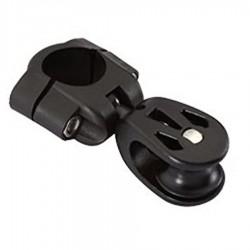
It can, but it shouldn't. Any signs of chafe would have me looking very closely at the run of the line - any line. My furling line is at least 15 years old and has no signs of wear. Possibly because I treated it to a set of these early on to reduce friction.

holt-stanchion-block.jpg
 
Even worse damage can be caused for those who leave their cruising chutes furlers up when leaving the vessel. I always wrap a sail tie around both headsails in addition to a few turns of the sheets round the sail. It’s not really possible to furl the clew of a self tacker round itself because of the hard board but the sail tie keeps secure. I had never thought of anchoring down the furler drum with a carbinier but useful trip ( provided you remember to remove before setting off )
 
Top