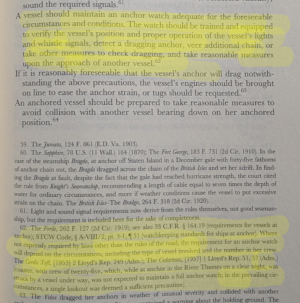
how can Colregs rule 5 - lookout - be met by solo sailors on long trips?

Point 51 says "navigational watch". So it's not saying you don't need to keep a watch, it's saying it doesn't have to be a "navigational watch" which presumably is a different level of manning to an anchor watch.

83 relates to an "engineering" watch.

Neither of these points say you don't need a watch at all times and if they did they still wouldn't trump the IRPCS.
I am not sure; I'd say also I do not particularly care about the verbatim application of rules that mainly have fully crewed supertankers in mind to tiny sailboats with only one person on board, surely beyond 24 hours I am in breach of the rules whatever I do. Shame on me I only have raised the motoring cone a handful of times in years and years. :)
 
I'd say also I do not particularly care about the verbatim application of rules that mainly have fully crewed supertankers in mind to tiny sailboats with only one person on board, surely beyond 24 hours I am in breach of the rules whatever I do. Shame on me I only have raised the motoring cone a handful of times in years and years. :)

Yup, no quarrel with any of that.
 
Last edited:
No. The Merchant Shipping Act applies to UK Vessels wherever they may be. The Col Regs part says:

Application

2.—(1) These Regulations apply to United Kingdom vessels wherever they may be and to other vessels while they are within the United Kingdom or the territorial waters thereof but not to seaplanes

And United Kingdom vessel” means a vessel which–

(i)is registered in the United Kingdom; or
(ii)is not registered under the law of any country but is wholly owned by persons, each of whom is either a British citizen or a British dependent territory citizen or a body corporate which is established under the law of a part of the United Kingdom and has its principal place of business in a part of the United Kingdom;


So MCA can get its “clutches” wherever you are unless you’ve registered elsewhere (or a not a UK national etc) when you probably fall under someone else’s laws.
Read what i asked. Does it apply to non uk flagged boats outside uk waters?

The answer is clearly no.
 
Read what i asked. Does it apply to non uk flagged boats outside uk waters?

The answer is clearly no.
Of course not, but that is neither what you asked, nor an accurate position for most UK based sailors. And I did explicitly cover the point in my reply.

You asked about British Flagged vessels not UK Ships (we can get into to details of the distinction if you want - but for the vast majority of UK owners they will have a UK ship; if you don’t have a UK ship your boat falls under someone else’s jurisdiction so you better check their law - which given the UK has some of the most laid back and pleasure boat rules probably isn’t going to say what you hope).
 
Of course not, but that is neither what you asked, nor an accurate position for most UK based sailors. And I did explicitly cover the point in my reply.

You asked about British Flagged vessels not UK Ships (we can get into to details of the distinction if you want - but for the vast majority of UK owners they will have a UK ship; if you don’t have a UK ship your boat falls under someone else’s jurisdiction so you better check their law - which given the UK has some of the most laid back and pleasure boat rules probably isn’t going to say what you hope).
I didnt mention british flagged vessels at all. I mentioned non uk flagged vessels.
As to Irish rules. I think you will struggle to find any instance of an irish flagged pleasure craft being prosecuted by Garda Cósta na hÉireann for not keeping a look out. Or indeed for anything else to be honest.
 
I didnt mention british flagged vessels at all. I mentioned non uk flagged vessels.
Yes, sorry, you are correct you didn't mention british flagged vessels, you invented a term "uk flagged vessels". The UK legisltation refers to UK Ships whilst the merchant shipping act adds in British Ships and British Flag and a different definition of UK Ships...

I will endeavour to remember the nationality of all posters in future when they ask vague questions which they already know the answer for. It still doesn't change the fact that the UK law, and UK enforcement would apply when you cross the Irish Sea (and I'd suggest its not that unusual for singlehanders from ROI to do that).
As to Irish rules. I think you will struggle to find any instance of an irish flagged pleasure craft being prosecuted by Garda Cósta na hÉireann for not keeping a look out. Or indeed for anything else to be honest.
Well given theres only a smattering of UK cases and there's 10x as many people in the UK that's no surprise - especially because dead sailors don't make good suspects. It doesn't mean they won't if something bad happens and there's a survivor to blame.
 
It seems like following the letter of the law and ever having any sleep are incompatible. Is there some exemption here? And has there ever been a serious effort to change these rules or ban single handers? or is it just a contradiction that everyone looks the other way from?
Your question has raised a good debate (as have previous threads on the subject).

It seems clear that taking your eyes off the sea for more than 10-20 mins is likely to mean failure to follow Colreg rule 5.

From the incidents Ylop highlighted, the cause of accidents (and prosecutions) seems more about negligence and wilful flouting of Colregs rather than singlehanded yachts taking naps or breaks on passage.

It is a contradiction but I think singlehanded yachts recognise it, equip their boats accordingly and apply judgement and experience to when and how they take a break from keeping a visual watch. Given that fatigue is an issue on passages over 12 hours it seems wise to make the effort to keep fed, rested and alert so you can monitor and make judgements more effectively.

How is that justified when commercial and large ship users have to follow the letter of the law? At least in part it has been because singlehanded small sailing boats have not caused many evidenced problems or incidents to other vessels, and singlehanding does not form a big consideration in Colregs (as most vessels are crewed). It seems to me less about whether you get caught and more about how you do your best to follow the principle of rule 5.

The arrival of fast and very fast singlehanded boats racing in busier shipping areas might change that but its difficult to see how to bypass the human need for rest.
 
Top