Hot water options

Will you be using the engine for long enough to heat the water?
When I had my Bukh I replaced the original calorifier and pump when we sailed in The Netherlands. At Hellevoetsluis we would leave the berth, motor slowly a few hundred metres to await bridge opening, tickover for a short time, then motor through and down the channel to the Haringvliet, about a further 200 metres. Once outside the hot water was too hot to hold my hand in.
 
I did advise someone quite a few years ago about fitting a calorifier to a 3GM30 by adding a pump. Same method as the Bukh, circulating water from and back to the block. I heard from him that it worked but I know no more.
It was with a 3rd party indirect cooling head that also fed the calorifier.
 
We've somehow managed to own four yachts, all with inboard diesels, yet have never had a calorifier. We will probably add one to the current boat.
We've survived through a combination of kettle, solar shower, gas water heater (I eventually removed that, it seemed pretty dodgy, didn't work very well, and was taking up valuable space) and of course the best solution- sail somewhere warm enough that you no longer need hot water.
 
We've somehow managed to own four yachts, all with inboard diesels, yet have never had a calorifier. We will probably add one to the current boat.
We've survived through a combination of kettle, solar shower, gas water heater (I eventually removed that, it seemed pretty dodgy, didn't work very well, and was taking up valuable space) and of course the best solution- sail somewhere warm enough that you no longer need hot water.
Fair enough if you are prepared to do that. I believe those black bladder things with a shower attachment can work pretty well too.
 
Fair enough if you are prepared to do that. I believe those black bladder things with a shower attachment can work pretty well too.
Even when cruising the west coast of Scotland we found a solar shower was good enough. But you have to cheat and put a kettle of hot water in alongside a couple of litres of cold.
 
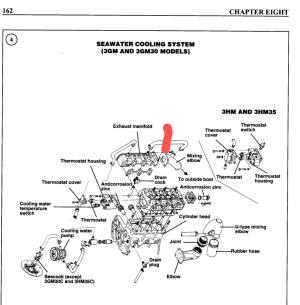
That will not give hot water. The flow to the exhaust includes bypass water and is typically at a temperature of 40C.
Ah, the expert agrees with me! Fr Hackett says it has worked for him, so I guess a check on the OP's particulsr engine is needed
 
Thanks for all the responses. Much appreciated.

I don't like the idea of adding a gas boiler. Lots of space taken up and needing to route a flue. The calorifier is already there, so it makes sense to get that working again.

Will I use the engine long enough to warrant it? If my sailing ability is anything to go by, absolutely.

Is the verdict that interrupting the seawater flow at the point highlighted in red on the attachment wouldn't give enough heat to get hot water in the calorifier?
 

Attachments

  • Screenshot_20250512-153507.png
    Screenshot_20250512-153507.png
    409.8 KB · Views: 12
As I wrote previously that hose carries both heated and bypass water, usually at less than 40C. You can check by touching it while the engine runs.
Water flow through the Bukh DV20 is low, which may account for the experience noted above. If the majority of flow is passing through the engine, not through the bypass, the flow would be hotter. This is not normally the case with other engines.
 
Taking rerouting seawater coolant to the extreme, in theory, if you could take the water going through the block into the calorifier, then meet it back with the bypass water after the thermostat, everyone is a winner.

The complication being the yanmar fittings don't look the easiest to alter.
 
Throw in the option of a hubble ...bonus if you allready have a Eberbasto/planerchinaspacer diesel heater.
Three seasons now and still heating my water at anchor. Though I have piped up my raw water cooled Bukh, as per VicS instructions , I haven't got around to fitting a 12v pump so can't comment on efficiency.
20 litre calorifier approx 45 min from cold to awwch that needs cooling with the hubble


Sorry Bobil water heater not hubble (senior moment)

BOBIL
 
Last edited:
Taking rerouting seawater coolant to the extreme, in theory, if you could take the water going through the block into the calorifier, then meet it back with the bypass water after the thermostat, everyone is a winner.

The complication being the yanmar fittings don't look the easiest to alter.
The problem there is that the engine may run cool, causing high wear rates and higher fuel consumption.
 
The problem there is that the engine may run cool, causing high wear rates and higher fuel consumption.
Not sure I follow. The route of the cooling would be the same in the block.

Do you mean if you added an electric pump? I thought the risk would be overheating, as you're increasing the length of the run.
 
Throw in the option of a hubble ...bonus if you allready have a Eberbasto/planerchinaspacer diesel heater.
Three seasons now and still heating my water at anchor. Though I have piped up my raw water cooled Bukh, as per VicS instructions , I haven't got around to fitting a 12v pump so can't comment on efficiency.
20 litre calorifier approx 45 min from cold to awwch that needs cooling with the hubble


Sorry Bobil water heater not hubble (senior moment)

BOBIL

That sounds promising. There is an eberspacher diesel heater, so this may be the best option.
 
That sounds promising. There is an eberspacher diesel heater, so this may be the best option.
I originally installed mine as I wasn't sure if I could take raw water from my Bukh. However I now have that option once I install a pump, however the Bobil is great although their website is a little cluttered. They do have decent demo videos on utube.
 
Ah, the expert agrees with me! Fr Hackett says it has worked for him, so I guess a check on the OP's particulsr engine is needed
@vyv_cox has details of how it works on a seawater cooled Volvo 2003 engine, and I can vouch for it working well, as it's my engine that is pictured on his website! But the cooling circuit on that engine is far from intuitive.
 
Top