Holy Bolt

arawa

Well-Known Member
Joined
21 Nov 2007
Messages
79
Location
Black Isle
Visit site
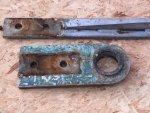
The stainless steel plates (about 4kg in total) shown in the first picture extend from the keel of my 2008 Trusty 23 and support/protect the bottom of the rudder. They were coppercoated from new by the builder although the coppercoat quickly peeled off the stainless steel but a few traces can still be seen.
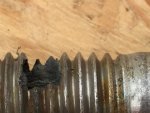
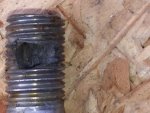
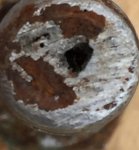
The 12mm bolts holding the 2 plates together are marked with a “Winged V” and “A2-70”. One appears fine but the other has a large hole in it filled with what appears to be metal fibres. The hole runs to the end of the screw thread and the bolt would have surely have failed in the near future.
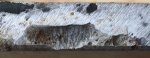
There appears to be some nibbling away of the stainless plates themselves. These are attached to the boat’s GRP hull and are in contact with a large stainless keel band – but to no other metal except for perhaps the Coppercoat itself via the keel band. The boat has anodes (which slowly melt away) but the plates shown are not connected to an anode. The boat normally lives on a deep water mooring but has spent a season in a marina. It has a galvanic isolator fitted. There is no sign of any problem on the stainless rudder or the bronze prop.
Is this just caused by using A2 rather than A4 bolts?
IMG_1507.jpgIMG_1497.jpgIMG_1501.jpgIMG_1498 (2).jpgIMG_1511 (2).jpg
 
They are nice examples of crevice corrosion. A4 is a little better than A2 where crevice corrosion is concerned by virtue of its molybdenum content but it is not immune from the problem. If there is one warning in particular regarding stainless steel it is not to use A2 bolts underwater, so this selection by your builder is surprising. I suggest that the best thing you can do with the current kit is to use sealant to try to prevent access by seawater. Try A4 bolts but keep an eye on them in future. Anodes, galvanic isolators, marinas have no effect on crevice corrosion.

There are plenty of examples of similar crevice corrosion on my website under Metallurgy.
 
They are nice examples of crevice corrosion. A4 is a little better than A2 where crevice corrosion is concerned by virtue of its molybdenum content but it is not immune from the problem. If there is one warning in particular regarding stainless steel it is not to use A2 bolts underwater, so this selection by your builder is surprising. I suggest that the best thing you can do with the current kit is to use sealant to try to prevent access by seawater. Try A4 bolts but keep an eye on them in future. Anodes, galvanic isolators, marinas have no effect on crevice corrosion.

There are plenty of examples of similar crevice corrosion on my website under Metallurgy.

Thanks Vyv. Helpful and authoritative as ever.
I had heard of crevice corrosion but it was a bit of a surprise to find a hollow bolt.
 
If there is one warning in particular regarding stainless steel it is not to use A2 bolts underwater, so this selection by your builder is surprising.

Kindred Spirit was the same, I don't think small builders know as much about these things as perhaps they should. Our corrosion was much more spectacular, an M10 bolt reduced to a thread for much of its length. I replaced them all with A4, which reduced but didn't eliminate the problem, and in the end got the whole fitting copied in bronze by Classic Marine.

Pete
 
Kindred Spirit was the same, I don't think small builders know as much about these things as perhaps they should. Our corrosion was much more spectacular, an M10 bolt reduced to a thread for much of its length. I replaced them all with A4, which reduced but didn't eliminate the problem, and in the end got the whole fitting copied in bronze by Classic Marine.

Pete

Thanks. Having done some research, I was thinking of retaining the stainless fitting but replacing the stainless bolts with bronze ones. Is this a stupid thought?
 
Some years ago, I also found crevice corrosion on shroud U bolts on a Jaguar 27 - one had been weeping slightly so tried tightening the nut and sheared the thread! Removed it and both threads were badly corroded where they were hidden by the deck. Checked all 4 and most had some evidence of crevice corrosion and replaced with Wichard U bolts which were the same hole centres.
 
Top