High 'anti-siphon' loop required with a 'piddle tube'?

I wouldn’t assume that anything on this boat is there for a reason! Some of the original gear, assumed sound by the PO, could’ve sunk her if launched ‘as is’. It’s a mess of previous bodges…

But are we saying there’s a risk of reducing (not entirely removing) the vertical ‘loop’ section? Remember that there’s an effective ‘siphon break’ vent to atmosphere, via a 10mm ID ‘piddle tube’ to a purpose made s/s breather ‘manifold’ that vents on the topside. It is easy to check visually and can’t see how it would fail without soon being noticed. And if it did block, surely a loop wouldn’t help anyway?

Bear in mind also have a high rise exhaust mixer with sufficient fall to the waterlock. The system is designed and specified not to hydro lock!

The waterlock is there to stop the water in the exhaust getting into the exhaust manifold, thence the engine. The vented loop or piddle pipe is there to stop the sea water that was being pumped through the cooling system from siphoning into the system and possibly entering the engine. Both devices break the siphon, when correctly installed and working.

Not much to go wrong with the piddle tube, provided it's correctly installed and doesn't get blocked (hard to see how it could get blocked, if it did, you'd likelt notice the lack of peeing). The valves in the vented loops need maintenance and checking from time to time. If the valve fails in the closed position it won't break the siphon and the engine could get water in a cylinder/s, resulting in damage.
 
Been following this thread. It seems to me that the OP in the first post raised a few questions which have not been adressed (perhaps I’ve missed the answers).
The piddle tube IS an anti syphon break, there is no need for two anti syphon breaks.
Would it not be more correct to say the piddle tube is an AS, provided it connects to a loop in the cooling water pipe that by some margin is taken above the water line? (Beta in their installation guide lines recommends this margin should be 50 cm, IIRC).
 
Been following this thread. It seems to me that the OP in the first post raised a few questions which have not been adressed (perhaps I’ve missed the answers).

Feel free to fill in the blanks (y)

Would it not be more correct to say the piddle tube is an AS, provided it connects to a loop in the cooling water pipe that by some margin is taken above the water line? (Beta in their installation guide lines recommends this margin should be 50 cm, IIRC).

Depends how nit picking and pedantic one wants to be i suppose. You could say the same about just about every subject that gets discussed on these forums. When there is an anchor thread we don't usually mention that the anchor won't work unless we deply it, or the sails don't generate much forward momentum if they are in the sail locker, or the engine oil doesn't lubricate the engine if it's still in the can etc. ;)

Nonetheless, in post #21 i think i may have covered all bases:

The waterlock is there to stop the water in the exhaust getting into the exhaust manifold, thence the engine. The vented loop or piddle pipe is there to stop the sea water that was being pumped through the cooling system from siphoning into the system and possibly entering the engine. Both devices break the siphon, when correctly installed and working.

Not much to go wrong with the piddle tube, provided it's correctly installed and doesn't get blocked (hard to see how it could get blocked, if it did, you'd likelt notice the lack of peeing). The valves in the vented loops need maintenance and checking from time to time. If the valve fails in the closed position it won't break the siphon and the engine could get water in a cylinder/s, resulting in damage.
 
  • Like
Reactions: pvb
Could not agree more, and for completeness post#4 made exactly the point that a piddle tube is an anti syphon device. Why do some have to then make it all so complicated by nitpicking terminology resulting in endless attempts at explaining really simple things!
 
Could not agree more, and for completeness post#4 made exactly the point that a piddle tube is an anti syphon device. Why do some have to then make it all so complicated by nitpicking terminology resulting in endless attempts at explaining really simple things!
Are you saying that a piddle tube acts as an AS device regardless of where it connects to the cooling water pipe in relation to the water line? Even if the connection point is under the water line?
 
Are you saying that a piddle tube acts as an AS device regardless of where it connects to the cooling water pipe in relation to the water line? Even if the connection point is under the water line?

What's wrong with you ?

In post #4 (which Tranona refers to above) he says:

"The piddle tube is an anti syphon loop - just not a valve. The purpose is to provide a syphon break well above the waterline. "

Do you have anything useful to add to the thread ?
 
why do I need a (so-called anti-siphon) loop at all?

Won't the piddle tube, alone and wherever it connects to between the h/e and mixer, act as my anti-siphon break?

it would simplify things considerably to reduce it (to go position closer to the h/e and exhaust) or even remove it altogether.

Instead, I could have a short loop between the (Beta) heat exchanger and the exhaust elbow, with a tee at the highest point (I could manage say 200mm above the mixer in situ).
To the OP: In your first post you make these suggestions about eliminatiing or greatly reducing the AS loop, without any mentioning of how your engine is installed in relation to the water line. I get the impression from your later posts that you, following replies from other posters, now feel reassured to go ahead. I would advise strongly against doing so. Much of the advice given in this thread on piddle tubes is unclear at best IMHO.
However, don’t take a nit picker’s word for it, go get some professional advice.
 
To the OP: In your first post you make these suggestions about eliminatiing or greatly reducing the AS loop, without any mentioning of how your engine is installed in relation to the water line.
No - fair point - the piddle tube cannot tee at a point so low that the whole lot could just be ‘flooded’ below the waterline.

The mixing point on our high-rise elbow is above the static w/l anyway. I was operating under this assumption for our installation - which I appreciate I didn’t state - so caution be advised to others with different setups!

So, it’s above already, but won’t be 30cm as required by Beta so that height will still need to be made up.

I can make it at least 300mm minimum of height ‘AWL’ without an exaggerated loop. The previous location was maybe 500mm above (but with the addition of a 1500mm longer hose run to achieve this).

go get some professional advice
No chance of that up here! This forum is by far the best we’ll do - and judging by what the pros have left behind in the past (including this installation - which didn’t even meet Beta’s clear and modest ‘specifications’) were safer for it!

But we can tidy up the advice in this thread to make it clearer for others. Is it simply enough to re-state Beta’s 30cm?

There’s a good diagram in the manual which I can re-post when I get on the proper PC.
 
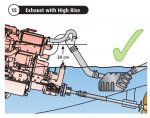
Perhaps not so clear-cut based on the Beta Installation Manual...:

This is our setup:
Beta15.JPG
But - there isn't going to be close to 30cm at the elbow. I'd guesstimate closer to 100mm (max). However, assuming a piddle tube tee directly above the injection bend - but higher (at least 300mm) then surely the same is achieved?

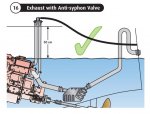
Now, the next diagram - showing an anti-siphon loop - complicates things a bit:
Beta16.JPG
Here the required height suddenly changes to 50cm! I can see how this could have influenced the previous installation, as to achieve a towering 500mm you would need to run the loop forward and up under the bridgedeck.

But should 50cm be required for an anti-siphon vent that ultimately plumbs to the exhaust above the static w/l? Obviously the diagram makes it look quite dramatic, with the whole donk under water. But in reality, ours looks more like Figure 15 - only with the water level somewhat higher.

So @BabaYaga - back to my original question really - does the water really need to be forced a considerable height (500mm here) above w/l, on top of having a reliable factory-fitted vent and a high-rise exhaust mixer fitted?
 
Having installed exactly what Beta show (altho with a valve ) I make these points :
If you draw the waterline across your transom (sketch or photo) at a level and angle sustained when sailing hard - up to decks awash - you will see why the height and any distance from CL become important.
I assume that the 50cm is shown because it allows a significant drainage fall to the outlet position - unless the line sags it will not be blocked by water and obstruct air being pulled in. So an outlet high on the transom may defeat this precaution.
If you take the full bore of cooling water up to this kind of height you have an extra volume to cater for in the waterlock.It is not clear if with a standard bend the water around the anode has chance to drain but with such a high loop it is pretty certain that it can't .These engines certainly get through anodes quickly .
When you take the loop this high you are almost certainly going to support it on the compartment wall or a bulkhead so you now have relative movement between the engine connection and a fixed point.Reinforced hose ,which you might otherwise desire,is too inflexible for this duty so silicone hose which allows tighter radii and has elbows available is a solution .So some arguments against the full bore /full height loop.
I wonder whether Beta will expand on their advice in further manuals.
 
The piddle tube IS an anti syphon break, there is no need for two anti syphon breaks.
But words of warning on bth types:
1. Valve type - an old wooden 45 Moody - the owner didnt know the valve was there - after many years it blocked and filled the cylinders with water.
2. The Westerly type piddle tube: in the Med its the favourited nesting place for a tiny wasp - result no piddle - and worse , no syphon break. I normally leave some tape over it when I leave the boat to prevent this, but in Oct 2019, I did not do it - role on June 2021, no piddle..... Very small bore to rod through - badly blocked- so a reel of monel metal did the job.

I have seen many a blocked valve type over the years - its surprising how many owners dont know what it is or what it is for. 2 minutes work each year could save £1000's in totally avoidable repairs
 
The first diagram really deals with the question ”can I get away with installing no AS device at all?”
As you only have about 10 of the required 30 cm’s between the WL and the injection point on the elbow, the answer must be no, you need an AS device.
Second diagram deals with a completely different measurement, namely the height of the vented loop in relation to the waterline. This is a somewhat trickier question IMO, because the recommendations have become stricter over the years and they also vary between manufacturers (Vetus gives minimum 40 cm, IIRC, where Beta says 50).
It is difficult to know if these stricter guide lines are well founded or just an expression of back-covering.
When you mention connecting a piddle tube to a tee above the injection bend ”but 300 mm higher”, are you then taking the measurement from the injection point or from the WL?
If the former, you would be about 40 cm above WL and I believe you would be safe. As you say, the fact that the injection point on the elbow is already somewhat above the WL should be in your favour.
 
Last edited:
Apologies to the OP for a small tangent about valve-types. Given how important the operation of the valve is to prevent syphoning and the difficulty of checking through disassembly I added a hose about a foot long to the spigot (on a Vetus). As part of routine engine checks I do a quick gentle blow and suck down the hose which tells me the valve is operating. A five second check.
 
Thanks all - what's interesting, for me at least, is that it brings 'gravity' (and fluid mechanics?!) back into consideration, whereas normally the advice on anti-siphons is that simply having a loop above a water level does nothing on its own, of course.

Beta obviously have a reason for their 50cm (in addition to any back-covering, as suggested) - although I am stuck in my own head-scratching loop trying to identify it! So far, I've considered:
- Extreme conditions (as suggested above) which might risk water mechanically sloshing about (but then, why do loops need 50cm but no loop needs only 30cm?)?
- Gravity - in that water has a greater guarantee of ending up where it needs to be with a 50cm fall vs. a 30cm one (although, again, it looks more compelling in the diagrams, with the entire engine under water - but in reality ours is somewhere between Figures 15 and 16)?

When you mention connecting a piddle tube to a tee above the injection bend ”but 300 mm higher”, are you then taking the measurement from the injection point or from the WL?
Thanks. I'd need to measure to be sure (and do this once the engine has been repositioned - see above), but I'd say it would be closer to 300mm (absolute minimum) from the static w/l and 200mm if measured from the injection point.

I definitely didn't mean to imply I had loads of headroom above the w/l at the aft end. I'd be surprised if it met the Vetus 40cm requirement, although it should be close in its final position.

Of course, the alternative is to put the top of the loop right back where it was before. That would exceed the Beta 50cm.

I assume that the 50cm is shown because it allows a significant drainage fall to the outlet position - unless the line sags it will not be blocked by water and obstruct air being pulled in. So an outlet high on the transom may defeat this precaution.

Yup, I would describe ours as 'high'. It is on the topsides, but in the aft 1m (of 12,5) and slightly above the exhaust. In theory, the exaust should block before the piddle breather (salt, critters, and other factors aside).
 
I wouldn’t assume that anything on this boat is there for a reason! Some of the original gear, assumed sound by the PO, could’ve sunk her if launched ‘as is’. It’s a mess of previous bodges…

But are we saying there’s a risk of reducing (not entirely removing) the vertical ‘loop’ section? Remember that there’s an effective ‘siphon break’ vent to atmosphere, via a 10mm ID ‘piddle tube’ to a purpose made s/s breather ‘manifold’ that vents on the topside. It is easy to check visually and can’t see how it would fail without soon being noticed. And if it did block, surely a loop wouldn’t help anyway?

Bear in mind also have a high rise exhaust mixer with sufficient fall to the waterlock. The system is designed and specified not to hydro lock!


Unfortunately on some boats the Volvo Piddle tube was positioned in a way that the only function it carried out was to indicate a sea water flow through the cooling system. Removing the anti syphon loop as in the OP post removes the protection against water flowing to the exhaust elbow via the sea inlet which IT DOES the sea water vane pump does allow a small leakage.
If the OP has a high rise exhaust elbow this is not a problem however for instance if he were to have a boat where a modern low height engine has replaced a Volvo MD2B he could be joining the legion of unhappy boaters who have seen their brand new Beta or Volvo 20 series suffer gradual failure of the rearmost exhaust valve and seat due to sea water ingress after stopping . Quite a few in the marina I use that I know off have had this problem and some more than once due the reason not being identified on the first occasion.

Heaven knows why more effort is made by engine suppliers and fitters to include these in the spec. When I spoke to Beta some years ago the first time the subject was brought up was when I asked about it. How many know the importance of this item.

If I was the OP I would not remove the loop , It may be absolutely necessary and if he doesn't like piddle tubes then fit a Vetus valve . The valves and piddle tubes are only there to make the anti syphon loop work. If no anti syphon loop you do not need the piddle tube , however it can be connected elsewhere to the cooling system where its only function is to indicate water flow and in this case it may be necessary to ensure that a suitable HIGH rise exhaust bend is fitted. IE the inside OD of the bend is always above sea level when the boat is at rest.

The OP needs to revue his whole system checking the relative heights of the overboard exhaust outlet and he height of the exhaust elbow as well as any high points in between. Some smaller yachts are forced to mount the exhaust water lock higher than advisable and this can introduce problems. This was the probable
The piddle tube IS an anti syphon break, there is no need for two anti syphon breaks.

cause of problems on one of the local boats here and a high rise exhaust elbow would have solved it. It was finally sold with a low rise elbow and damaged valves. (third time) Some people do not listen :)
 

Thanks Bilgediver - it was a general awareness of this risk/issue that prompted me to order the high-rise elbow. The previous installation had the high loop (and working piddle/siphon break), but the stock elbow/mixer didn't give enough fall above the waterlock. We've now got their 'crossover' type (due to space constraints) and this isn't quite as 'high' as the regular 'high-rise', but it does add maybe 100mm (at a push) above the stock elbow mixing point.

The OP needs to revue his whole system checking the relative heights of the overboard exhaust outlet and he height of the exhaust elbow as well as any high points in between.
Yup, good advice. Will do. That process is underway. Although the engine needs to be re-positioned to accommodate the new elbow (that will put it in the 'right' place anyway - it was 'professionally' installed too far aft, to facilitate the reuse of the old shaft).

I'm hoping that no damage was done with the old low-rise elbow, before our ownership.
 
I have my piddle pipe in the cockpit, piddling directly into a cockpit drain a distance of about 100 mm.
The beauty of this is that I can see it at all times, and if it were to stop!
I know the engine will overheat in less than 5 minutes.
 
Also just to be clear and upfront - I was indeed swayed towards a diminutive replacement to the previous loop. It would've saved me a fair bit of mess/hassle in the installation - thus my inclination to dismiss previous suggestions I needed one!

In other words, I'm in the process of forming an opinion (and changing my mind a bit) as I go, rather than consciously trying to contradict mine or anyone else's previous replies! ;)

For instance, I now realise the high-rise elbow (and the water-level relative to that mixing point) is a material factor.

I'm still genuine confused as to why such a large height above w/l (Beta's 50cm vs 30cm) is needed where a loop vents high up elsewhere. But if it is simply a matter of headroom added as a caution when a valve/vent is involved, I'd take that!
 
And for future readers on this subject: Claims have been made upthread (esp. posts 2, 4, 20 and 21) that by the unwary could be interpretated to mean that a piddle tube is an AS device in its own right or that it could replace the vented loop without any considerations.
This is simply not correct.
The core component of an AS is the vented loop, taken well above the WL.
Connecting a small bore tube or hose (piddle tube) to the top of the loop is simply one method of venting it to the open air.
Another common method of venting the loop is installing an AS valve in the same location.
 
Yup, good advice. Will do. That process is underway. Although the engine needs to be re-positioned to accommodate the new elbow (that will put it in the 'right' place anyway - it was 'professionally' installed too far aft, to facilitate the reuse of the old shaft).

I'm hoping that no damage was done with the old low-rise elbow, before our ownership.

The damage is usually to the aft cylinder exhaust valve initially. A basic compression test might reassure you here. Take out your injector and get one of those wooden taper blocks in your tool kit for plugging broken ship side valve outlets and hold it in the injector pocket. Do not hammer in. The force by which it lifts is a good indicator and if you can hold it firmly in place start worrying now, if you can not hold it in place then go sailing and check again later, maybe with a borrowed compression gauge clamped correctly in place to hold injector sleeves in place if fitted.

The engines in our marina affected with this all quickly developed rough running indications due to the leaky exhaust valve. Smooth running is a good sign.
 
Top