Hi-Lo platform hydraulic cylinders burst !

BartW

Well-Known Member
Joined
9 Oct 2007
Messages
5,236
Location
Belgium
www.amptec.be
Last year, beginning of june, when arriving at the boat from home,
I tried to lower the hilo platform,
It had happened before that the mechanical safety hook didn’t’ release immediately after pushing the low button.
At that occasion it took a few seconds before it released but now: there was a build up of pressure in the hydraulic system,
so that when the mechanical hook released, the platform shot down approx. 30cm, with a big bang.
and instantly there came a pool of oil on the water surface, around each lifting arm.

I realized that I had a big problem,

inspecting the lift system with a diving mask, while pushing the hi/lo buttons,
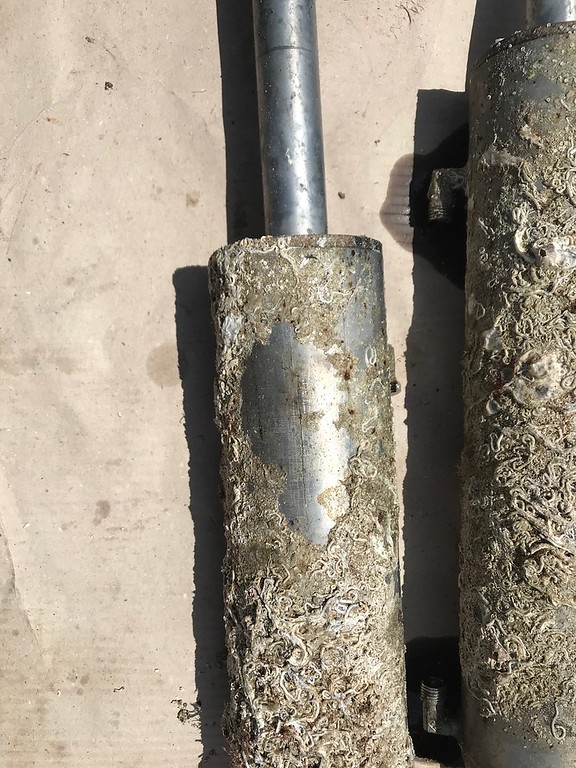
I found that both cylinders leaked oil and had a major crack.

After a lot of swearing, thinking, eventually planned for the next steps.

Immediately called my friends at h+b for advice, and ordering new cylinders and some extra spares, to be delivered 1,5 week later, the only “day” I had available before summer hols, for doing that repair myself (with help from Alf)
We were in Marina D’arechi just for that one month,
Luckily this Marina has a suitable travellift
Alfonso was able to arranged for the lift out,
wich in the end after lots of Italian drama, was just limited to a stay for maximum half a day !

So on that day,
Immediately after arrival from the airport,
we navigated the boat slowly, with the platform half submerged, to the travel lift,
And the boat was placed on the dry,

The repair went without too much problems,
And three hours later they could put the boat back in the water.


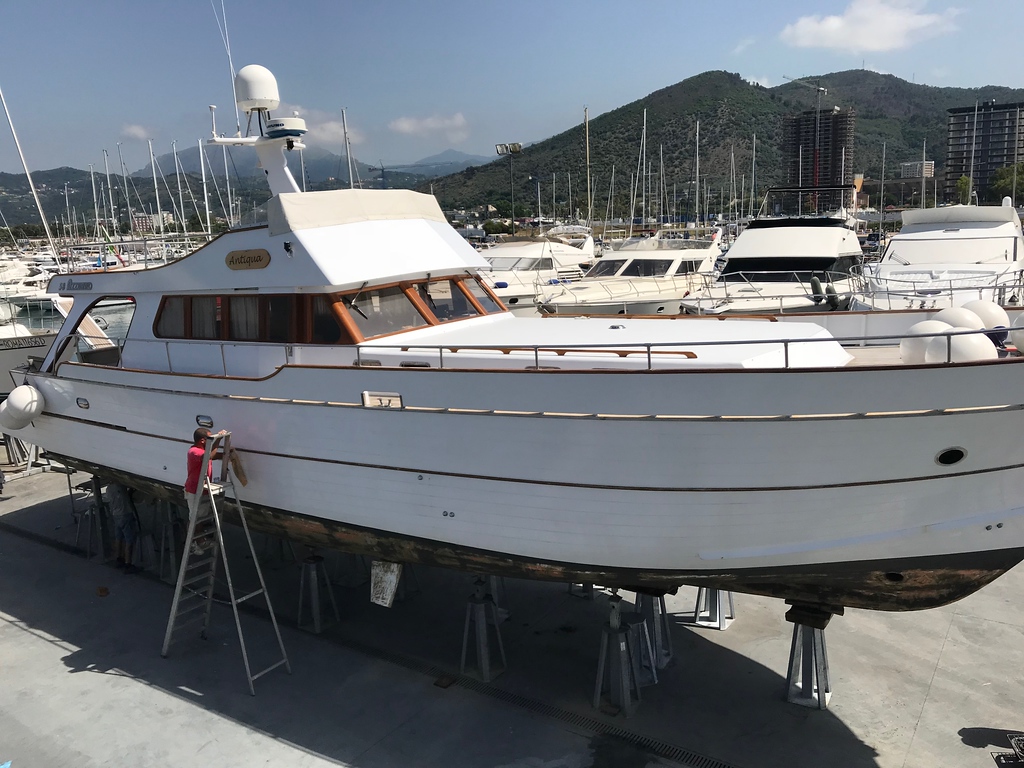
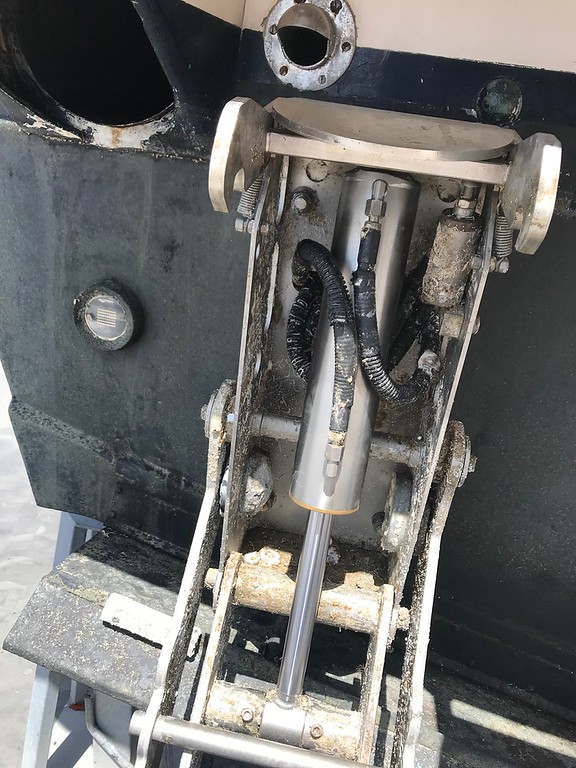
Here some pics

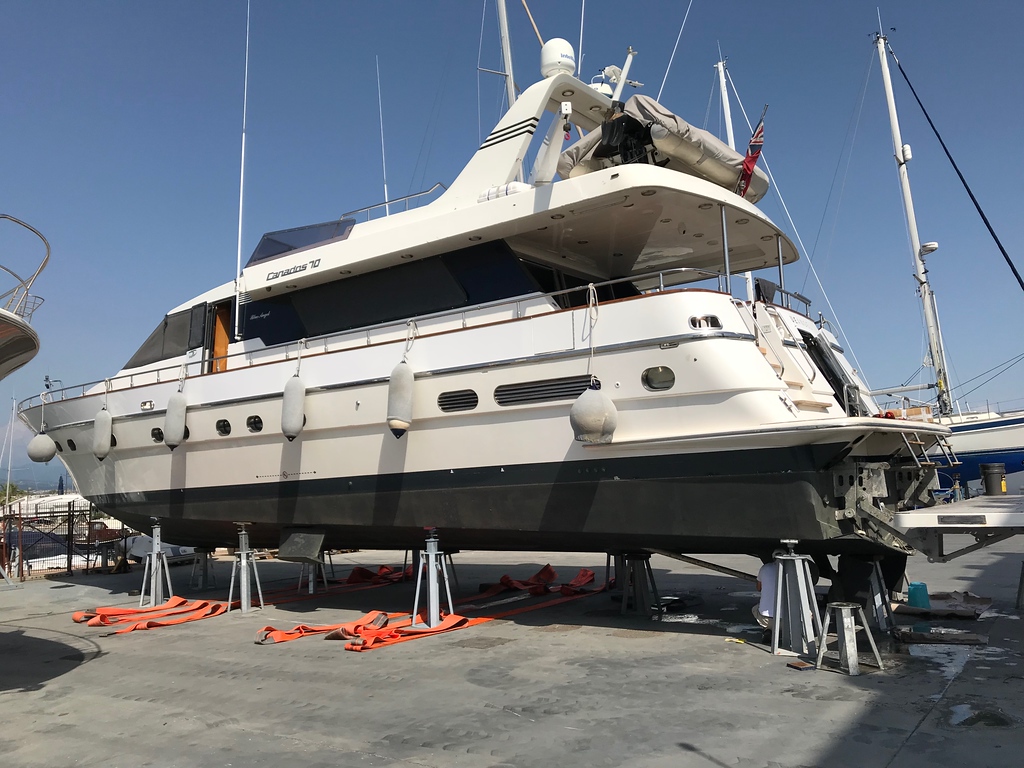
This boat on the side of the lifting dok might look familiar to some
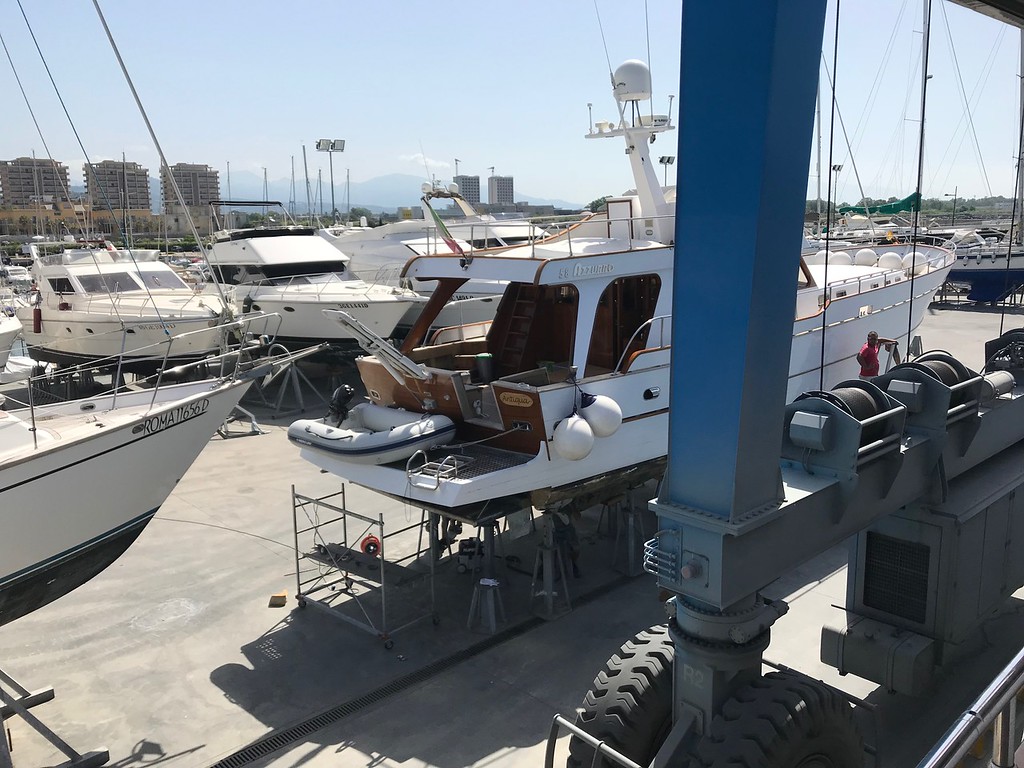


Still in doubt about the real cause of the problem,
First of all there is too much corrosion on the back of these cylinders,
is it advised to place anodes on them ?
there are plenty anodes on the system frame, but not on the cylinders

The last few season when lowering the platform, we noticed that the mechanical hook was sometimes released with a short delay
And I have to admid that we ignored the instruction from h+b, to alway’s first push “up” before lowering the platform, for pressuring the hydraulic system,
Perhaps there was also a leak in the hydraulic system, causing air to come inside.
We still don’t know for sure.

We have replaced the hydraulic oil in the system, the oil had a bad smell, perhaps there was seawater mixed with the oil ?
I’m not sure that we drained the last drop of oil in the system.

So here are my remaining questions, welcoming advice:

1) Shall we place anodes on these cylinders ?
2) Should we replace again the oil in the hydrailic system, and how to drain that out completely ?
3) These submerged hydraulic hoses look fairly intact, should I replace them as a precaution ?

Just to confirm,
A broken hilo platform during summer time would be a disaster and holiday stopper !!!
 
Last edited:
Cant answer your questions, but many things are built to a level of strength that they can't destroy themselves - or a seal pops etc before it does so it is a simple repair.

Shame they don't to that!
 
not sure about that Bart, but I'd expect H+B should have an electronic backup system setup with a simple oil pressure sensor and make sure that once pressure goes up to over X bar:
  • valves open
  • pressure is released
  • alarm rings
  • system is reset!


No?
Not sure about anodes, but I'd definitely antifoul the lot, the less free metal you have around, the less of a problem with anodic/cathodic whatever protection you'll have!

V.
 
I think you have said it yourself- it needs a dab of raise to ensure clean disengagement of the safety hook ( marked with a red arrow ) from the bar marked below .
If you attempt accidentally to force it down with a bit of hook engagement then the ram will pressure overload , first a bit a slight hesitation.But it may get distorted and need ever increasing force to slip off .
Inevitably it won,t slip off and in the absence of a working pressure relief system the ram casings split .

Had the safety hook mechanism distorted leading to difficult disengagement ?View attachment 75954
 
As said above, you absolutely must press up before down , for 3 seconds, if you have not used the system that day.

When you examine the system the reason is easy to see. The “locking hooks up” is on same circuit as “platform down” without any delay or sequencing.

It could be designed out with separate solenoid valve for “hooks up” and a timer circuit but I never bothered and it isn’t really necessary.

Separately, the weakest link in all hydraulics should be the pressure relief valve, so if you burst anything then you MUST fix or replace this valve.

As you know (and thanks for the help Bart) I’m having both cylinders replaced in 2 weeks on my boat because I have a slight oil weep. I’m not sure about corrosion but I will report back. I suspect a bit of pitting on one of the rams. It’s not obvious how to attach an anode to the hydraulic cyjlunders directly and the circuit from the existing anodes should be good anyway.

Nice to see Ant :)
 
Last edited:
If anyone is looking for anything hydraulic, Might be worth giving these a call,

I seem to have read somewhere that they would also repair re-furbish Volvo Rams,

The owner is also a boating so I am sure would like to help were they can

https://www.unwinhydraulic.co.uk

I have no commercial links to company , He just happens to be a fellow Hunton owner whom does a large amount of development work which he tests on his own boat,
 
Porto, which boat is in your picture please?. It has the lighter h+b units than mine and barts, which are much bigger. Your pic shows that the anodes should protect the cylinders. Btw, that boat has a prev generation Lumishore light.

John,

looks like Porto just edited one of Bart's pics, so I guess it's BA.

V.
 
Porto, which boat is in your picture please?. It has the lighter h+b units than mine and barts, which are much bigger. Your pic shows that the anodes should protect the cylinders. Btw, that boat has a prev generation Lumishore light.

The pic is from post #1 on this thread .
 
Separately, the weakest link in all hydraulics should be the pressure relief valve, so if you burst anything then you MUST fix or replace this valve.
....

Nice to see Ant :)

I'm quite sure that the pressure release valve is ok,
because when we force the system to go higher or lower than max excursion, I assume the pressure release valve works; same "over pressure" noise from the hydraulic pump as before

There are two important observations :
1) both cylinders were cracked at the same moment, more or less at the same place, and in that zone is lots of pitting corrosion
2) when the hook released, the platform lowered instantly 20..30cm when the crack / burst occured, with a short powerfull bang !

it appears to me that there might have been a oil leak, and air trapped in the system,
the safety hook was disengaged under hi pressure, and that trapped air enabled the cylinders to move a few cm, until pressure was stabilised, causing that smash, and causing that burst in both cylinders.
I can't think of another reason why the cylinders moved that much, when the hook was disengaged

I've discussed with h+b, and they confirmed that they have had cases of corroded and or leaking cylinders, but they could not remember similar cases like mine. But on the other hand, it is rare that they are involved with a repair themselves, mostly done by a yard.

the CNA in the pic is a sistership to Ant. :)
 
Last edited:
as a answer to other comments,
I don't think that the rams were burst by over pressure,
but from that pressure smash on the corroded cylinder body's
 
the CNA in the pic is a sistership to Ant.
Yup. Well, almost, since there's no such thing as two sisterships, in CNA production.
This one particularly is a bit longer than mine (labelled as "58", in fact).
I've only seen her once a couple of years ago, docked in the very same marina, so I suppose she's in her home port.
I guess from the bow porthole that the additional length was required for adding a crew cabin.
Mine didn't have any, and she only had portholes in the superstructure. If so, that's definitely a nice addition.
She looks well maintained in general, but I really don't like the combination of varnished and raw caps.
I can understand bare teak everywhere, to get rid of the hassle of refreshing the varnish yearly (eventually, I painted in white the whole gunwale, to be done with that!), or varnish for the lovers of traditional look. But mixing the two is a weird choice, imho.
 
as a answer to other comments,
I don't think that the rams were burst by over pressure,
but from that pressure smash on the corroded cylinder body's
That's hard to tell, B.
I guess that corrosion was a contributing factor, but my train of thought considering the failure dynamic (and the fact that from your pic the cylinder appear to be double effect) is as follows:
1) the cylinders began pressurizing to pull down the platform;
2) the locks didn't release immediately, because without the preventative upward command (btw, I agree with PF and jfm that it is crucial, before lowering the thing) they were more strongly engaged by the platform weight, which since the last lift was not sustained anymore by the cylinders, whose pressure over time went slowly down;
3) by the time the locks released, the cylinders were already highly pressurized downward, which in combination with the platform weight caused the sudden platform fall;
4) now, THAT fall probably created a sudden overpressure on the cylinders, which cracked before the pressure relief valve could save the day.
But that's just speculation, of course.

All that aside, I'm not sure that additional anodes could have made any difference.
One thing I certainly would do is antifoul the cylinders, and maybe also the other parts permanently submerged.
It ain't easy to make a/f stick to polished s/steel, but with a good primer you can get decent results.
That said, if space allows, collar anodes on the cylinders (akin to the ones I have on my trim tabs) surely wouldn't hurt...
 
4) now, THAT fall probably created a sudden overpressure on the cylinders, which cracked before the pressure relief valve could save the day.
But that's just speculation, of course..
If thats the case then the relief valve wasnt doing its job because its job is to blow off when the maximum hyd pressure in the system is reached however instantaneous that is. I have never seen a hyd cylinder crack due to overpressure anyway. Far more likely the cylinder seals fail and pressure is relieved that way. If Bart's cylinders have cracked it is more likely to be due to some kind of mechanical bending force on the cylinder. I'm not familiar with Bart's platform but is there some way the locking devices can apply a bending moment to the cylinders?
 
Either way the cylinders shouldn't burst as in any hydraulic cylinder the seals are the first thing to go.

These are two way cylinders and use removes the air and they are self bleeding and even if there was an air lock it wouldn't blow a cylinder as air is compressible and would give a damping effect.

We are left with limited options: system overpressure would blow the seals and not crack the body of the rams, and certainly not both rams at the same time, this also eliminates any overload device as even if it failed it would still blow the seals first which leaves us with a couple of options.
Were the cracks longitudinal along the body of the ram or where they at a seam? for longitudinal cracks it is either a manufacturing defect or poor materials as the body should withstand many times the working pressure and most certainly exceed the maximum pressure the pump can deliver, for a seam it can be almost universally a welding defect as most are machine welded and only batch tested which means many would be produced with defective welding before they were detected.

Is it an aluminium or steel bodied ram?

One other suggestion would be to see if these were retrofitted or replaced by a previous owner if you are not the first owner as the incorrect rams could be fitted or have been replaced on the cheap.

I would also suggest getting the manufacturers original specifications as this would give the original specifications, these would include the bore and stroke sizes and the original working pressures and if you find lower working pressure rams have been fitted then this could also be your problem. Working pressures dictate the wall thickness of the ram and if you find your wall thickness is too low then it could be a lower pressure ram fitted to your application with an excess or overpressure from your pump and as most applications have a range of standard sizes with variable working pressures, you may find exchange units will give the same problems in the future.

Fitting new flexible hoses? yes, always a good idea and get double braided Aeroquip or BF Goodrich if possible.
 
Spent a lifetime working with SS in a very hostile environment.
Flexing it constantly causes it to undergo embrittlement over time .It then fractures with previous Ok forces .
Seen this before many times .
Interestingly proper 316 starts out elastic and we used that property then with multiple flexing episodes it loses its elasticity, then if the multi flexing carries on embrittlement occurs and if the flexing is not ceased = fracture of that part of the appliance .

So not quite disengagement of the safety hook by sagging or forgetting to monetary raise it before lowering it has caused a pressure build up just so , not enough to blow the seals ( rubber has seen the force a moment then relaxed before rupturing ) .
But as infered by Assassin above the cylinder manufacturing quality carries a big question mark ,or was it the correct spec in the first place ? Too small / tiny and flexing*?
Barts allready confirmed to me he thinks the brackets have not distorted .

The casing .
It’s not quite thick enough and just flexed *out , then rebounded , this cycle over and over again maybe also exaggerated by a simple heavy up lift indeed any big forces wether accidentally locked or normal use has fatigued/ embrittled the casing over time .
So enventually it ruptures out in normal use .

Corrosion
We will need to return to the quality issue .Proper Austentic 316 should be inert .Any impurity’s then that’s a different matter .
Welding SS - in my experience, we occasionally have to weld appliances components before fitting .
heat changes the crystalline structure of the SS and can bring what impurity’s to the surface Theses impurity’s are now in contact with the environment in this case seawater . Heat btw kills elasticity.
Also you start to get into dissimilar metals problems of the two metals and adjuncts to the weld , entering the world of galvanic corrosion, basically the joint can become a weak spot from a corrosion POV .

Having said that the cylinders end caps have not bust off ,looking at the pics it’s the body that’s ruptured right in the place of max flex .So I,am not convinced corrosion playing a significant role , as other parts the ends are weaker .
Surface corrosion, pitting -hmm i,am not convinced that’s the culprit either .
There gonna be a bit of microscopic surface crevice corrosion if you care to be predantic but imho that’s a red herring .
No that’s not the culprit, it’s embrittlement.

Uri Geller - spoon bending , flex it a number of times same force ( or decreasing ) and it’s fractures .

So what’s the way Fwds .

-Check the safety hook disengagement before lowering.
-Lighten its load .
- Bigger ram spec .

Or just accept as is and be prepared to replace as and when .

* just to be clear when I say flexed or flexing I don,t mean ballon inflation of the cylinder from the oil pressure .I mean actually bending type flexing of the ram body .
That’s why the seals and valve have had nothing to do with this failure .
 
Last edited:
I agree and know very well that the system should be pressurised (first "up" command) before "down" command,
We have the hilo system from 2012, and mostly 'forgot' that manouvre, and didn't have any issue with that in the past, but I 'm aware that this action caused the break,
actually there was a sign, because the previous season, every now and then, there was a short hesitation before the hook released.

3) by the time the locks released, the cylinders were already highly pressurized downward, which in combination with the platform weight caused the sudden platform fall;
4) now, THAT fall probably created a sudden overpressure on the cylinders, which cracked before the pressure relief valve could save the day.

thinking further on your chain of thoughts,
oil is not compressible, (any liquid isn't)
at 1bar, it has exactly ! the same volume at say 100 bar
in the system is no single elastic element
so there must have been a reason why the cylinder moved so abrubt,

I can only think of one reason; trapped air on the lo pressure side of the cylinder,
and the release of the mechanic hook, allowed the platform to fall / compressing the air on the lo pressure side, until the weight of the platform was stopped by the liquid in the cylinder (air totally compressed by the weight of the platform )

just for confirmation to other posters,
the system was installed by ourselves in 2012 (with good instructions from H+B) with orriginal new components, and SS stainless steel lifting arms and cylinders.
Actually the lifting arms were delivered in one piece each, no assembling required, just mounting and connecting hydraulic hoses in and out to each lifting arm.

There is NO bending anywhere in the system, that could be related to this burst.
 
All that aside, I'm not sure that additional anodes could have made any difference.
One thing I certainly would do is antifoul the cylinders, and maybe also the other parts permanently submerged.
It ain't easy to make a/f stick to polished s/steel, but with a good primer you can get decent results.
That said, if space allows, collar anodes on the cylinders (akin to the ones I have on my trim tabs) surely wouldn't hurt...

a few details to take note,
both cylinders are burst in the same region, and that is, the side of the cylinder that gets the pressure burst when the platform falls down.

When this happened, that was during down movement,
at that moment the "return valve" was open, and the oil pressure was regulated by a passive "load controll valve" enabling slow down movement (contra acting the weight of the platform)
as far I can understand, no overpressurevalve involved at that moment, on that side of the hydraulic cirquit.

I agree that a rubber sealing is more likely to fail instead of the cylinder body,
but again, I could see corrosion on that part of the cylinder, and h+b confirmed corrosion issues on cylinders on other systems,
It would be interesting to know where Jfm's Hilo cylinders leak oil

another small detail,
our boat with hilo system has been on the dry, during 6 months,
in that period the platform was moved just on 2 - 3 occasions.
and it was in half up or full down position during quite some time.
that burst took place 3 weeks after she was put back in the water.
 
Top