Help: HFL Generator 8v output?

Tim Good

Well-Known Member
Joined
26 Feb 2010
Messages
2,888
Location
Bristol
Visit site
Hello. We’re in Senegal and relying on our genset for our watermaker.

Model: HFL H2W6FIC / phase 1 / 3000RPM

It stopped outputting AC so I checked the voltage output at the genset and it’s only 8.5v. All other connections appear ok. Chat gpt suggests this could be an AVR issue but I believe my model doesn’t have an AVR.

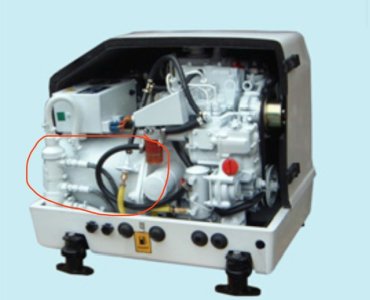
All the AC wiring comes from a large cylinder on the side of the genset; circled in red in the photo.

This is as much as I know. Can anyone suggest where I go next? It seems very difficult to access that cylinder without having the entire unit lift out.
IMG_0511.jpeg


IMG_0512.jpeg

26060897-FEEC-41C5-9011-C46084038BD0.jpeg

IMG_0509.jpeg
 
Last edited:
Hello. We’re in Senegal and relying on our genset for our watermaker.

It stopped outputting AC so I checked the voltage output at the genset and it’s only 8.5v. All other connections appear ok. Chat gpt suggests this could be an AVR issue.

All the AC wiring comes from a large cylinder on the side of the genset; circled in red in the photo. I believe this is where the AC alternator and AVR must be.

This is as much as I know. Can anyone suggest where I go next? It seems very difficult to access that cylinder without having the entire unit lift out.
View attachment 203632
Again, much lack of detail, what make, model, how old etc? Impossible to tell what the problem is. However if the alternator has brushes and slip rings I would suspect the brushes as the first place to look. Sorry but looks, from that picture, like a strip down job. The rectangular box above your red circle looks like a control box maybe a look there?
 
Again, much lack of detail, what make, model, how old etc? Impossible to tell what the problem is. However if the alternator has brushes and slip rings I would suspect the brushes as the first place to look. Sorry but looks, from that picture, like a strip down job. The rectangular box above your red circle looks like a control box maybe a look there?
I’ve attached a few more pictures and info.

I believe it doesn’t have an AVR or at least one which isn’t external. This model did have some variants without an AVR and relied on RPM alone.
 
I’ve attached a few more pictures and info.

I believe it doesn’t have an AVR or at least one which isn’t external. This model did have some variants without an AVR and relied on RPM alone.
May have a "Regulator" as per normal engine alternator. Still has brushes!;) Can't see any other photos or info.:(
 
May have a "Regulator" as per normal engine alternator. Still has brushes!;) Can't see any other photos or info.:(
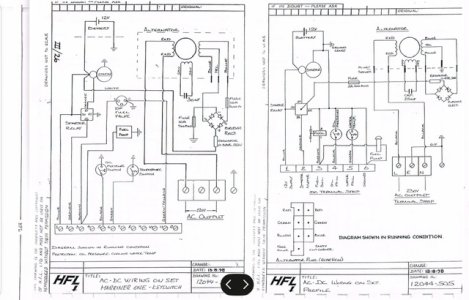
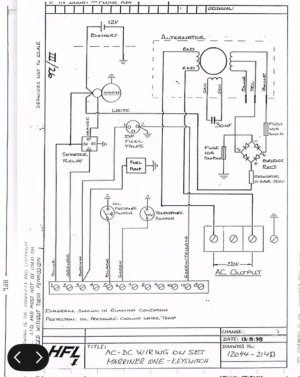
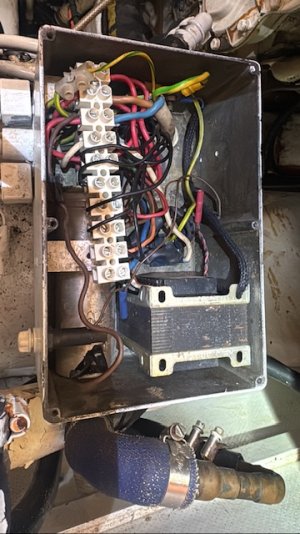
Perhaps refresh you page or check in phone. I added some circuit diagrams and a photo of the control box.

I just want to add some more info.

I did run the generator with no load for a few hours recently by accident. I turned off the water maker and forgot to turn the genset off as the engine was running also and I could hear it.

I believe this can cause it to loose residual magnetism and it needs to be restored.

Could that be an issue?
 
Go back to first principles - you’re getting approximately half output from the generator so it is working to a point, but half is broken.

Going by the circuit diagram there; your two options in that case is either the alternator brushes or the 10a fuse upstream of the bridge rectifier.

check these and fix what’s faulty and 90% certain you’ll be back up and running.
 
The large cylinder, as you call it is the alternator. Driven off the end of the crank in your diesel engine. Usually this type of alternator doesn't have brushes. I don't know enough about your alternator but certainly my 35 year old generator has no brushes. Mine has no AVC. It uses a capacitor to trim the voltage. In your control box, I can see a capacitor so I suspect yours is the same. The capacitor only trims, so it is unlikely that this is the problem. The voltage is a function of the number of windings on the alternator.
With your voltage being so low it's possible that you have a varistor failure within the alternator or a winding failure. Only my guess. I have had a varistor failure on mine that dropped the output voltage from 240v to 160v. I suspect with your voltage drop being so massive that it may be more than a varistor failure.
I would first check all the connections on that nasty looking piece of chocolate block. A couple of connections looks brown. Corrosion? Or heat?
If you can't find any obvious electric connection faults then I suspect you will need to remove the generator and take it to a motor rewind company who can inspect the varistor and windings.
There is such a company in Antigua but that's a long way from where you are
 
Perhaps refresh you page or check in phone. I added some circuit diagrams and a photo of the control box.

I just want to add some more info.

I did run the generator with no load for a few hours recently by accident. I turned off the water maker and forgot to turn the genset off as the engine was running also and I could hear it.

I believe this can cause it to loose residual magnetism and it needs to be restored.

Could that be an issue?
Possibly, You also have a couple of fuses in the DC side. I would have thought it unlikely to have damaged the DC side rectifier diodes as there would have been load on the DC from the battery. Have you checked in the connection box to se if you can get DC voltage? We still don't know which model you have as there are slight differences in the diagrams. You could try and just "Flash" a battery across the ac output and then run the set and see. :unsure: Shouldn't hurt with the set running, Just a quick flash on the ac o/p.
Or with the set running give the alternator casing a sharp clout with a hammer! You could be in luck ;)
 
Last edited:
The large cylinder, as you call it is the alternator. Driven off the end of the crank in your diesel engine. Usually this type of alternator doesn't have brushes. I don't know enough about your alternator but certainly my 35 year old generator has no brushes. Mine has no AVC. It uses a capacitor to trim the voltage. In your control box, I can see a capacitor so I suspect yours is the same. The capacitor only trims, so it is unlikely that this is the problem. The voltage is a function of the number of windings on the alternator.
With your voltage being so low it's possible that you have a varistor failure within the alternator or a winding failure. Only my guess. I have had a varistor failure on mine that dropped the output voltage from 240v to 160v. I suspect with your voltage drop being so massive that it may be more than a varistor failure.
I would first check all the connections on that nasty looking piece of chocolate block. A couple of connections looks brown. Corrosion? Or heat?
If you can't find any obvious electric connection faults then I suspect you will need to remove the generator and take it to a motor rewind company who can inspect the varistor and windings.
There is such a company in Antigua but that's a long way from where you are
Thanks. The connections, albeit in a horrible choc bloc, are all clean, corrosion free and working.
 
Possibly, You also have a couple of fuses in the DC side. I would have thought it unlikely to have damaged the DC side rectifier diodes as there would have been load on the DC from the battery. Have you checked in the connection box to se if you can get DC voltage? We still don't know which model you have as there are slight differences in the diagrams. You could try and just "Flash" a battery across the ac output and then run the set and see. :unsure: Shouldn't hurt with the set running, Just a quick flash on the ac o/p.
Or with the set running give the alternator casing a sharp clout with a hammer! You could be in luck ;)
When you say flash a battery. So apply 12v across the two red ac wires coming out of the alternator housing.

There are in fact 4 red wires exiting the housing. Two come out and are just connected together, forming a loop that goes back into the housing. The other two go to the AC live snd neutral.

On the picture of the control box you can see the two red wires at the far end (top of photo) and these are the two wires that come out, connected together and go back into again.
 
When you say flash a battery. So apply 12v across the two red ac wires coming out of the alternator housing.

There are in fact 4 red wires exiting the housing. Two come out and are just connected together, forming a loop that goes back into the housing. The other two go to the AC live snd neutral.

On the picture of the control box you can see the two red wires at the far end (top of photo) and these are the two wires that come out, connected together and go back into again.
Be careful of doing this. Make sure you get the correct wires. If the varistors have failed, you run the risk of damaging components in the alternator. Check the resistance of the varistors if you can. The resistance should be very high. There should be two of them. If one has failed, the resistance will be lower than the other.
 
Be careful of doing this. Make sure you get the correct wires. If the varistors have failed, you run the risk of damaging components in the alternator. Check the resistance of the varistors if you can. The resistance should be very high. There should be two of them. If one has failed, the resistance will be lower than the other.
Can you elaborate on what a varistor is and how to check them if I haven’t got the main alternator case off?
 
Be careful of doing this. Make sure you get the correct wires. If the varistors have failed, you run the risk of damaging components in the alternator. Check the resistance of the varistors if you can. The resistance should be very high. There should be two of them. If one has failed, the resistance will be lower than the other.
Non of the diagrams shown indicate Varistors (or zink oxide modules) However, yes, I agree they can be damaged with spikes, although that is what they protect against. Trouble is, everytime they get a spike a little bit dies until, eventually, you get total failure.
 
Go back to first principles - you’re getting approximately half output from the generator so it is working to a point, but half is broken.

Going by the circuit diagram there; your two options in that case is either the alternator brushes or the 10a fuse upstream of the bridge rectifier.

check these and fix what’s faulty and 90% certain you’ll be back up and running.
Not sure he is talking DC. I think he means his ac O/P?
 
When you say flash a battery. So apply 12v across the two red ac wires coming out of the alternator housing.

There are in fact 4 red wires exiting the housing. Two come out and are just connected together, forming a loop that goes back into the housing. The other two go to the AC live snd neutral.

On the picture of the control box you can see the two red wires at the far end (top of photo) and these are the two wires that come out, connected together and go back into again.
Have you not got an ac socket? You want the live and neutral.
 
Last edited:
Non of the diagrams shown indicate Varistors (or zink oxide modules) However, yes, I agree they can be damaged with spikes, although that is what they protect against. Trouble is, everytime they get a spike a little bit dies until, eventually, you get total failure.
I agree, but lots of suggestions online that HFL generators use varistors. My generator wiring schematic also doesn't show the varistors.
 
I agree, but lots of suggestions online that HFL generators use varistors. My generator wiring schematic also doesn't show the varistors.
Quite! With all due respect to the OP I think we may be talking above his knowledge of such things.
We still don't know if he is getting any output either ac or DC, We don't know the model of his set, there are differences in the 3 diagrams shown.
Impossible to make any definative statement. We can only offer suggestions. Perhaps email or message hfl@hfl-hattingen.de
 
Last edited:
The circuit diagram is dated 1998, so it's old and probably well used.
The 4 red wire are so it can be configured as 110v AC connected in parallel or 220v AC connected in series, which is what the OP has.
There are 2 additional outputs one is solely a DC to charge a starter battery. It has a bridge rectifier and the components you need to get a reasonable DC supply
The other has a 30 micro Farad capacity "shorted" across a winding. The capacitor will short out high frequency AC. Perhaps more to do with suppression of radion interference.
There's no indication of any dynamic speed or frequency control. Perhaps this is achieved mechanical rpm control of IC engine.
That just leaves the alternator.
I start by checking the resitance of the 2 windings, engine off (obviously!). The resitance should be low and the same for both windings. If it's high, there's a discontinuity in one or both the windings.
The next step is to open up the alternator.
Perhaps something I wouldn't do, but it could be something as simple as a broken solder joint, or catastrophic, like melted windings or burnt insulation.
If the windings are ok, then whatever generates the rotating magnetic field has failed, and I don't know enough about the alternator to speculated about that.
But my honest opinion is the scrap the generator and by a small Honda or equivalent, it's 20+ years old well used and probably knackered.
 
The circuit diagram is dated 1998, so it's old and probably well used.
The 4 red wire are so it can be configured as 110v AC connected in parallel or 220v AC connected in series, which is what the OP has.
There are 2 additional outputs one is solely a DC to charge a starter battery. It has a bridge rectifier and the components you need to get a reasonable DC supply
The other has a 30 micro Farad capacity "shorted" across a winding. The capacitor will short out high frequency AC. Perhaps more to do with suppression of radion interference.
There's no indication of any dynamic speed or frequency control. Perhaps this is achieved mechanical rpm control of IC engine.
That just leaves the alternator.
I start by checking the resitance of the 2 windings, engine off (obviously!). The resitance should be low and the same for both windings. If it's high, there's a discontinuity in one or both the windings.
The next step is to open up the alternator.
Perhaps something I wouldn't do, but it could be something as simple as a broken solder joint, or catastrophic, like melted windings or burnt insulation.
If the windings are ok, then whatever generates the rotating magnetic field has failed, and I don't know enough about the alternator to speculated about that.
But my honest opinion is the scrap the generator and by a small Honda or equivalent, it's 20+ years old well used and probably knackered.
Mine is 35 years old. Similar tech and still going strong. The alternators in these things are super simple with no electronics. It is very much worth a bit of work to establish the cause of the problem. If the OP can remove the stator and rotor and get it to a rewind shop, they will certainly be able to fix it.
 
Top