Had enough ... Electrical Supplier changed owners - now its a joke !!

Refueler

Well-Known Member
Joined
13 Sep 2008
Messages
24,125
Location
Far away from hooray henrys
Visit site
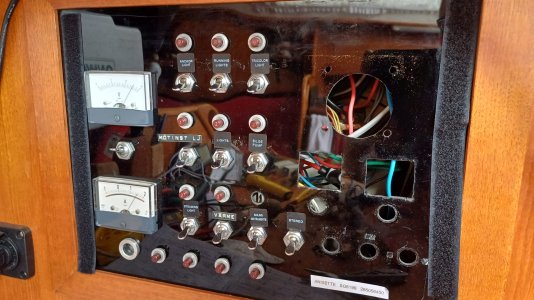
My Switch panel is a disaster .. based on plain toggle switches back up by ETA breakers.

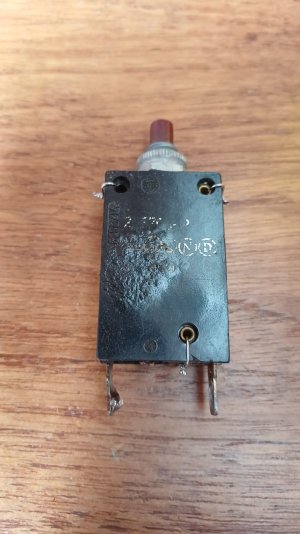
Fine ... it works - but when the bilge pump destroyed itself - the ETA breaker also decided to die a death. I ordered a replacement - they took the money ... then couple of days later told me order was cancelled and I would have to re-order via the new owners. Refund ? Transfer my money to new ? Ha Ha ... they said - refund only and that would take at least 14 days .. posiibly 1 month. But I was free to re-order from new owners ...

Given the price of the item - I was not amused.

Its prompted me to look at the panel again and design my own.

The original is 360mm x 290mm ... but the meters are strange sizes no longer can I find replacement for the ammeter. Various trip counters etc are not used - so removed from onld panel now - leaving holes etc.

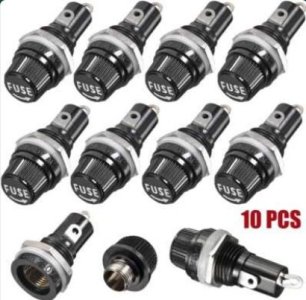
My plan now - I've ordered a plain black plastic panel. I will go back to old fuse fittings - the ones where fuse is held by a screw cap .... that way its a few pence instead of 50 euros for ETA ..
I can print a boat outline on it and fix LED's to show nav lights on etc.

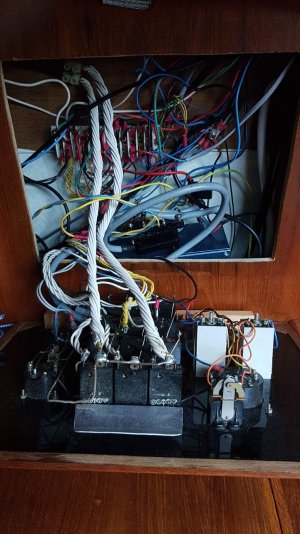
It will also make4 me sort out spaghetti junction behind the panel ...

Attached is initial idea ... Switch Panel.jpg
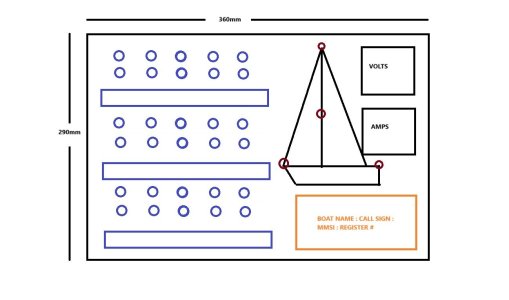
I may change the AMPS to a second VOLT display .. so I have one for domestic bank - another for engine bank. The blue circles are Fuse + Switch and then name tag under. I've put 15 ... but I think 10 will most likely be enough.

I know some are going to say - don't use old fashioned fuse ... but if you had what is on there now - youy may also think to change !!
 
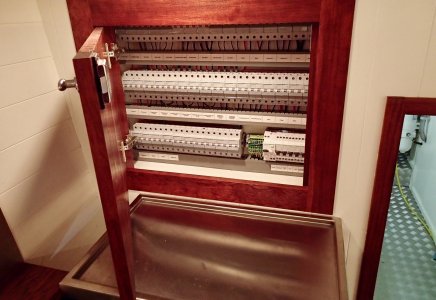
Consider a circuit panel consisting of DIN rail circuit breakers.

These circuit breakers are readily available from a multitude of manufacturers, all conforming to the same dimensions. Hence, replacement is easy. Proprietary circuit breakers of unique dimensions seem to be one of your main gripes with your current system, a problem I sympathise with.

DC circuit breakers have a limited life if used as a switch. The easy and cheap replacement of DIN rail circuit breakers removes this problem. The new CB simply clips into place.

Below is an example from my boat:
You_Doodle_2025-08-08T21_25_13Z.jpeg
 
Last edited:
Hello Nigel. Should be a nice winter project for you. I would suggest digital volt meters like Pardon Our Interruption... or Pardon Our Interruption...
The latter tiny ones are so cheap and for me very reliable. The first one seems to have more digits however.
The 3 wires are so that you can use an external power supply ie 9v battery so you can measure down to zero. In practice you connect the sensing wire + and supply wire + to your ship battery and it will measure down below 9v which hopefully is all you need.
ol'will
 
All ideas in the pot ... shake it about ... see what comes out !!

Why do I like the old glass fuse with screw cap ? I can drill the holes for switches and fuses with same drill ... they are slim and can be close to switch ... unlike the ETA's which are large.

WhatsApp Image 2025-07-15 at 13.29.21 (3).jpeg

Replace with these ....

fuse holders.jpg

I thought about press and latch button switches - but I think better to go with standard toggle switches.

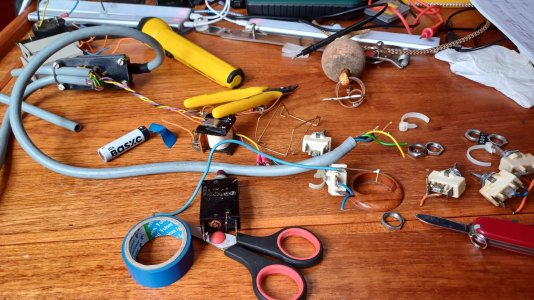
Here's what I removed from the old panel .... old stuff not in use .. (two meters as well not on the desk)

WhatsApp Image 2025-07-15 at 14.20.31 (1).jpeg

Panel now (I've tidied it up a bit of course !! )

WhatsApp Image 2025-07-15 at 14.20.23 (1).jpeg

Its a confusing panel until you start wire tracing ...

The top row of red buttons are ETA breakers covering all the switches AND lesser rated ETA's immedaitely below ... so there are three main ETA breakers ... initially you would think that those three cover the three switches next to them ... no.
Each switch is actually covered by a lower rated ETA red button immedaitely BELOW it ....
The confusion started because of the bottom left red button is not in line with a switch ... but in fact covers the switch at 45 deg up right of it ..

Here's a larger pitcure showing how all ETA's are hard wired in and creating a nightmare to diagnose / service. This is before I removed the obselete items. Its one of those panels - that as long as you are the originator - its fine ... but without any schematic / info - its a mess to try and sort.

WhatsApp Image 2025-07-15 at 09.16.04.jpeg

I hope to create a panel - that can be understood by anyone after me ...

As to the LED's - I really do want to know my nav lights are working ... without need to go on deck. I have always liked the panels with a boat outline ... but I am not about to pay the price they ask for one over counter !!
 
"I like to know nav lights are working " There is a neat arrangement if you use a magnetic reed switch to detect correct current flow. 20 X Magnetic Glass Reed Switch 2 x14 mm Normally Open N/O 2-Pin Low Voltage US | eBay. These little things. You need to wrap a coil around the glass tube which carries the current to the light. The current flow and magnetic field will activate the reed switch. The reed switch then can operate a warning light either to indicate on and working or on but current (light or wiring) failure.
The coil would be made of enamelled copper wire. You have to experiment but typically 20 turns of 20g wire might operate at 1 amp. The coil does add some potential for faults but will not drop significant voltage to light. Something for winter fiddling ol'will
 
There is a neat arrangement if you use a magnetic reed switch to detect correct current flow.

Ingenious, but what about the Mk 1 Eyeball? The lights are on because it is dark (or dusk) and the lights will cast a gloom... edit: or should that be loom (as in a light seen but not its source?)
 
Last edited:
Ingenious, but what about the Mk 1 Eyeball? The lights are on because it is dark (or dusk) and the lights will cast a gloom... edit: or should that be loom (as in a light seen but not its source?)

Obviously bow dual light has a tell-tale hole that allows a pinprick to be seen .. plus the light lets pulpit be seen ..

Steaming light is not so easy unless you still have genny up - then it shines on that ...

Stern light - easy to check ...

But I would still like the LED's to light up .... just feels more reassuring ...
 
Obviously bow dual light has a tell-tale hole that allows a pinprick to be seen .. plus the light lets pulpit be seen ..

Steaming light is not so easy unless you still have genny up - then it shines on that ...

Stern light - easy to check ...

But I would still like the LED's to light up .... just feels more reassuring ...
But all the LED does is tell you the switch is on, the bulb could have blown and you won't know.
 
But all the LED does is tell you the switch is on, the bulb could have blown and you won't know.

My pal - who's an absolute wizzo with this sort of stuff - we are working on the LED actually saying light is working ...

I agree that the usual switch panel only shows switch is on ...

IF we get it sorted - I will gladly upload for others.
 
But all the LED does is tell you the switch is on, the bulb could have blown and you won't know.

There is a way for the LED to shaw the light is working by using a read relay and a twist or wire fron the Nav light to lose the read relay by the magnetic field in the wisted wird operating the read relay and switching on the indicator LED
 
In basic form ... a switch / item and LED would need 3 wires ... as Roger indicates ..

The light working has a flow of electricity and using this to close a relay and light up the LED.

Its all in discussion with my pal ...
 
OK ... just to pass on ...

Discussions so far concentrate on whether I have filament nav lights or LED. We have decided that for all switches except the nav lights can be normal switch on - indicator LED on.
But I want indicator LED to show nav light is working.

With a filamernt bulb - its not hard to setup - if lamp blows - circuit is broken ... as it has only the filament ..

But LED lamps have many small LED's making up the bulb .. and usually its only partial failure of the LED's - so in effect power still flows (low power) but still circuit is complete - so indicator LED stays lit.

We are looking at how cars do it - because many of todays cars do detect LED failure ...

Its becoming a really interesting subject ...
 
Interesting use of the MCB ..... similar to a domestic panel.

But I would like to keep the panel free of such large items other than the voltmeters.
DIN rail MCBs are larger than most alternatives, so I can understand that some boats may not have the required room.

This is one of the few drawbacks, although it is not really fair to compare the size of circuit breakers that have the combined magnetic/thermal function with the simpler thermal-only circuit breakers such as the Eta examples shown in this thread.

Nevertheless, the DIN rail breakers are made by all manufacturers specified to be a similar uniform size. This means replacement is easy. A number of manufacturers make a near identical product. However, it also means they are a reasonably bulky alternative. Some dedicated marine breakers such as many (not all) of the Blue Sea offerings are smaller and still offer the dual protection of the magnetic and thermal function.
 
Last edited:
OK ... just to pass on ...

Discussions so far concentrate on whether I have filament nav lights or LED. We have decided that for all switches except the nav lights can be normal switch on - indicator LED on.
But I want indicator LED to show nav light is working.

With a filamernt bulb - its not hard to setup - if lamp blows - circuit is broken ... as it has only the filament ..

But LED lamps have many small LED's making up the bulb .. and usually its only partial failure of the LED's - so in effect power still flows (low power) but still circuit is complete - so indicator LED stays lit.

We are looking at how cars do it - because many of todays cars do detect LED failure ...

Its becoming a really interesting subject ...
An alternative sensing system involves a small resistance through which the current flows.This develops a small voltage drop which can be detected by an Op amp to determine amount of current flowing thus providing either LED on and working or Lights switch on and not working. This can easily be ajusted tp precisely activate with all LEDs shining.The concept for many years in transport planes is a dark cockpit. ie warning lights only on if attention is needed. (fault) ol'will
 
Top