GPS/GLONASS/GALILEO/BAIDOU - How important?

Just checked again: it says 'as close as possible to the centre' for more accurate roll and pitch data output. I was fortunate to get it what I think was central. The dead ahead alignment is added by a whooping arrow!

 
Interesting thanks. Don't suppose you have any handy links to viable Belkin devices? Can't find anything that looks feasible on first look

What do you want to connect it to ?

ie .. I have a Belkin 880 that is smaller than a euro coin and has 0183 for connection to VHF or similar for DMSS .... OOOPS .. I should have said BEITIAN .... not Belkin !!

Banggood has many similar ...

beitian gps - Buy beitian gps with free shipping | Banggood Shopping

They are reliable .. easy to connect ....
 
You've got me curious about user selection of satellite networks - I must poke around in the more obscure menus on my new recently installed chartplotter!

My old Lowrance ... my new Onwa .... various Raymarine and Garmin ... I entered menu and could choose the Sat Network ...

On rechecking Onwa manual ... it appears that my set will use two systems GPS and BEIDOU ... so I may be wrong with later machines ...
 
Alongside accuracy, I've found that modern GPS units (which, as said by someone before, usually support at least one of the other networks) also acquire very quickly - like literally within seconds. My last experience of GPS was 90's Garmin handhelds, which would sometimes take several minutes.
 
On rechecking Onwa manual ... it appears that my set will use two systems GPS and BEIDOU ... so I may be wrong with later machines ...
Interesting that the Onwa chartplotters support Beidou, but not their dedicated GPS antenna...

ie .. I have a Belkin 880 that is smaller than a euro coin and has 0183 for connection to VHF or similar for DMSS .... OOOPS .. I should have said BEITIAN .... not Belkin !!

Ah that makes more sense! Actually I would like to connect a small dedicated GPS antenna outputting 0183 onto my VHF for redundancy, so that if any part of my NMEA network failed it wouldn't inhibit use of DSC etc. The VHF doesn't have its own built-in GPS as it's a bit too old. One of those tiny GPS receivers that ouputs NMEA directly could be perfect for that.
 
How do you provide the 5V power to it from your 12v supply?

Thats easy .... I use what is termed a BEC .... Battery Elimination Circuit ....

It provides 5V from a supply voltage of 10 up to 25+ volts.

We use them to power Rx's on models etc.

DC-DC Converter Step Down Module UBEC 3A 5V / 12V BEC For RC Airplane FPV for RC Drone FPV Racing

The 5v output version accepts from 7.4 up to 25.2V input ... the output is steady even with fluctuation or decline of supply voltage.
 
Ah that makes more sense! Actually I would like to connect a small dedicated GPS antenna outputting 0183 onto my VHF for redundancy, so that if any part of my NMEA network failed it wouldn't inhibit use of DSC etc. The VHF doesn't have its own built-in GPS as it's a bit too old. One of those tiny GPS receivers that ouputs NMEA directly could be perfect for that.

Which is what I planned to do ... but then my VHF failed and I replaced with a GPS equipped version.

The Beitian is strong enough to only need connecting to VHF and not hidden behind metal .. does not need mounting outside etc.

The 12v supply to BEC can be tapped of the VHF power lead ... the GPS only needs the ground and 0183 connected ...
 
Which is what I planned to do ... but then my VHF failed and I replaced with a GPS equipped version.

The Beitian is strong enough to only need connecting to VHF and not hidden behind metal .. does not need mounting outside etc.

The 12v supply to BEC can be tapped of the VHF power lead ... the GPS only needs the ground and 0183 connected ...

This is the thread I started about my VHF and adding the GPS :

Fancy creating a permanent GPS feed on board instead of from plotter ?

Hope it helps.
 
Most new GPS recerivers supports Glonass and Galleo system as extras. Actually, very rarely to see a GPS reciever only support GPS system nowdays.
 
I think the distance is less than 10 meters. You should be able to find a online tool to calculate it.
$GPGGA,100000,5145.9898,N,00054.5004,E,1,20,0.7,2.5,M,,M,,0000*5A
$INGGA,100000,5145.9865,N,00054.5037,E,1,09,1.1,-5.6,M,,,,*20
If someone can tell us the distance between the two lat/long?
 
I did do some calculations but have lost them. I was a little dismayed. The two antenna are not much more than 2 metres apart and my calc suggested a lot more. Might repeat that.
 
I must admit I thought someone would have done the calc for me. I was a bit busy at the time.

How about:

$INGGA,101503,5146.6609,N,00052.9267,E
$GPGGA,101503,5146.6608,N,00052.9264,E

I can't make any calculator work
 
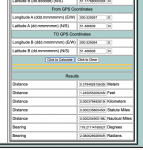
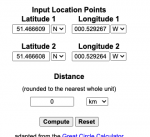
@tillergirl You very possibly are already doing this, but you have to move the decimal point for some calculators to work with the coordinates from the NMEA sentences

e.g. (bad example as this calculator doesn't do decimal places in the distance!)
1659430357930.png
 
I knew someone would do it for me (seriously I am playing around with something else at the moment - very unsuccessfully!).

The Humminbird antenna is internal, situated on the starboard side of the wheelhouse; the Onwa antenna is external just about a foot to port. Both antenna are very close in line fore and aft. So 1.24 ft is pretty good but I would expected it more 2.5ft apart. The Onwa was using 24 sats, the Hummin only 8. There also is a different of opinion of the two transducers: Onwa says there was 3.645m of water while the Humminbird quoth 3.492m of water. Variation of 0.153m. Onwa ducer port side, Humminbird has ducer's both side but the depth reads off the starboard. The boat was on the mooring in line with the stream and the variation is the slope of creek (I claim:sneaky:!).

There is a third antenna which is on the centre line and has pitch, elevation and roll correction but I didn't note the lat/long at the time.

Ta Matt
 
Top