Going downwind.

I was surprised to see 35kn polars. Generally it’s kind of survival of the fittest at that windspeed. And sensible Dragonfly 920s stay at home. Exactly how does one develop a polar in wind where the difference between max speed and ‘a tiny bit too much’ is serious breakage?
Very true.

I think in a way you mainly need them if you're going offshore for routing purposes.
 
I was surprised to see 35kn polars. Generally it’s kind of survival of the fittest at that windspeed. And sensible Dragonfly 920s stay at home. Exactly how does one develop a polar in wind where the difference between max speed and ‘a tiny bit too much’ is serious breakage?
Polar diagrams assume flat water. 35kts could easily come with 5m seas. I guess you would not being trying to hit polar predicted speeds 🫣
Unless you were Alex Thompson who appeared to have zero mechanical sympathy and sailed his Imoca flat out into a low pressure systems and broke the boat
 
Polar diagrams assume flat water. 35kts could easily come with 5m seas. I guess you would not being trying to hit polar predicted speeds 🫣
Unless you were Alex Thompson who appeared to have zero mechanical sympathy and sailed his Imoca flat out into a low pressure systems and broke the boat
Downwind you'd be exceeding them by some margin as you surf the waves. Upwind.... not so much....
 
Our flat water hard limit is just over 21kn, it seems. But we’ve done over 25 briefly in waves, twice that I’ve noticed. If there were other times, I must have been concentrating on staying alive.
 
Possibly, but launching off breaking crests and nose diving into the back of another wave might ruin your day🤔
That's when you need the buoyancy in the bow that modern designs give you....

The difference in hard downwind conditions between the Elan 37, traditional C/R we used to race and the JPK is night and day. And designs have gone a lot further since then.

I well remember sticking the bow of the Elan down the mine and having water back as far as the mast. Did that a few times.... Despite pushing the JPK harder we simply haven't done that, the bow just lifts, you get a really impressive wall of spray either side of the bow for a second or 2 then you're over the wave and off again. But you really don't get the water over the top thing that you get in more traditional style boats.
 
That's when you need the buoyancy in the bow that modern designs give you....

The difference in hard downwind conditions between the Elan 37, traditional C/R we used to race and the JPK is night and day. And designs have gone a lot further since then.

I well remember sticking the bow of the Elan down the mine and having water back as far as the mast. Did that a few times.... Despite pushing the JPK harder we simply haven't done that, the bow just lifts, you get a really impressive wall of spray either side of the bow for a second or 2 then you're over the wave and off again. But you really don't get the water over the top thing that you get in more traditional style boats.
The latest Dragonflys have gone all reverse bows and wave piercing floats. They also carry the floats further forward in relation to the main hull than we have. But the ‘performance’ versions have got more radical rig wise. One of the 28ft DFs has 25% more SA/D than us, and a 2 metre taller mast. It was one of those that contributed to the capsise stats in the RTI about 10 years ago. In exactly the way Geem suggested. You push hard enough, and no amount of bow buoyancy can stop it happening. I guess it’s more self limiting in a mono. In a multi, it feels great, until it doesn’t.
 
The latest Dragonflys have gone all reverse bows and wave piercing floats. They also carry the floats further forward in relation to the main hull than we have. But the ‘performance’ versions have got more radical rig wise. One of the 28ft DFs has 25% more SA/D than us, and a 2 metre taller mast. It was one of those that contributed to the capsise stats in the RTI about 10 years ago. In exactly the way Geem suggested. You push hard enough, and no amount of bow buoyancy can stop it happening. I guess it’s more self limiting in a mono. In a multi, it feels great, until it doesn’t.
My understanding is that it's a little different in a multi, as it's not necessarily diving that you're trying to prevent, but increased resistance leading to dramatic slowing and therefore flipping. And that since you're never going to give a multi the sort of bow volume that could actually allow it to skip across the waves like a scow, a safer bet is to have a bow where the resistance does not increase the further you push it under.
 
My understanding is that it's a little different in a multi, as it's not necessarily diving that you're trying to prevent, but increased resistance leading to dramatic slowing and therefore flipping. And that since you're never going to give a multi the sort of bow volume that could actually allow it to skip across the waves like a scow, a safer bet is to have a bow where the resistance does not increase the further you push it under.
Hence the wave piercing floats. Everything has limits though. Going into the back of a wave at 25 kn and slowing to 15, if there’s 35kn of wind, well, do the maths. It’s a sudden increase in pressure at the sail CE, whilst you’re already bows down. You totally dump the kite on the instant of suspecting a dig in. We’ve pitchpoled a Dart, and come very close on a spinnaker equipped Hurricane 5.9. We don’t push Chiara that hard in marginal conditions.
 
Hence the wave piercing floats. Everything has limits though. Going into the back of a wave at 25 kn and slowing to 15, if there’s 35kn of wind, well, do the maths. It’s a sudden increase in pressure at the sail CE, whilst you’re already bows down. You totally dump the kite on the instant of suspecting a dig in. We’ve pitchpoled a Dart, and come very close on a spinnaker equipped Hurricane 5.9. We don’t push Chiara that hard in marginal conditions.
Well quite!

And you're illustrating nicely why I'm not a multi man. I like being able to have a moment and being able to dust ourselves off and carry on.

Well, that and the cost increase.
 
Well quite!

And you're illustrating nicely why I'm not a multi man. I like being able to have a moment and being able to dust ourselves off and carry on.

Well, that and the cost increase.
It’s not hard, it just means hand holding the sheets, and being ready to release.

John, that vid does show what it’s like in a bit of a sea. Lots of water chucked up, not much over you. A 920 is a bit wetter than the 28, but it’s better than a 30ft mono in the same wave set. A multi is so much easier to go quickly on than a high performance mono that you just don’t have to push that hard unless racing other multis. The only reason I can see for owning a Pogo is to name her ‘Fanny’.
 
It’s not hard, it just means hand holding the sheets, and being ready to release.

John, that vid does show what it’s like in a bit of a sea. Lots of water chucked up, not much over you. A 920 is a bit wetter than the 28, but it’s better than a 30ft mono in the same wave set. A multi is so much easier to go quickly on than a high performance mono that you just don’t have to push that hard unless racing other multis. The only reason I can see for owning a Pogo is to name her ‘Fanny’.

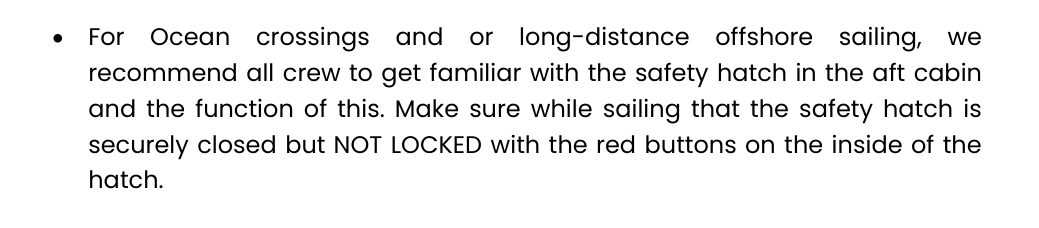
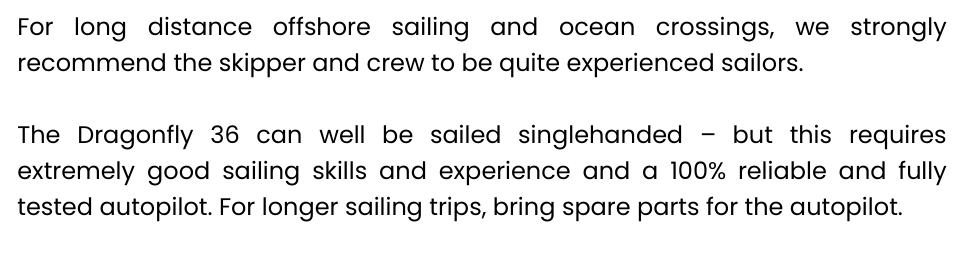
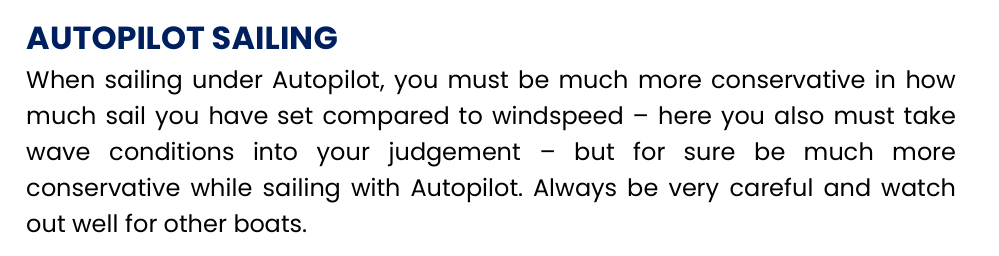
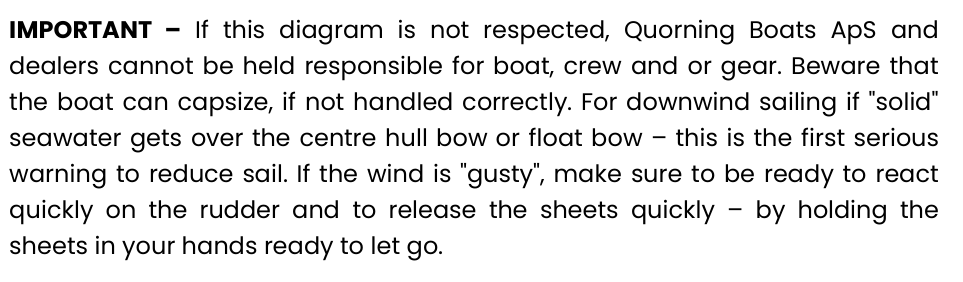
It is only 'a bit of a sea,' by Atlantic / Biscay standards......and 'hand holding the sheets....ready to release' really rules out solo cruising, other than short day hops. Your experience very much echoes the caveats in the DF36 manual though:

DF1.png
DF2.png
DF3.png
DF4.png

* 'this diagram' refers to a table of wind strength v sailplan recommendations.

I'm actually coming round to the idea that, if enhanced light airs performance, windward ability (all wind strengths) and 'good behaviour' in a seaway in a breeze are my priorities, then something more 'old school,' like a J-boat, might be the best compromise (for me). Much though something more innovative appeals at a gut level.
 
Last edited:
Hand holding sheets in extreme conditions when racing does not rule out short handed cruising. Just don’t fly the kite in over 20kn. Like I said, you’ll still be a lot faster than the equivalent Pogo or similar. You mitigate the risk by sticking to the reefing chart. That rarely slows you down much anyway. We are pretty relaxed in 30kn of wind, up or downwind, with 2 reefs in the main and about half a jib, Still going quickly, just not bursts over 20kn.

Just to be totally clear. We don’t hand hold the sheets in 10kn, or even 15kn except if a lot of trimming is needed. And if cruising, we would scarecely bother with downwind sails of any kind in average winds of 12-13kn. But we’ll be well into double figures STW by then. The white sails don’t need hand holding unless you haven’t reefed in time. Cruising, there’s just no need to push.
 
Last edited:
I haven't sailed the Pogo 30, but I have sailed the Pogo 36

For the 36, I would call those upwind target angles extremely optimistic.

Would be interesting to see polars for the Sam Manuard Seascape/Beneteau First 36 & 30. Or, for that matter, his Pogo RC race boat. Have they cracked (improved on) the JPK code, for upwind height and off wind planing ability?
 
Would be interesting to see polars for the Sam Manuard Seascape/Beneteau First 36 & 30. Or, for that matter, his Pogo RC race boat. Have they cracked (improved on) the JPK code, for upwind height and off wind planing ability?

I guess the 30 and 36 aren't intended to be raced in races with a lot of upwind

i found some ORC certificates, and they weren't hugely different than the polars above. I did some racing on the 36, and I think the upwind angles were more in the 40-45 degree range.

In about a month, I will be sailing a Pogo 44 in Brittany, so it will be interesting to see what that boat is capable of upwind. I am sure it will be a ton of fun off the wind!
 
Top