Genoa sheet handling single handed

Dutch01527

Well-Known Member
Joined
7 Jul 2016
Messages
718
Visit site
My new 28 foot boat has a self tacking jib and a conventional genoa.

I had the genoa out yesterday for the first time single handed and my sheet handling during a tack was not very elegant. I basically had to slip forward of the wheel swop sides and let go, swop sides again during the tack, sheet in and winch tight and swop sides again to sail the boat from the windward combing . It worked ok but was not slick and my not unconciderable weight is on the wrong side immediately after the tack when I need it up high to maintain speed. Previous boats had the winches further aft or were tiller steered and it was less of an issue.

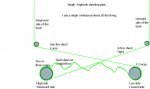
I was thinking about options on the drive home. Is there any way I could run a continuous jib sheet with the two bitter ends attached to the genoa and the loop sheeted to the windward winch and run across the cockpit and around the leeward winch with no turns. A bit more friction but the loads on this size of boat are not huge.

I could then stay sitting on the combing to let go (leaving the sheet behind the winch), move sides behind the wheel during the tack and sheet in, winch tight from my usual steering position on the windward combing.

I think that dingy sailors use a similar system. Would it work on a small yacht? I am sure that there must be a flaw in my thinking or it would be a common option and I can not find anything online.
 
Last edited:
A single sheet with both ends tied to the clew of the genny works. Did it for a season once on a boat where the sheets were far too long and the owner didn't want to cut them. Seemed to help with feeding out the old working sheet during a tack, I think just from the shaking of the sheet as it was hauled in on the other side, but there were crew on both winches.

I think your problem will be running the sheet. What you suggest means that there is only one winch in use. Once you throw the line off you then have to put the wraps on before hauling in on the other side, so there'll be a bit of a delay. Tacking is always easiest if you get the timing right.

One thing I find helps when using two winches is to position yourself ideally for throwing off the old sheet then pull on the new sheet on the other winch (which you've had set up with the sheet ready in the other hand). You can generally pull the sheet in regardless, within reason, of where you are standing and move towards the winch by the time you need to grind. It is very hard to throw off a sheet if you're in the wrong position.
 
Looking at the photos of your boat it seems the winches are positioned assuming the person operating them is forward of the wheel and mainsheet. Logical as there is only room for the helm aft of the wheel. So, not laid out for single handing and not an easy solution. Even if you move the winches back you will have problems. first there is not enough width on the coamings to fit the current winches, then you will lose sitting space and finally a crew member will have difficulty in working the winches because the wheel, mainsheet and you will be in the way.

Just one of those things you will have to learn to live with - consequence of cramming an aft cabin and wheel steering into a 27' boat.
 
My new 28 foot boat has a self tacking jib and a conventional genoa.

I had the genoa out yesterday for the first time single handed and my sheet handling during a tack was not very elegant. I basically had to slip forward of the wheel swop sides and let go, swop sides again during the tack, sheet in and winch tight and swop sides again to sail the boat from the windward combing . It worked ok but was not slick and my not unconciderable weight is on the wrong side immediately after the tack when I need it up high to maintain speed. Previous boats had the winches further aft or were tiller steered and it was less of an issue.

I was thinking about options on the drive home. Is there any way I could run a continuous jib sheet with the two bitter ends attached to the genoa and the loop sheeted to the windward winch and run across the cockpit and around the leeward winch with no turns. A bit more friction but the loads on this size of boat are not huge.

I could then stay sitting on the combing to let go (leaving the sheet behind the winch), move sides behind the wheel during the tack and sheet in, winch tight from my usual steering position on the windward combing.

I think that dingy sailors use a similar system. Would it work on a small yacht? I am sure that there must be a flaw in my thinking or it would be a common option and I can not find anything online.

A good autohelm is the key to s/h sailing imho, then you are forward of the pedestal in the crew role
 
Tranona has summarised the issue perfectly. Not set up for single handed sailing because of the wheel / small cockpit. Autopilot helps but is still awkward.

Would the use of single continuous sheet be a viable option?
 
I think I would get used to steering whilst standing ahead of the wheel, and have some means of quickly locking it. Also I would bring her round onto the other tack slowly enough to allow time to cast off one sheet and haul in the other before much weight comes onto it.

(However, I'm lucky in having a long-keeler which carries her way well and gives me plenty of time to handle the sheets when tacking.)
 
No problem with windward sheeting. You get in front of the wheel & start the tack whilst sitting to windward. Release the sheet from the windward winch & pay it out & flick it off the leeward winch once it is slack enough ( you have to put it back on but it reduces friction for a few seconds). Leave the new side of the sheet hooked once around the winch (which will become the leeward one) & gather in a bit of the slack.

Put one hand back on the wheel to keep the boat turning taking care to miss the mainsheet if it gets in the way.

Take the slack up to windward & get a couple of turns round the winch & hook it in the tailer. Place the handle in the winch. Give the wheel a couple of flicks again but do not bear off too quickly. With one hand on the wheel to hold the course wind like h..ll. on the winch to get the sail in.

Letting the sail back a little (it will do if you are a little slow) will help keep the boat turning. But do not let it go too far as you will struggle with a full sail.

It may help to ease the main a little prior to the tack to give the boat some drive but you then have to harden it up again & so you may find it hard work if your gear has a lot of friction. Plus you loose a lot of ground if short tacking. Depends on where you are & how the boat handles.
It does help to make sure that the winches are serviced at the start of the season. It is surprising how easily one tends not to notice a build up of friction over time.

Get the boat on course. Look round & realise that you have tacked right in front of a line of moored boats. Swear at the idiots who have been mooring there for the for the last 10 years. Then tack back again repeating the process but this time looking before you tack
 
Last edited:
I use my autohelm, and just hit the "tack" function, then go and do the sheets.
 
I use my autohelm, and just hit the "tack" function, then go and do the sheets.

Same here - and although it doesn't set up the boat perfectly (and I can risk losing all momentum) it does enough of a job that I can get loose and tighten sheets at exactly the right moments with a quick tweak to autohelm angle if it looks wrong.

For singlehanding with any performance in mind then I find the autohelm invaluable (although in my case it's more that I'm the only person on watch rather than the only person on board). Basically the autohelm steers for hours while I tweak the course occasionally but mostly am forward tweaking sheets, traveller, roller reefing, vang etc.
 
I don't think that a 'single sheet' will necessarily improve things - I have it and it has its own problems but it's not bad enough to bother changing.

Cross winching - on port tack you can just lead the sheet around the stbd winch - a 'quarter turn' if you like - up to the port one, but on stbd tack you might get away with three quarters of a turn around the port winch but that may cause the departing bit to rub over the incoming and so adding an extra whole turn should be enough to lift it clear. In theory, if you have added that extra turn, you'd get away with one less on the stbd winch.
 
I presume you use the 'self-tailing' function on your sheet winches.

Consider, instead, fitting a pair of open-jawed Clamcleats back adjacent to your position at the helm. ( They do a variant with a cord-pull release ) Tail the sheets back into these, using typically one turn on the winch barrels.

Snatch a trim when hauling in on the new tack - you have the body-bulk for a 'heave' - without needing to go forward. Have a strong bungy cord P & S with a hook, to hold the wheel temporarily.
 
I don't think that a 'single sheet' will necessarily improve things - I have it and it has its own problems but it's not bad enough to bother changing.

Cross winching - on port tack you can just lead the sheet around the stbd winch - a 'quarter turn' if you like - up to the port one, but on stbd tack you might get away with three quarters of a turn around the port winch but that may cause the departing bit to rub over the incoming and so adding an extra whole turn should be enough to lift it clear. In theory, if you have added that extra turn, you'd get away with one less on the stbd winch.
Better to fit a block somewhere that gives a fair lead to the opposite winch.
 
Don't bother with a pukka single continuous sheet to start with, just tie the cockpit ends of the two sheets together and see how you get on.

I agree with much of what's been said above. Don't try to rush through the tack - a gentle curve through it rather than a tight corner gives you much more time, and steals some distance to windward (but will depend on the boat).

Get your sheet for the next tack set up with a turn or two round the winch, get the currently loaded sheet uncleated and in your hand, keeping under tension (so the winch holds it) until just the right moment you're ready to let it go, and get the sheet for the new tack pulled in quickly as soon as the sail starts coming over and before there's any weight of wind in the sail. You'll only need to grind the winch to trim, if at all.

Autohelm is very handy until you can get that wheel replaced by a proper tiller, allowing you to steer with your backside. ;)
 
On one boat, I used to cross-sheet, using the genoa winches as turning blocks and sheeting with the halyard winch on the coach roof.
Helming from alongside the wheel and crossing the boat ahead of the wheel is common for me anyway.
I used to use a wheelpilot, just to lock the wheel with an easy lever.
Unless you are racing, it may be best to roll up some genoa when there is any tacking to do.
 
Look on page 3-15 of this free book: http://sfbaysss.org/resource/doc/SinglehandedTipsThirdEdition2.pdf
You will see how I have a single, continuous sheet set to the windward winch on my boat. I singlehand my boat all the time and I consider this to be one of the best ideas I've ever had. I can tack my boat faster than anything else on the water because of this setup.
9 cross sheeting.jpg
One other thing. I find, especially when tacking my genoa, that it is much better to steer by hand than using an autopilot. The reason is that I can pause the tack 2/3 of the way across to get the genoa back. The autopilot doesn't know to pause like I can do by hand.
 
Last edited:
Look on page 3-15 of this free book: http://sfbaysss.org/resource/doc/SinglehandedTipsThirdEdition2.pdf
You will see how I have a single, continuous sheet set to the windward winch on my boat. I singlehand my boat all the time and I consider this to be one of the best ideas I've ever had. I can tack my boat faster than anything else on the water because of this setup.
View attachment 70085
One other thing. I find, especially when tacking my genoa, that it is much better to steer by hand than using an autopilot. The reason is that I can pause the tack 2/3 of the way across to get the genoa back. The autopilot doesn't know to pause like I can do by hand.

Thanks, the link is a great single handed “bible” covering much more than the subject of this post, very valuable . However, I am not convinced that a block in front of the winch is needed for a realativly small boat. Why would a 1/4 turn around the leeward winch not work?. A bit of additional friction but not too significant surely given the mechanical advantage of the winch? Using the picture as a guide I am suggesting a U shape not a X shape.
 
Last edited:
Yes, I have used single sheets and twin sheets. I would say it depends on the boat. Obviously it can work.

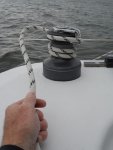
With self-tailing winches a useful trick can be to prepare the winch as described below so that it can be released from across the cockpit with a tug. Simply reduce the number of turns to the bare minimum and place the tail on the wrong side of the winch. If your timing is good, you should be able to release one and tighten the other from the steering position without grinding (if you catch it just right) (usually there is a little grinding to fine tune, but it can wait). You will also learn to throw the excess turns off using the tail from a distance.

You can do this with cam cleats as well. I always have cam cleats near my self-tailers for windy days.

I learned this trick for tacking a cat with a cockpit 12' wide!

http://sail-delmarva.blogspot.com/2016/11/singlehanded-tacking-releasing-sheet.html
winch%u00252Bsheet%u00252Btrick%u00252Baround%u00252Bthe%u00252Bback%u00252Bside%u00252B3.jpg
 
Last edited:
The old trick on dinghies is to tie the end of the sheets together, so you have control from either but especially the windward side.

On my 22' I go for whole seasons without using the sheet winches, I have the option of cheek blocks and cam cleats on the coamings and usually use these, with timed tacks they are handy even with quite high loads in fresh winds.

So in your case I'd simply tie the genoa sheet ends together and use the tack feature on the autohelm, especially while getting used to the boat.

Keep an eye on your battery condition though, as autohelm gremlins have a wicked sense of humour ! :)
 

Other threads that may be of interest

Top