Generic Unbranded Unthickened Bleach

I once tried Lanolin. It was a disaster, it encouraged fouling.
It does seem quite likely that vegetable oil, as a biological material, will have a similar effect, unless it is either
(a) rendered noxious by chemical modification or admixture
OR
(b) covered up
Or both

At present I intend covering the stuff on the bilge keels with bitumastic paint and then antifouling, which, (unless it all falls off after a soak in seawater, a distinct possibility) should avoid the fouling issue as well as antifouling usually does.

The chlorination idea was an attempt to render the oil noxious, for which there are other possibilities even more speculative and half formed/half assed at present.

Its very likely this treatment wont/cant be rendered useful underwater by any practical means. However, I'm fairly confident that, even in the marine environment, it will be useful above the waterline, as on my anchor (already done), on my galvanized taburnacle which has rusty areas, and on exposed engine and transmission components.
 
Last edited:
Just a quick side note.

I used to manufacture the thick bleach you get in supermarkets. It contains Sodium Hypochlorite which is a by product of Sodium Hydroxide production so is a strong alkaki, Sodium laurel sulphate which is the detergent that also makes it thick, Sodium Hydroxide itself which adjusts the thickness, and a perfume.

As a child, I used to go with my mother to the high school at the weekend as I would help clean the pool. She would test it for free & total chlorine and also pH and would add Sodium Hypochlorite to make sure the water was ready for the high school pupils for the week. It was definitely the same raw material that I would use 20 years later to make bleach.

My point is that Bleach can consist of other things other than Sodium Hypochlorite and especially if you are using it on drinking water vessels, it may leave a trace of something fragrant behind that would taint the taste. However, to remove veg oil from deck/hull I would not hesitate to use hot water with thick bleach added to help scrub off the oil. I would rinse down to minimise residue left behind.

For the water tanks I would use what we use in the water industry to sterilise water mains before they go into service. It is similar to Milton and Sodium Bi Sulphate that is used by home brewing. I think there is a product called Puriclean in the chandlery for tanks. Key use of these is contact time. The usual recommendation is overnight to 24 hours depending on strength.

Sorry for the long winded message.
 
Just a quick side note.

I used to manufacture the thick bleach you get in supermarkets. It contains Sodium Hypochlorite which is a by product of Sodium Hydroxide production so is a strong alkaki, Sodium laurel sulphate which is the detergent that also makes it thick, Sodium Hydroxide itself which adjusts the thickness, and a perfume.

As a child, I used to go with my mother to the high school at the weekend as I would help clean the pool. She would test it for free & total chlorine and also pH and would add Sodium Hypochlorite to make sure the water was ready for the high school pupils for the week. It was definitely the same raw material that I would use 20 years later to make bleach.

My point is that Bleach can consist of other things other than Sodium Hypochlorite and especially if you are using it on drinking water vessels, it may leave a trace of something fragrant behind that would taint the taste. However, to remove veg oil from deck/hull I would not hesitate to use hot water with thick bleach added to help scrub off the oil. I would rinse down to minimise residue left behind.

For the water tanks I would use what we use in the water industry to sterilise water mains before they go into service. It is similar to Milton and Sodium Bi Sulphate that is used by home brewing. I think there is a product called Puriclean in the chandlery for tanks. Key use of these is contact time. The usual recommendation is overnight to 24 hours depending on strength.

Sorry for the long winded message.
Thanks. Useful insider information.
 
Yeh, that'd do it. Diluted to 3% use strength that'd be 100 litres, Escalated quickly, since I only came in for a bottle of bleach.

Perhaps tablets/powder would be more convenient if going for scale or high strength, maybe something like this, if one could confirm what was in it.

clearwater-chlorine-granules-1kg~5031470039332_01bq


https://www.diy.com/departments/cle...MIse3q49eokgMVeJpQBh0cTgx0EAQYBCABEgLw__D_BwE
This might work but could not see the coshh form. If it contains Sodium Dichloroisocyanurate, it is the same compound as we use for water mains. You need to thoroughly rince with fresh tap water to remove it and what is left of the dead nasties before you can consume it.
 
To borrow from that Project Farm guy with the irritating voice:-

Is a picture worth a thousand pisstakes?

Lets Find Out!.

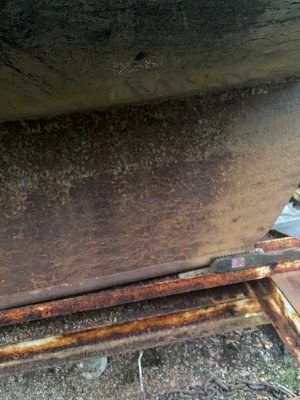
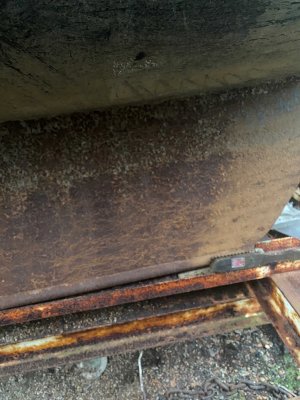
Hand wire brushing of the starboard keel. The light coloured bits seem to be residual galvanizing. Oviously much rust remains.

stbdwirebrushing50.jpg

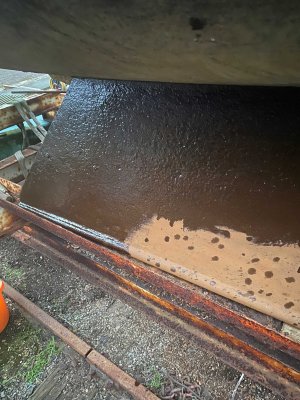
Overpainting with SFO. Heating might have improved penetration but a brisk NE wind with rain defeated that idea, and it seemed to soak in OK. Left for 2 days. Note the splashes
stbd_splashes50.jpg
Note the light coloured areas corresponding to the splashes. I'd guess these are trapped air and its better to paint from the bottom up.
stbd_bubbles_50.jpg
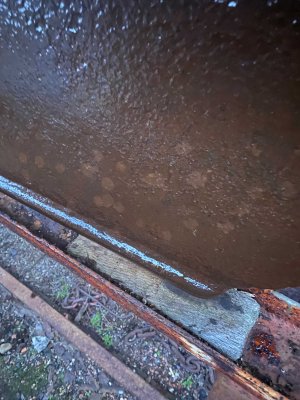
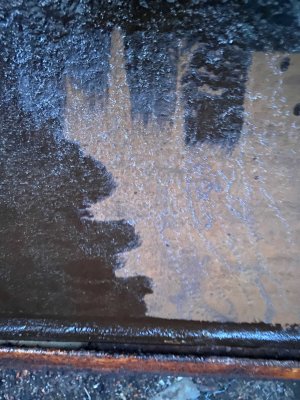
"Aluminiumising" after 2 days. Rainwater beading on the surface and some washover didnt seem to be a serious problem. After application some rust coloured aluminium-free pits were apparent, which were filled by overbrushing another layer of oil on, dragging aluminium into the pits, but they likely remain less well treated, which may tend to amplify them over time. In Taiwan I had various aluminium tubes which could get into pits but I'm not set up for that here yet.

stbdTreat.jpg
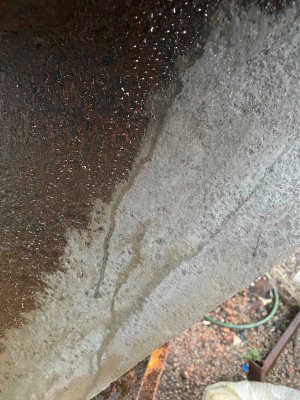
Port side, which I additionally de-rusted with aluminium dry, visible as silvery tracks on the surface. I doubt this would make a significant difference unless one had the considerable patience required to do it thoroughly, since the disk covers too small an area
PortBrushN1stCoat50.jpg

Aluminiumizing the port side after overnight soak, with my formerly trusty drill having a last lie down before expiry - Ah, wont upload, must have exceeded an allocation or something. Never mind.

Zinc would almost certainly be better for this but I;m not aware of a free source of zinc.

I suppose if you used copper sheet (flashing?) you might be able to generate antifouling in situ, but only on the keels and it'd likely increase corrosion being forced into intimacy with the iron/steel, the opposite of the intended effect here.
 

Attachments

  • stbdwirebrushing50.jpg
    stbdwirebrushing50.jpg
    1.4 MB · Views: 1
Did you add the bleach or just use straight sun flower oil?

I’m surprised it’s polymerised in the current conditions - are both sides equally well “cured”? When we last gave our keel some TLC one side was in shade and took much longer to dry.
 
Its not clear to me where you are getting the free aluminium powder or flake at a, few, micron sized levels

Jonathan
Its not clear to me what a few micron sized levels means. The aluminium comes from beer or cola (“juice” in neo-scots) cans, and will contain traces of epoxy, paint, (and product if I didnt bother to wash them) which I usually do but not this time due to press of weather. Conditions were fairly horrible but will probably get worse.
 
Did you add the bleach or just use straight sun flower oil?

I’m surprised it’s polymerised in the current conditions - are both sides equally well “cured”? When we last gave our keel some TLC one side was in shade and took much longer to dry.
Perhaps the high winds are a factor, since its an oxidation reaction. I also think rust and perhaps the aluminium may catalyse the reaction, as some metals (though principally cobalt and manganese) do in “boiled” linseed.

I had some fully polymerised sfo re-liquify in a cupboard (though it was in a shallow open dish and probably had cockroaches walking over it) and IIRC it then re-solidified, so the physiochemical changes are likely to be complex, but the aluminium-loaded stuff seems stable on a car.

I tried heating it up with an old electric iron resting on the keel bottom but it blew off and broke after a few hours and the warmed section didnt seem much different. Its probably only surface-cured but hopefully will set full depth in time.

Straight SFO about 1 year post-purchase.Premature to use chlorinated operationally ATPIT, and I havnt yet tried to make any.
 
Its not clear to me what a few micron sized levels means. The aluminium comes from beer or cola (“juice” in neo-scots) cans, and will contain traces of epoxy, paint, (and product if I didnt bother to wash them) which I usually do but not this time due to press of weather. Conditions were fairly horrible but will probably get worse.
Most metallic pigments, aluminium, brass, or active ingredients zinc are micron sized, say 5 microns. Powder are used to develop coverage. The smaller the particle the greater the coverage . A Coca Cola or Guinness tin maybe aluminium + paints or varnish - but are not micron size (but bg lumps).

So how are you incorporating the used tins in the application where you are maybe using the aluminium as protection, iron, or steel, from rusting.

Jonathan
 
Most metallic pigments, aluminium, brass, or active ingredients zinc are micron sized, say 5 microns. Powder are used to develop coverage. The smaller the particle the greater the coverage . A Coca Cola or Guinness tin maybe aluminium + paints or varnish - but are not micron size (but bg lumps).

So how are you incorporating the used tins in the application where you are maybe using the aluminium as protection, iron, or steel, from rusting.

Jonathan
Thought I’d said.
(Checks Yes I did, but the picture got knocked back and I didn’t bother resizing it again)
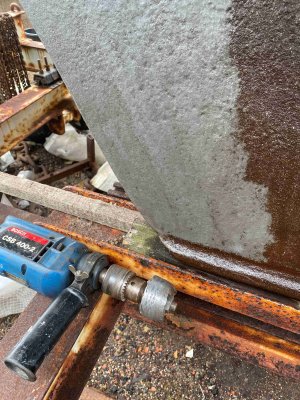
I grind with disks or cups made from the cans, both before and after applying the vegetable oil binder. The idea is that this forces aluminium into intimate contact with the surface of the steel, poor mans flame spraying stylee.

If you want flakes, aluminium foil provides them, but ive only used that when derusting by hand, as for tools, fastners or very light rust, I have thought about-putting foil inside a can that one then flattened intoa disk. Should work. But havnt tried it.

Technique (in the original automotive context) discussed here, with more pictures

https://bobistheoilguy.com/forums/threads/coke-can-for-brake-drums.242350/

Missing pic above
port_treat20.jpg

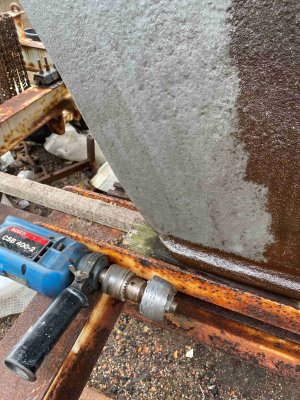
The mandrel seen here on my old dead drill is a bought one that I had from 20 years or so ago, before I went to Taiwan. One can make better ones, with less obstruction by the end nut, and more capacity, by cutting the head off a suitable bolt, which I will do soon.

This type of stacked-flattened-cans disk starts out spiky, with a lot of vibration, and in this form is probably most suitable for de-rusting, but it rapidly develops into a 'tyre', as seen here, which is more suitable for laying down metal, as long as the surface being abraded is a bit rough/pitted.
 

Attachments

  • port_treat20.jpg
    port_treat20.jpg
    1.8 MB · Views: 3
Last edited:
Thought I’d said.
(Checks Yes I did, but the picture got knocked back and I didn’t bother resizing it again)
I grind with disks or cups made from the cans, both before and after applying the vegetable oil binder. The idea is that this forces aluminium into intimate contact with the surface of the steel, poor mans flame spraying stylee.

If you want flakes, aluminium foil provides them, but ive only used that when derusting by hand, as for tools, fastners or very light rust, I have thought about-putting foil inside a can that one then flattened intoa disk. Should work. But havnt tried it.

Technique (in the original automotive context) discussed here, with more pictures

https://bobistheoilguy.com/forums/threads/coke-can-for-brake-drums.242350/

Missing pic above
View attachment 205938

The mandrel seen here on my old dead drill is a bought one that I had from 20 years or so ago, before I went to Taiwan. One can make better ones, with less obstruction by the end nut, and more capacity, by cutting the head off a suitable bolt, which I will do soon.

This type of stacked-flattened-cans disk starts out spiky, with a lot of vibration, and in this form is probably most suitable for de-rusting, but it rapidly develops into a 'tyre', as seen here, which is more suitable for laying down metal, as long as the surface being abraded is a bit rough/pitted.

Thank you. I'm not sure if I missed your original post on the topic - or I did not understand it. I picture is still worth a thousand words.

Jonathan
 
Thank you. I'm not sure if I missed your original post on the topic - or I did not understand it. I picture is still worth a thousand words.

Jonathan
Depends on the words. Youtube provides many examples to the contrary,

Where I've come from, the words are pretty much pictures, and pretty much useless, though they can be quite pretty.
 
Didnt seem to work as well with the cast oron ballast keel. Not sure why. The surface is very irregular, with paint/antifouling/filler(?) in a lot of the pits, and this, and/or a self lubricating property of the cast iron itself, may have made it less efficient at grinding the aluminium.

The centre keel on a Trident 24 is also a peculiar shape, with a “notch” or “waist” running downwards from top front to bottom rear. This isnt intuitively faster (though I’m not a naval architect) and it makes it even more difficult to grind.

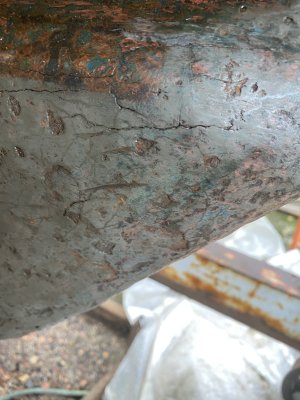
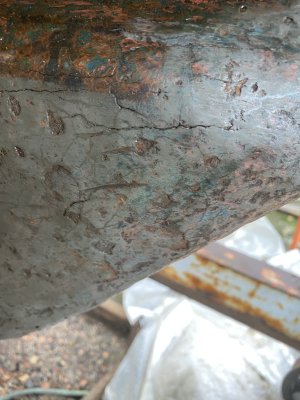
Also had some fine cracks in it which cant be a good thing, though I dunno how bad it isA245B995-EA07-48A4-8CCF-CDC80DBF3C8A.jpeg
 

Attachments

  • 1564D809-3F5C-4494-98D0-A4E863A5B039.jpeg
    1564D809-3F5C-4494-98D0-A4E863A5B039.jpeg
    1.7 MB · Views: 2
Last edited:
Long term its supposed to rot the seals
It doesn’t at all. The manufacturer confirmed as much and someone around here tested the seals in jars for a very long time with various chemicals none of which caused harm.
 
Top