Gas Locker ( I feel a survey coming on!!)

Another origo convert. Much safer too. A little slower but who's in a hurry.


LPG gas is not lighter than air.

LPG (propane) is heavier than air.

Butane is also heavier than air.

In fact, LPG is over 50% heavier than air at sea level (1 atm).

As a result, LPG gas will settle in low places
At room temperature, butane gas is colourless, odourless and flammable. Flammable (or combustible) gas means that a particular type of gas is explosive when that gas is mixed with air or oxygen in the right proportions
Because butane gas is a flammable gas, it is essential to store butane or iso-butane gas correctly. You should store butane gas in a closable and dark area. Keep the cylinders away from heat, sparks, flames or hot surfaces at all costs. Keep the area in which butane gas is stored ventilated and cool, and away from any consumable beverages.
https://semagases.com/butane-gas-3-things-to-know/

Gas is more dense than air, so in the case of a leak, it will make its way to the lowest point i.e. the bilges where it will stay until the boat is aired to clear it or something ignites it, which can result in a significant explosion.
https://www.rya.org.uk/knowledge-advice/safe-boating/look-after-yourself/Pages/gas.aspx

To prevent gas, which has escaped in the cylinder locker, from entering the interior of the boat LPG must be able to drain effectively from the lowest point of the cylinder locker to a point outside the hull, above the waterline. Boats manufactured before 3 January 2000, which have a cylinder locker drain as near as practical to the bottom of the cylinder locker, are exempt from this part of this Standard. [7.2]
https://www.boatsafetyscheme.org/bo...-lpg-installations/location-of-lpg-cylinders/

This one will give you all nightmares until you go and check you boat
http://www.walshsurveyor.com/yachts/articles/gas/index.htm

So it seems that a drain is necessary especially if butane mixes with O2 and then a spark happens , BOOM
 
LPG gas is not lighter than air.

LPG (propane) is heavier than air.

Butane is also heavier than air.

In fact, LPG is over 50% heavier than air at sea level (1 atm).

As a result, LPG gas will settle in low places
....
...
Utter bollux.

It's a gas.
It will obey the gas laws.
I suggest you lie on the floor so that some of the oxygen that will have settled there gets to your brain.
Or not.
 
Utter bollux.

It's a gas.
It will obey the gas laws.
I suggest you lie on the floor so that some of the oxygen that will have settled there gets to your brain.
Or not.

Dont be silly. CO2 is the heaviest of the common constituents of air. There will be a layer of it on the floor.
 
On ships, we gas test before entering confined spaces. We do so at the top, the middle and the bottom of any enclosed space before we enter it and there are bloody good reasons for doing so.

I remember the deckhand who was killed in a methane explosion on a coal carrier because it was at the top of the space and he had tested at the bottom before starting welding on the hatch cover,and the two ABs on a small timber ship who went down a ladder into the forepeak to get a tarpaulin and were asphyxiated by the lack of oxygen at the bottom because the forepeak was common to the hold full of sawn timber and they had tested at the top. And a few dozen others.
 
Last edited:
LPG gas is not lighter than air.

LPG (propane) is heavier than air.

Butane is also heavier than air.

In fact, LPG is over 50% heavier than air at sea level (1 atm).

As a result, LPG gas will settle in low places

Only initially, and under the right conditions. The molecular weights are close enough that LPG and air mix quite quickly by diffusion (my car wouldn't run very well if they didn't) and so a slow leak will normally diffuse away as fast as it is supplied. That is not always a good thing, because propane (for example) is explosive between 2.1% and 10.1% concentration, so during the diffusion process it can/will pass between those limits.

Gas leaks are not good things, but whether any given one is dangerous depends on other factors. Best to avoid 'em all.

Thus, using Butane (C4H10 -> 58 g / mole), and a locker height of 50cm gives the variation of concentration of Butane over the locker of 0.01%: put another way, at the top of the locker it's 99.99% as concentrated as it is at the bottom of the locker.

That is after full mixing has occurred, of course. If you vent propane into the atmosphere it will initially sink down before diffusion does its thing.
 
I got an Origo two burner and ditched the gas system on my boat. Mind you, it's a small boat at 31 feet and we never used the oven. It's efficient, wont explode and fire can be doused with water. I'm burning clean Bio Ethanol so other advantages are no smell and no Carbon Monoxide. Gas is heavier than air and if it gets into your bilges its hard to shift without turning the boat upside down. you can have a pinhole leak in your inboard hose and you will know nothing until BOOM! The Origo 3000 cost me less than the repairs certification that were needed for my old gas system. Bonus is a new locker for flares and foghorn etc.
 
Utter bollux.

It's a gas.
It will obey the gas laws.
I suggest you lie on the floor so that some of the oxygen that will have settled there gets to your brain.
Or not.

i find it amazing that there are so many experts on these forums when the info came from a gas producer on the internet, gas can only mix and move around if there is air flow to mix the gases , i.e ventilation is always a priority when storing gas

Question
a) The two gases will mix evenly within the container; or, b) the two gases will separate, so that the heavier gas is "on the bottom"?

Would the relative volume of the two gases have any effect one way or the other?

Further, assuming the two gases are initially in a "random/agitated" state (as a result of the physical forces of them being injected into the container), how long would it take for them to reach their end-state?

Answer

The second part of your question is a bit different since it starts with separated gases and asks how quickly they would mix. Given the gas molecules are travelling so fast you might think the mixing would be extremely rapid, but in fact this isn't the case. The trouble is that gas molecules collide with each other and ricochet back in random directions. The average distance a gas molecule travels before hitting another molecule is called the mean free path, and at room temperature and pressure the mean free path is around 0.1 microns.So even though a nitrogen molecule is moving at about 500 m/s it's moving at random not in a straight line. If you start with two gases separated into different layers then the mixing is surprisingly slow. In fact as discussed in the question Why is it difficult to mix helium and nitrogen gases? it can be so slow that it takes days or weeks to happen.

https://physics.stackexchange.com/questions/213903/behavior-of-two-gases-in-a-closed-container

I would also appreciate it if you can answer in a civil manner and not reference anything to my brain (brain Damaged in car Accident)
this is a normal discussion leading to creative ideas
 
Last edited:
A mundane reason for having a drain at the base of any compartment, which falls to the overboard discharge point, is so that any common or garden water that gets in can take itself out again.

That, I suspect, is by far the best reason for having a drain to a gas locker, After all, if it really let heavier than air gas out there would be no reason not to have a loose-topped gas locker inside one's cabin. Anyone like to try to get that past a surveyor?
 
I got an Origo two burner and ditched the gas system on my boat. Mind you, it's a small boat at 31 feet and we never used the oven. It's efficient, wont explode and fire can be doused with water. I'm burning clean Bio Ethanol so other advantages are no smell and no Carbon Monoxide.

Want to bet your life on that?

http://www.wilderness-survival.net/forums/entry.php?138-Alcohol-stoves-and-CO-poisoning

http://www.backpackinglight.com/cgi-bin/backpackinglight/stoves_tents_carbon_monoxide_pt_4.html

http://zenstoves.net/COHazard.htm

Gas is heavier than air and if it gets into your bilges its hard to shift without turning the boat upside down.

Or just ventilating the area reasonably and letting diffusion do its thing. Mind you, that could take several minutes, if any gas makes it to the bilge without diffusing away in the first place,

you can have a pinhole leak in your inboard hose and you will know nothing until BOOM!

Did you know that mercaptan odorant is added to LPG to make it smellable well below the lower explosive limit?
 
I always try to be civil.

My point is that gravity makes little odds. This is because the difference in potential energy over the height of a normal gas locker is minute compared to the kinetic energy of each molecule at room temperature.

The posting saying that mean free path is only a few microns (or even less) is absolutely correct, and indeed mixing of gasses by diffusion of one gas into another happens surprisingly slowly, but it is absolutely backing up the point about gravity being not really relevant. Consider the trajectory taken by a molecule: yes it's a parabola, bending down due to gravity just as everyone was taught at school. But the speed of the molecule is some hundreds of metres per second - about the speed of sound (no coincidence) - and it travels only for a few microns before colliding so the path really, really won't look curved!

On the "how fast does LPG mix with air?" question, it's actually quite glacial (carburettors and fuel injection systems work through turbulence not diffusion I believe). One can expect the governing equation to be the classic relaxation one, and indeed it is: known as Frick's second law for diffusion.

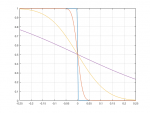
This has solutions only if one knows boundary conditions and initial condition, so let's choose a box 50cm wide in which at time t = 0 half contains some LPG at concentration 1.0 (an arbitrary value) and the other half has none:

lpg_diffusion.png

The curves are for t = 0.1s, 10s, 300s and 1 hour. It really does take quite a long time to mix! But isn't this further proof that the oft-repeated idea of 'heavier gas flowing downhill' in the gas locker is just tosh?

Edit: It does, however, show that should gas have accumulated in some reasonably enclosed space, for instance the bilge, it may stay there a very surprisingly long time - representing a hazard. It also backs up the regulation that one should test concentration not just at one place but at several places in a ship's hold.
 
Last edited:
Not to get to technical and I appreciate there is a discussion going on with Diffusion of Gases but as my last post explained this can take a long time especially in a sealed area with no air to mix and move the gasses .

Diffusion refers to the process of particles moving from an area of high concentration to one of low concentration. The rate of this movement is a function of temperature, viscosity of the medium, and the size (mass) of the particles. Diffusion results in the gradual mixing of materials, and eventually, it forms a homogeneous mixture.
Diffusion coefficients can be calculated from the detailed kinetic theory equation which is a proper mind twister, but if some one wants to calculate the volume of their gas bx and the amount of air and then the potential leak rate from a faulty gas connector , to work out the diffusion rate before it is safe
or you can put a vent at the bottom of the locker and let the gas drain out , simply I think :D oh and the safest , I always wonder why over cautiousness on this site is frowned upon.
 
i find it amazing that there are so many experts on these forums when the info came from a gas producer on the internet, gas can only mix and move around if there is air flow to mix the gases

That is simply not true. Diffusion will mix gases over time even with no large scale fluid motion. The only exceptions are hydrogen and helium which are so much less dense than other gases that barometric effects (ie gravity) prevails over diffusion. That's why there is effective no hydrogen or helium in the atmosphere; they both rise over time to the top and then diffuse away into space.

 
That is simply not true. Diffusion will mix gases over time even with no large scale fluid motion. The only exceptions are hydrogen and helium which are so much less dense than other gases that barometric effects (ie gravity) prevails over diffusion. That's why there is effective no hydrogen or helium in the atmosphere; they both rise over time to the top and then diffuse away into space.


You are using a sealed experiment in a confined space, I was referring ot open spaces were Gases mix constantly with free movement and disperse , but I get you point I can be confusing at times :D , but post 55 will sort it ,
Any one that does not have a gas vent is a walking time bomb , already explained that Butane and Air cause a mixture of dangerous explosives even after diffusion in your lovely sealed gas locker you open it and some on lights a match or a candle near by BOOM
 
Forget all that stuff.

Yes, I am another one of those annoying Origo owners....There are no downsides. It heats up nearly as fast as gas, and it won't smell if you run it on biofuel. A two burner hob will cook just about everything, especially if you add in an Omnia oven on top.
 
or you can put a vent at the bottom of the locker and let the gas drain out

This is fun. Let's do some fluids ...

My gas locker is 30cm deep. If it was half full of propane (density 1.88kg/m3) instead of air (density 1.22kg/m3) the additional pressure due to the 15cm column of propane would be (1.88 - 1.22) x 9.81 x 0.15 = 1Pa (near as dammit) = 0.01mb.

The drain pipe from my gas locker has an internal diameter of 15mm and is 0.3m long. I can't be bothered to do the calculation by hand, but using http://www.pressure-drop.com/Online-Calculator/ gives a flow rate of 0.5 m3 hour with that head. That's 0.94 kg of propane per hour.

Surprisingly high, to be honest.
 
Any one that does not have a gas vent is a walking time bomb

We agree on that.

, already explained that Butane and Air cause a mixture of dangerous explosives even after diffusion in your lovely sealed gas locker you open it and some on lights a match or a candle near by BOOM

Only if it's between 2.5% and 12.5% gas, of course.

Years a go a friend of mine was transferring liquid propane into an LPG powered Land Rover from 47kg bottle inverted with a chain hoist. The hose between the bottle and the car came undone and a wall of propane vapour moved steadily up the garage to the gas heater he was using to keep the propane warm, it being the dead of winter. The heater was between him and the door - all he could do was wait.

The propane reached the stove, was sucked in the air inlet and ... snuffed it out. Hooray for upper explosive limits!
 
Top
