Fuses for solar...

Sea Change

Well-Known Member
Joined
13 Feb 2014
Messages
2,385
Visit site
It's necessary to fuse the connection between the panel and the MPPT, and then again between the MPPT and the battery.
It's also a bad idea to disconnect the battery whilst the panel is generating power.
So...
Could you use a dual pole breaker? I admit that for higher voltage panels the current is going to quite different on either side of the MPPT, but in principle, would this work? If I understand it correctly, you'd avoid the situation where the MPPT is connected to solar only.
 
Circuit protection is always needed between the controller and the battery. Circuit protection on the solar panels’ input side is only needed if you have three or more solar panels in parallel. In this case, each panel needs protection.

The circuit protection can be fuses or circuit breakers. Circuit breakers have the advantage that they can more readily work as isolation switches to ensure the solar input is turned off before the battery connection which is important with some controllers. If you do use fuses on the solar panel side, make sure these have a higher enough voltage rating if you are using high-voltage panels (some marine fuse holders have a 32V limit).
 
It's necessary to fuse the connection between the panel and the MPPT, and then again between the MPPT and the battery.
It's also a bad idea to disconnect the battery whilst the panel is generating power.
So...
Could you use a dual pole breaker? I admit that for higher voltage panels the current is going to quite different on either side of the MPPT, but in principle, would this work? If I understand it correctly, you'd avoid the situation where the MPPT is connected to solar only.
Only needs to be single pole.
 
Understood, I thought you could kill two birds with one stone, with the significant advantage that it's impossible to have solar connected and not the battery.
Perhaps i misunderstood what you were thinking...

If you meant a dual circuit breaker that breaks the positive circuits either side of the controller, yes you could do that. But i wouldn't use a circuit breaker, a dual pole switch would be OK, but you'd still need fuses. I would fit a fuse close to the batteries, then you could use a fuse and switch between the panels and controller, or a resettable circuit breaker.

FYI, with Victron MPPT controllers (no doubt some others, but i don't know which for sure) there is no need to disconnect the panels before disconnecting the batteries.
 
Getting back to the purpose of a fuse it is to protect the wiring from excessive current which can melt the wire and possibly start a fire. The wiring of the PV panel to the controller should be well capable of carrying max current of the PV panel. The source of excess current can only be the PV panel.
However while the connection of controller to battery should have a known and limited current controller to battery, the battery has the capacity to provide huge current which could melt wiring in case of a short circuit in the controller or the wiring to it. hence need for a fuse that will protect that wiring.
Hence IMHO fuse only needed for wiring controller to battery preferably as close to the battery as possible.
Switches I think would be optional and not needed in my opinion . ol'will
 
Getting back to the purpose of a fuse it is to protect the wiring from excessive current which can melt the wire and possibly start a fire. The wiring of the PV panel to the controller should be well capable of carrying max current of the PV panel.
True, but the wires inside solar panels are only rated for a little over the maximum current rating of this single panel. In a fault condition, the output from other solar panels in the string can be conducted via these internal wires, hence the need for fuse protection on the panel side of the controller in some circumstances (in addition to the always mandatory protection between the controller and the battery).

Unfortunately, there is a common belief that circuit protection is never needed between the controller and the solar panels, and this is wrong (although it is not needed in all cases).
 
True, but the wires inside solar panels are only rated for a little over the maximum current rating of this single panel. In a fault condition, the output from other solar panels in the string can be conducted via these internal wires, hence the need for fuse protection on the panel side of the controller in some circumstances (in addition to the always mandatory protection between the controller and the battery).

Unfortunately, there is a common belief that circuit protection is never needed between the controller and the solar panels, and this is wrong (although it is not needed in all cases).
Yes conceivably you could get a panel feeding in to a panel in parallel. You would need to have a fuse between each panel and the others accurately rated to max panel current and not much more. Do people do that? ol'will
 
Yes conceivably you could get a panel feeding in to a panel in parallel. You would need to have a fuse between each panel and the others accurately rated to max panel current and not much more. Do people do that? ol'will
I think that there maybe some misunderstanding in what the OP is saying, I maybe entirely wrong but I think that he meant. " Could he use one double pole circuit breaker to protect both incoming and output to/from controller." Perhaps OP could clarify? Personally never heard of such an arrangement and would say definite no, no. for one thing the current rating and trip settings are different for the solar panel and battery(s).
Probably I have misunderstood. I am certainly confused.
 
If I understand it correctly, you'd avoid the situation where the MPPT is connected to solar only.
I wouldn’t do what you suggest. The reason the battery needs connecting first is usually so the MPPT can boot up and sense battery voltage. The reason for a switch on the solar side is so that you can perform maintenance without disconnecting the panels. With a single switch neither of these can happen effectively, and switches aren’t all that expensive.
 
I think that there maybe some misunderstanding in what the OP is saying, I maybe entirely wrong but I think that he meant. " Could he use one double pole circuit breaker to protect both incoming and output to/from controller." Perhaps OP could clarify? Personally never heard of such an arrangement and would say definite no, no. for one thing the current rating and trip settings are different for the solar panel and battery(s).
Probably I have misunderstood. I am certainly confused.
That's indeed what I was suggesting.
For lower voltage panels the same size breaker in and out would be well within the range suitable to protect the cable.

I did previously kill an MPPT by accidentally disconnecting it from the battery whilst the panel was in full sun. So I'm perhaps a bit paranoid, but a breaker that cuts off both sides simultaneously seems like one way to stop it from happening again.
 
I wouldn’t do what you suggest. The reason the battery needs connecting first is usually so the MPPT can boot up and sense battery voltage. The reason for a switch on the solar side is so that you can perform maintenance without disconnecting the panels. With a single switch neither of these can happen effectively, and switches aren’t all that expensive.
That's a fair point, although you might want to shut the whole thing down for other reasons. If the MPPT is sharing a connection at the battery with anything else then you'd just want to shut the solar down entirely so that you could disconnect it.

I'm not saying this is a necessary solution but I thought it would be fairly idiot proof and so far I'm not really seeing any downsides, unless the panels are a high enough voltage that it would no longer be safe to have the same size breaker on both sides.
 
One potential downside is that you could get in a situation where you flip the switch and the MPPT decides to throw 48V into a 12V system because it didn’t have time to sense the battery before solar came online.
I’ve no idea whether this is an actual problem and I’m not going to test it, but it is one reason the battery must be connected first.
 
That's indeed what I was suggesting.
For lower voltage panels the same size breaker in and out would be well within the range suitable to protect the cable.

I did previously kill an MPPT by accidentally disconnecting it from the battery whilst the panel was in full sun. So I'm perhaps a bit paranoid, but a breaker that cuts off both sides simultaneously seems like one way to stop it from happening again.
It isn't voltage that you are concerned about it is current, as far as the breaker is concerned the current put out by the panels could be less, at a higher voltage, than the current, at a lower voltage on the output side of the controller. Hence I suggest there could be different tripping characteristics required. You off course can work it out and decide but I wouldn't advise it. Personally to me as someone who has ben working with electrics for more years than I care to think about, it is a bodge :unsure: :)
 
One potential downside is that you could get in a situation where you flip the switch and the MPPT decides to throw 48V into a 12V system because it didn’t have time to sense the battery before solar came online.
I’ve no idea whether this is an actual problem and I’m not going to test it, but it is one reason the battery must be connected first.
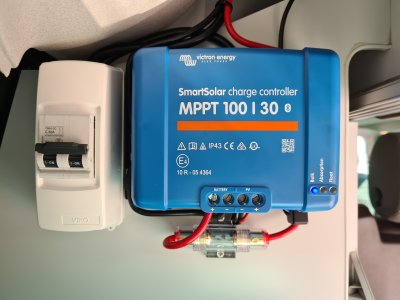
09_MPPTandPanelCircuitBreaker.jpg

Connected my MPPT in the camper van to the solar panels with one of these. The panels were connected in series and around 320W in total.
The dual pole switch isolated the panels completely from the MPPT in the case where I needed to work on batteries or wiring in the van.
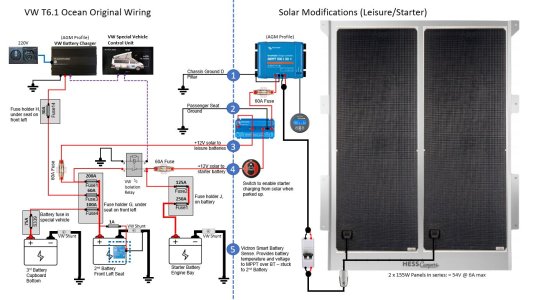
Due to the use of an Argofet between the charger and the batteries, the fuse for the MPPT output was on the MPPT end instead of the Argofet end. The Argofet outputs were fused at the batteries. See diagram.
To avoid the MPPT shutting off when the sun went down, I used the alternator energise output of the Argofet to power the MPPT when the solar array was off.
Works flawlessly and charged both banks of batteries from one MPPT without upsetting the smart-alternator or bridging the VW isolation relay during engine start when start/stop kicked in.
The Victron MPPTs learn battery voltage on first power-up and then the automatic function is switched off. The MPPT spuriously choosing 48V does not happen - if the MPPT is only powered from the solar panels, and not connected to batteries, it defaults to 12V which can then be manually changed in the settings.


01_Plan.JPG
 
Victron MPPT controllers ( may also apply to other MPPT controllers, i only fit Victron) :

The only time you must connectthe battery first, so the controller can sense battery voltage, is during installation, the settings are stored and there is no need to disconnect the batteries first in future. The MPPT controllers don't care if there is a battery connected or not, they can be used to power loads using the load terminals, whether or not a battery is connected.

A fuse must be fitted between the controller and the batteries, as close to the batteries as possible, but this applies to anything connected to the batteries.

There is no need for switches between the batteris and the controller or between the panels and the controller, but no harm in fitting them if you wish.

Other than the conditions mentioned by Noelex, there is no need to fuse the wiring between the panels and the controller. A short in the wiring from the battery will melt the wiring, or cause a fire, it needs fusing. A short between the panels and the controller does nothing, other than stops the charging.
 
It isn't voltage that you are concerned about it is current, as far as the breaker is concerned the current put out by the panels could be less, at a higher voltage, than the current, at a lower voltage on the output side of the controller. Hence I suggest there could be different tripping characteristics required. You off course can work it out and decide but I wouldn't advise it. Personally to me as someone who has ben working with electrics for more years than I care to think about, it is a bodge :unsure: :)

I didn't think it was a bodge... I thought it was quite elegant tbh!

Let's say you have a 100w panel at an operating voltage of 17v, connected via 4mm² cable. You'd expect a maximum current of <6A.
Your MPPT might be putting out that 100w at as low as 12v so the current goes up to a little over 8A.

On both runs you're likely to be using decent cable, say 4mm², to reduce voltage losses, which is rated to 39A.

So you could fit a 10A dual pole breaker to protect both sides, and everything is happy. I'm not sure I see the problem?

Obviously there will be combinations of different panels, cable sizes, etc where it wouldn't work.
 
Victron MPPT controllers ( may also apply to other MPPT controllers, i only fit Victron) :

The only time you must connectthe battery first, so the controller can sense battery voltage, is during installation, the settings are stored and there is no need to disconnect the batteries first in future. The MPPT controllers don't care if there is a battery connected or not, they can be used to power loads using the load terminals, whether or not a battery is connected.

A fuse must be fitted between the controller and the batteries, as close to the batteries as possible, but this applies to anything connected to the batteries.

There is no need for switches between the batteris and the controller or between the panels and the controller, but no harm in fitting them if you wish.

Other than the conditions mentioned by Noelex, there is no need to fuse the wiring between the panels and the controller. A short in the wiring from the battery will melt the wiring, or cause a fire, it needs fusing. A short between the panels and the controller does nothing, other than stops the charging.
Well I did not know that. Another reason to go Victron!
The MPPT I killed was an Epever. I'm gradually swapping everything over to Victron now that their prices have become sensible.

So it looks like my idea is a solution looking for a problem...
 
Last edited:
If you are going to switch the battery side of a solar controller, say by turning off the main battery switch off while leaving the solar panels connected (something I would not recommend), check first that there is not any equipment that can be powered directly from the solar controller. It will be obvious if you have a circuit diagram.

Unfortunately, without a battery in the circuit damening the voltage fluctuations, the solar controller will sometimes reach a voltage that may damage equipment.
 
If you are going to switch the battery side of a solar controller, say by turning off the main battery switch off while leaving the solar panels connected (something I would not recommend), check first that there is not any equipment that can be powered directly from the solar controller. It will be obvious if you have a circuit diagram.

Unfortunately, without a battery in the circuit damening the voltage fluctuations, the solar controller will sometimes reach a voltage that may damage equipment.
I think this is the same reason why the solar should connect to the battery before the main fuse... so that if the fuse blows, the boat can't run off the solar...
 
Top