Fuse for VHF

oilybilge

Well-Known Member
Joined
3 Nov 2017
Messages
213
Location
Suffolk
Visit site
Morning all

My Standard Horizon VHF came supplied with an inline glass fuse, and the instructions tell me to put it somewhere between the battery and the radio.

My question is, can I dispense with this and use an equivalent blade fuse, as per the rest of the boat? Or might there be something special about this particular fuse (eg fast blow?) They literally give you no information about it beyond its amps rating.

Cheers!
 
Look at the amp rating of the supplied fuse. If it is followed by a T it is slow blow and if an F it is a fast fuse. If there is nothing after the A then probably best to contact Standard Horizon who are usually very helpful. Blade fuses are almost always slow blow.
 
VHF is usually wired directly to a main power source, ie battery, to lessen the impact of a failure in the main electrical system. Hence the inline fuse. No reason not to use a blade fuse though that I can think of.
 
“VHF is usually sometimes wired directly to a main power source, ie battery, to lessen the impact of a failure in the main electrical system because in the 80s 7 amps while transmitting was a heavy drain and yacht electrics could be iffy, and manufacturers wanted to minimise support issues due to poor performance so they told people to wire direct.“

If your boat’s electrical system was dodgy enough to warrant special wiring for the VHF “just in case it fails in an emergency”, why not apply the same principle to the nav lights? The bilge pumps? The autopilot, so that you have your hands free to deal with the problem? The depth sounder so you don’t run aground unexpectedly? Yet nobody ever does these (bilge pumps are sometimes wired separately, but that’s so they work when the boat’s unoccupied - “works in emergency” is never given as the explanation), it’s always the VHF, which is unlikely to be the thing you urgently want to use in the event of electrical problems anyway.

It’s just another of those PBO cargo-cult things.

Wire your VHF to your distribution board with an appropriate fuse or breaker, and if your boat’s wiring is so unreliable that you think the VHF might not work, fix that instead of going around it.

Pete
 
“VHF is usually sometimes wired directly to a main power source, ie battery, to lessen the impact of a failure in the main electrical system because in the 80s 7 amps while transmitting was a heavy drain and yacht electrics could be iffy, and manufacturers wanted to minimise support issues due to poor performance so they told people to wire direct.“

If your boat’s electrical system was dodgy enough to warrant special wiring for the VHF “just in case it fails in an emergency”, why not apply the same principle to the nav lights? The bilge pumps? The autopilot, so that you have your hands free to deal with the problem? The depth sounder so you don’t run aground unexpectedly? Yet nobody ever does these (bilge pumps are sometimes wired separately, but that’s so they work when the boat’s unoccupied - “works in emergency” is never given as the explanation), it’s always the VHF, which is unlikely to be the thing you urgently want to use in the event of electrical problems anyway.

It’s just another of those PBO cargo-cult things.

Wire your VHF to your distribution board with an appropriate fuse or breaker, and if your boat’s wiring is so unreliable that you think the VHF might not work, fix that instead of going around it.

Pete
Ahh well. In your perfect world with your perfect boat I have no doubt you’re right. In my less than perfect world I will continue to do things in a way which may give me a fighting chance if things go wrong.

As you obviously consider yourself ‘teacher’, crossing out lesser mortals’ dreadful errors, I’ve stuck you in my kill file. I really dislike ill mannered people.
 
If your boat’s electrical system was dodgy enough to warrant special wiring for the VHF “just in case it fails in an emergency”, why not apply the same principle to the nav lights? The bilge pumps? The autopilot, so that you have your hands free to deal with the problem? The depth sounder so you don’t run aground unexpectedly? Yet nobody ever does these (bilge pumps are sometimes wired separately, but that’s so they work when the boat’s unoccupied - “works in emergency” is never given as the explanation), it’s always the VHF, which is unlikely to be the thing you urgently want to use in the event of electrical problems anyway.

It’s just another of those PBO cargo-cult things.

My VHF supply is wired so that it comes on when the battery switch is on. That's nothing to do with doubts about the rest of the wiring; it's so that in an emergency I - or someone who knows the boat less well - do not need to worry about which breakers or switches are on. The battery switch is always on when we're on board, so the radio always comes on when you want it. Nothing to do with cargo cults.
 
Last edited:
Ahh well. In your perfect world with your perfect boat I have no doubt you’re right. In my less than perfect world I will continue to do things in a way which may give me a fighting chance if things go wrong.

As you obviously consider yourself ‘teacher’, crossing out lesser mortals’ dreadful errors, I’ve stuck you in my kill file. I really dislike ill mannered people.

Might I suggest you've rather over-reacted to prv's post? He makes a very good point - if you have such little faith in your electrics that you want to wire your VHF direct to the battery, there are other crucial items which also should be wired direct. Obviously this isn't the way to go, so if you're concerned about your distribution panel's integrity, fix that first.
 
Provided your new blade fuse is somewhere warm and dry you should have no problems
Most marine radios come from new supplied with a glass type fuse .The end terminals inside the little plastic tube are normally brass.
Blade fuses tend to most used in the auto industry.
Downside of blade fuses ie their habit of corroding into a ball of fussy mess, if exposed to road salt etc. resistance gradually stops current from passing.
Any blade fuses likely to be exposed to corrosion usually come with little snap shut enclosure to prevent moisture getting in.
Have both types on my boat.
Forget the fast or slow blow business.
Normally slow blow are only used in special applications.
A quick tip if your fuse box has blade fuses and lurks in dark dingy locker with 50 other fuses, you can buy fuses with a little LED ,that lights up if the fuse
has failed.
 
Last edited:
Provided your new blade fuse is somewhere warm and dry you should have no problems
Most marine radios come from new supplied with a glass type fuse .The end terminals inside the little plastic tube are normally brass.
Blade fuses tend to most used in the auto industry.
Downside of blade fuses ie their habit of corroding into a ball of fussy mess, if exposed to road salt etc. resistance gradually stops current from passing.
Any blade fuses likely to be exposed to corrosion usually come with little snap shut enclosure to prevent moisture getting in.
Have both types on my boat.

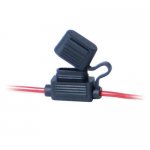
Ordinary inline fuse holders for glass fuses are dreadful things. If you absolutely must have an inline fuse, a waterproof blade fuse holder is probably the best choice.

Watertight-Blade-Fuse-Holder.jpg
 
“VHF is usually sometimes wired directly to a main power source, ie battery, to lessen the impact of a failure in the main electrical system because in the 80s 7 amps while transmitting was a heavy drain and yacht electrics could be iffy, and manufacturers wanted to minimise support issues due to poor performance so they told people to wire direct.“

If your boat’s electrical system was dodgy enough to warrant special wiring for the VHF “just in case it fails in an emergency”, why not apply the same principle to the nav lights? The bilge pumps? The autopilot, so that you have your hands free to deal with the problem? The depth sounder so you don’t run aground unexpectedly? Yet nobody ever does these (bilge pumps are sometimes wired separately, but that’s so they work when the boat’s unoccupied - “works in emergency” is never given as the explanation), it’s always the VHF, which is unlikely to be the thing you urgently want to use in the event of electrical problems anyway.

It’s just another of those PBO cargo-cult things.

Wire your VHF to your distribution board with an appropriate fuse or breaker, and if your boat’s wiring is so unreliable that you think the VHF might not work, fix that instead of going around it.

Pete

Certain vessels even require a separate battery fir one radio in case of emergency. ...

W
 
Might I suggest you've rather over-reacted to prv's post? He makes a very good point - if you have such little faith in your electrics that you want to wire your VHF direct to the battery, there are other crucial items which also should be wired direct. Obviously this isn't the way to go, so if you're concerned about your distribution panel's integrity, fix that first.
I’m not at all concerned about the integrity of my electrics which are all newly installed as the previous system was pants. I just don’t like arrogant twerps.
 
I’m not at all concerned about the integrity of my electrics which are all newly installed as the previous system was pants. I just don’t like arrogant twerps.

In that case, I was correct to say that you over-reacted. If you believe prv is an "arrogant twerp", you're sadly mistaken. His contribution to these forums is consistently well considered and appropriate. Maybe when you've been around the forums for a few more years, you'll understand.
 
The real reason things like VHFs are supplied with a fuse holder in the + lead is, so I am told, it reduces the incidence of DIY installers blowing the unit by connecting the supply the wrong way around. I have friends who work for a couple of equipment makers, stuff gets sent back as 'not working', the internal fuse has been blown, there is a diode just inboard of it designed to blow the fuse before anything else gets killed. Of course nobody ever admits to powering up their new toy the wrong way around....
It may also be designed to pop the fuse in the event of too many volts.
A replaceable fuse in the power lead saves embarrassment and is good for customer relations.
Never mind old chap, don't send the unit back to us, that would cost ten quid, we'll send you a spare fuse FOC, just check the polarity? If that doesn't cure it, call me again? Most of them take the new fuse and don't call back.
 
Our boat was built with an inline fuse for both the permanent live feed and the return for the VHF.
The only break in the live feed is either the engine or house battery isolation switch.
 
I’m not at all concerned about the integrity of my electrics which are all newly installed as the previous system was pants. I just don’t like arrogant twerps.
Gosh, the young people of today! Chill, soak up the knowledge freely given and enjoy.

Some of us old timers have seen the same question time and time again, but still take the time to answer them even if some of us are cynical engineers. What is your engineering background?
 
Gosh, the young people of today! Chill, soak up the knowledge freely given and enjoy.

Some of us old timers have seen the same question time and time again, but still take the time to answer them even if some of us are cynical engineers. What is your engineering background?
Ha, not so young unfortunately. I used to know a Sandy who lived on Great Cumbrae 20 odd years ago, met on uk.rec.boats.sailing. Wouldn’t be you by chance?
 
I always remove the inline glass fuses, they are rubbish.

If i'm just fitting a new price of equipment i might just fit an inline blade fuse at the supply end of the cable. If it's a bit more work i will fit whatever is consistent with the rest of the circuit protection. If the boat is fitted with blade fuse panels, use a spare fuse or add some more. If it's fitted with push button circuit breakers/switches, add an extra one.

I really don't like to see 50,000 different types/styles/sizes of fuse. There is absolutely nothing wrong with blade fuses on a boat, they are no different to any other type of fuse (or any piece of electrical equipment on a boat), if they are in a wet/damp area they need to be protected.).
 
Last edited:
Top