sarabande
Well-Known Member
I have a smallish diesel fuel tank (27l) and a selection of funnels/filters all neatly tied to the tank. It's a system which works well when alongside, but I'm wondering what is best practice when refuelling at sea. Spare fuel is in a couple of 10l plastic cans, with a 25l steel jerry can option.
The donk consumes 3l/hr at 3000 rpm, and about 1.4l/hr at 2000 rpm. Even with a full tank, that's a range of 9 hours at decent revs , giving a range of 45 miles before a top-up is needed
OPTIONS
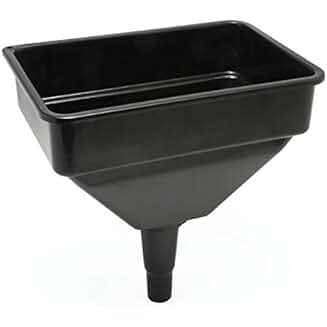
1 Pouring into funnel
2 Plain plastic oral suction/syphon
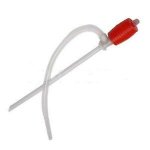
3 Jiggle syphon
4 Electric transfer pump
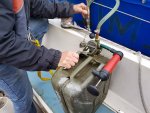
5 Manual transfer pump
5 Air compression transfer pump
1, 2, 3 all require the can to be above the fuel tank, and there is no really secure nook or cranny I can tie the can to if solo. Even with a buddy and lots of absorbent blue paper roll, there's a (demonstrated) risk of some fuel spillage or overfilling.
4, 5, 6 would mean I could secure the can on the cockpit deck while operating the elec, manual, or air pump. Also I can keep an eye on the level in the fuel filler tell tale.
At the moment I am favouring the air pump route, for which I need a spare can cap with an air IN tube, and a fuel OUT tube. Easy enough to make up and store on board, and a manual air pump would be independent of any power requirement . fuses, switch, etc.
Alternative suggestions, and comments please on achieving a clean and quick RAS
The donk consumes 3l/hr at 3000 rpm, and about 1.4l/hr at 2000 rpm. Even with a full tank, that's a range of 9 hours at decent revs , giving a range of 45 miles before a top-up is needed
OPTIONS
1 Pouring into funnel
2 Plain plastic oral suction/syphon
3 Jiggle syphon
4 Electric transfer pump
5 Manual transfer pump
5 Air compression transfer pump
1, 2, 3 all require the can to be above the fuel tank, and there is no really secure nook or cranny I can tie the can to if solo. Even with a buddy and lots of absorbent blue paper roll, there's a (demonstrated) risk of some fuel spillage or overfilling.
4, 5, 6 would mean I could secure the can on the cockpit deck while operating the elec, manual, or air pump. Also I can keep an eye on the level in the fuel filler tell tale.
At the moment I am favouring the air pump route, for which I need a spare can cap with an air IN tube, and a fuel OUT tube. Easy enough to make up and store on board, and a manual air pump would be independent of any power requirement . fuses, switch, etc.
Alternative suggestions, and comments please on achieving a clean and quick RAS